Dual connectivity. Sounds easy, right?
Just slap two networks together and boom—magic!
Except… no.
It’s not that simple.
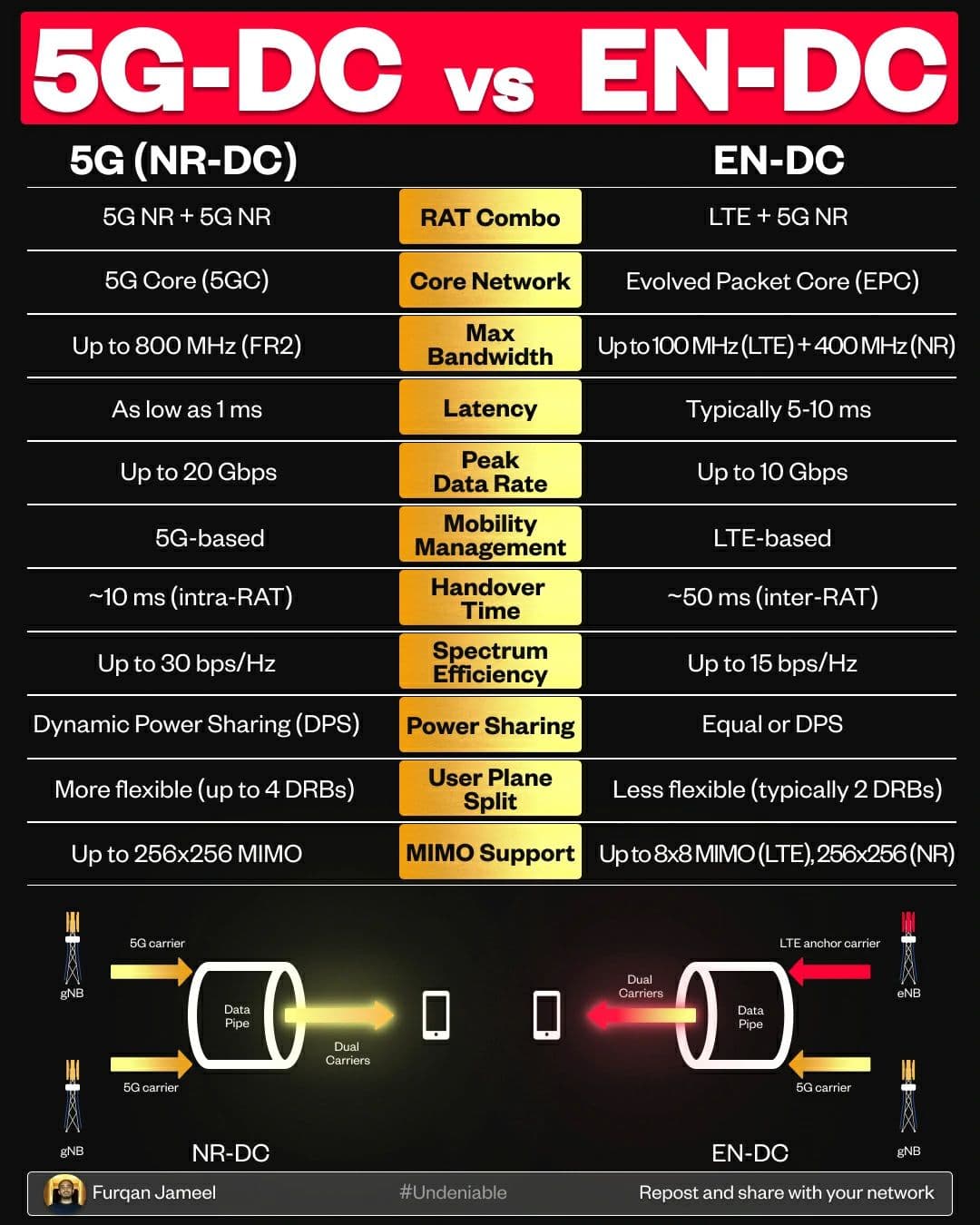
NR-DC connects to two 5G nodes at once.
The payoff is clear:
 Higher throughput.
 Lower latency.
 Stronger reliability.
It’s exactly what VR, smart factories, and critical apps need.
But there’s a caveat—it requires standalone 5G.
EN-DC takes a different path.
It pairs a 4G node with a 5G one.
That unlocks:
 Faster 5G deployment.
 Wider coverage.
 Lower rollout costs.
It’s the bridge for regions still tied to LTE.
Some argue NR-DC makes EN-DC irrelevant.
I don’t see it that way.
They aren’t rivals.
They’re complementary layers.
- EN-DC works with existing infrastructure.
- NR-DC is for advanced networks.
- NR-DC comes with higher costs.
- EN-DC delivers affordability.
Both solve different gaps.
And together, they extend the network’s reach.
For me, this isn’t about picking one.
It’s about building systems that evolve step by step.
Dual connectivity isn’t a shortcut.
It’s the map that gets us from today’s networks to tomorrow’s.
Thanks for reading.
LinkedIn: 