Your NOC engineer spent 4 hours diagnosing a 5G Core alarm last week. An LLM could’ve done it in 40 seconds. 
TelcoAI — Large Language Models applied to telecom operations — is moving from demo to production in 2026.
Here’s where LLMs are actually being deployed in telecom today:
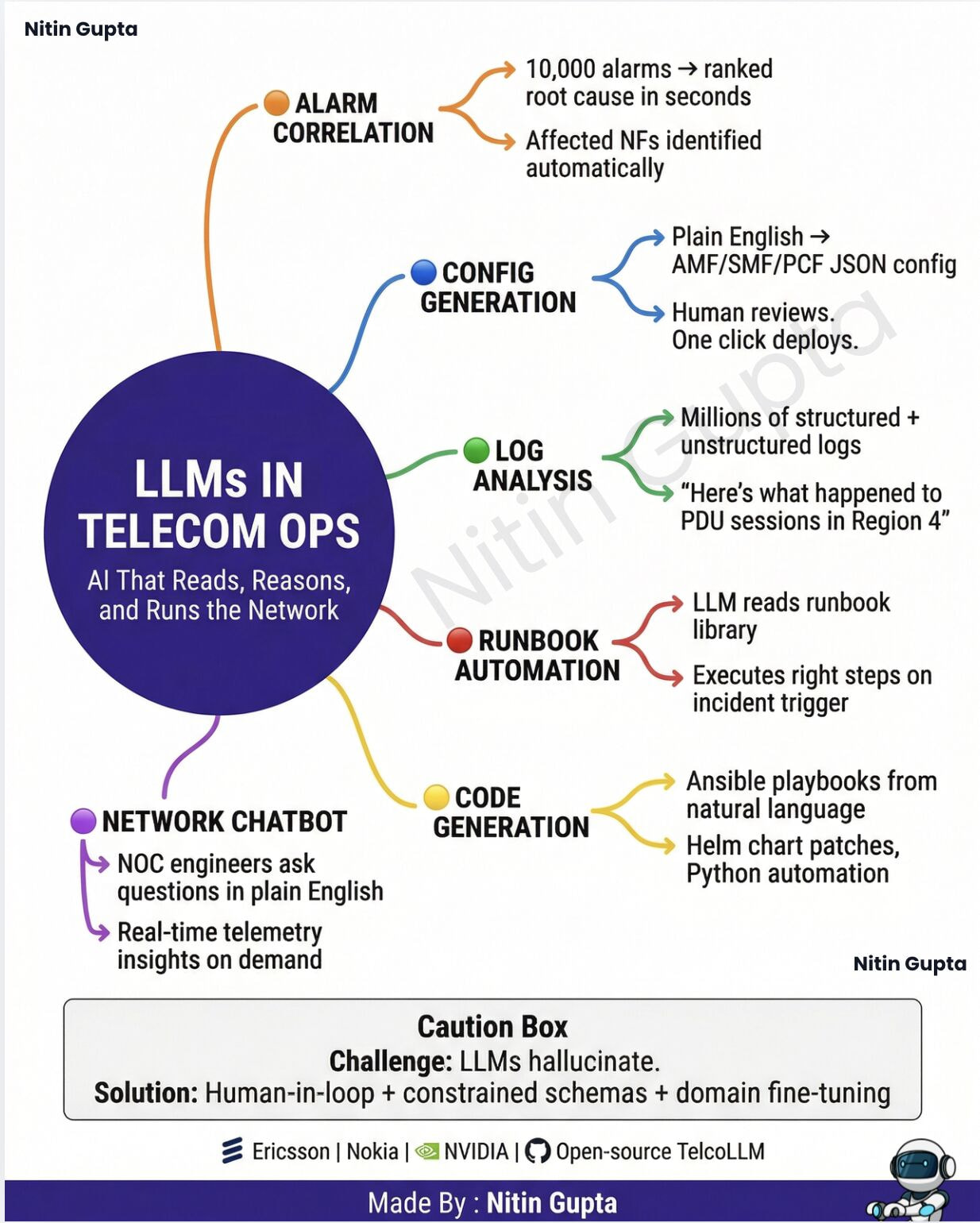
 Alarm Correlation & Root Cause Analysis
Feed 10,000 concurrent network alarms to an LLM. Get: root cause ranked by confidence, affected NFs identified, recommended actions — in natural language. No more alarm storms. No more manual log parsing.
 Configuration Generation & Validation
Describe the service in plain English: “Set up a 10Mbps QoS slice for the hospital VLAN, low latency, high priority.”
LLM generates the AMF/SMF/PCF configuration JSON. Human reviews. One click to deploy.
 Log Analysis at Scale
Millions of structured/unstructured logs from AMF, SMF, UPF, gNB — ingested, correlated, and summarized. “Here’s what happened to PDU sessions in Region 4 between 14:00 and 15:30.”
 Runbook Automation
LLMs read the operator’s runbook library and execute the right steps when incidents trigger — reducing MTTR from hours to minutes.
 Network Code Generation
Generate Ansible playbooks, Python automation scripts, and Helm chart patches directly from natural language operator intent.
Key TelcoAI platforms emerging in 2026:
→ Ericsson Cognitive Software Suite
→ Nokia Network as Code + AI assistant
→ NVIDIA AI Enterprise for Telecom
→ Open-source: Telco-LLM fine-tuned models on 3GPP specs
The challenge:
LLMs hallucinate. A hallucinated BGP route or wrong PLMN config can cause a network outage.
The solution: human-in-the-loop validation + constrained output schemas + domain-specific fine-tuning.
The telecom engineer who knows how to fine-tune, deploy, and govern LLMs in network operations is building the career that will define this decade.
LinkedIn: 