F_J
March 19, 2025, 7:28pm
1
Here’s why.
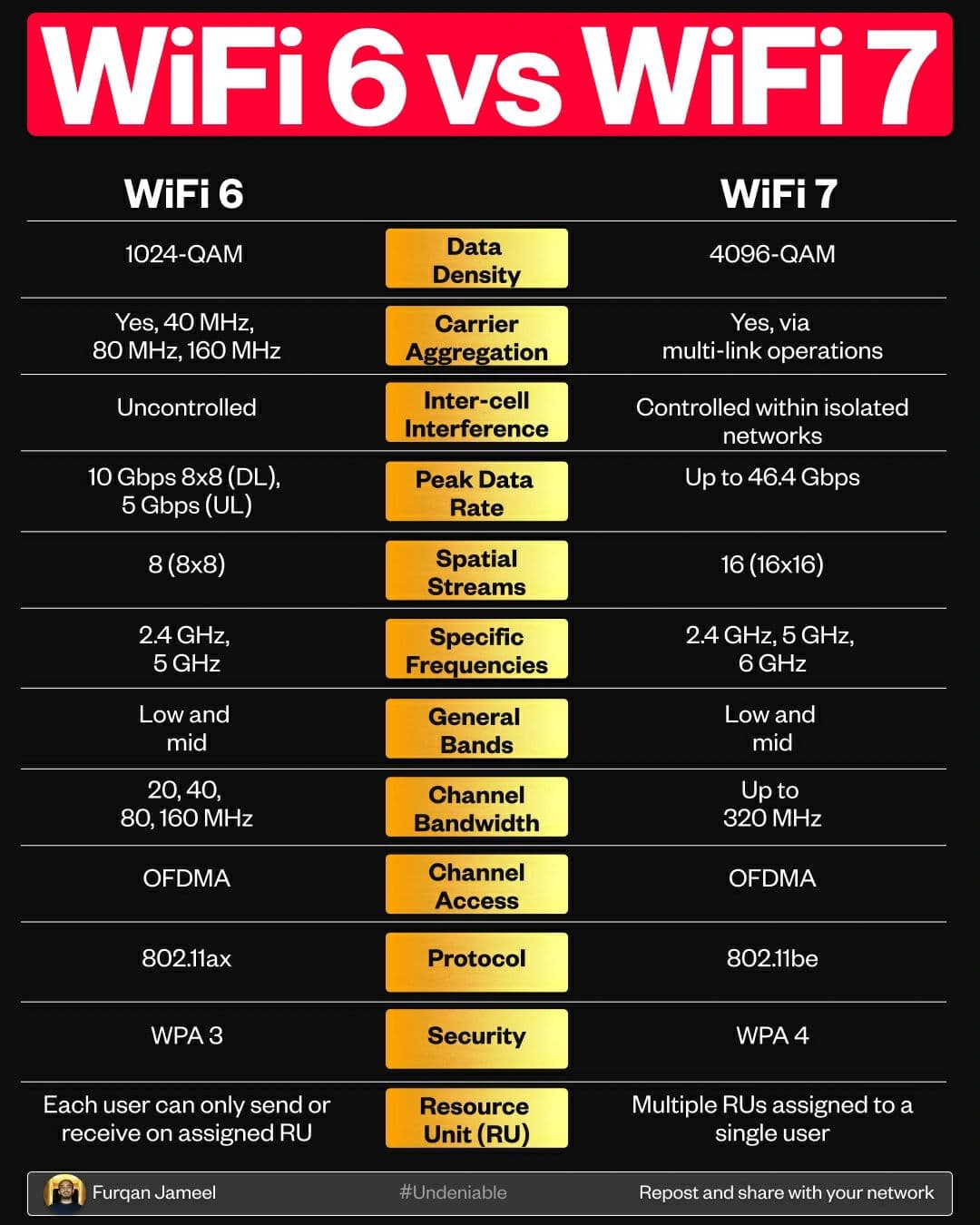
WiFi 7 a significant improvement over WiFi 6.
It’s much faster (on paper it’s ~4.8x faster than WiFi 6).
Here are 12 key advancements of WiFi 7:
Data density → 4096 QAM
Here’s why it matters:
WiFi 7 enables peak efficiency.
Faster speeds mean better productivity.
Fewer lags.
Almost no buffering.
It keeps all your smart devices online.
Every device, every time.
WiFi 6 still works fine.
But understanding these differences is important.
So, make informed choices with the right WiFi.
Thanks for reading.
LinkedIn:
F_J:
Here’s why.
WiFi 7 a significant improvement over WiFi 6.
It’s much faster (on paper it’s ~4.8x faster than WiFi 6).
Here are 12 key advancements of WiFi 7:
Data density → 4096 QAM
Here’s why it matters:
WiFi 7 enables peak efficiency.
Faster speeds mean better productivity.
Fewer lags.
Almost no buffering.
It keeps all your smart devices online.
Every device, every time.
WiFi 6 still works fine.
But understanding these differences is important.
So, make informed choices with the right WiFi.
Thanks for reading.
It’s a major upgrade over WiFi 6 — up to 4.8× faster on paper, with higher data density (4096 QAM), wider bandwidth (up to 320 MHz), multi-link operation, and support across 2.4, 5, and 6 GHz. It also brings lower interference, more spatial streams, and stronger security.
 Businesses: