 Ever Noticed Your Wi-Fi Feels Fast in One Room and Sluggish in Another — Even on the Same Network?
That’s not always because of signal bars or bandwidth. Sometimes, it’s because of timing.
In Wi-Fi, even a fraction of a microsecond can decide how efficiently your device talks to the access point.
This timing gap is called the Guard Interval (GI) — and it quietly shapes your network’s performance.
 What’s a Guard Interval, and Why Does It Exist?
Imagine shouting in an empty hall — your voice echoes for a moment before it fades.
Now, if someone starts talking before your echo dies out, both voices overlap, making it hard to understand.
Wi-Fi faces the same problem.
When a symbol (a chunk of data) is transmitted, reflections from walls or objects bounce back and can interfere with the next symbol.
To avoid this, Wi-Fi adds a small pause between symbols — the Guard Interval — allowing echoes to settle before the next transmission begins.
 The Two Timing Options
 Long Guard Interval (GI)
Duration: 800 ns
Best For: High multipath areas — warehouses, stadiums, or reflective indoor spaces
Impact: More reliable, but slightly slower throughput
Short Guard Interval (GI)
Duration: 400 ns
Best For: Clean RF environments — open areas, outdoor, or low-reflection spaces
Impact: ~10% higher throughput compared to Long GI
That small cut from 800 ns → 400 ns may seem tiny, but it lets Wi-Fi send more symbols per second, boosting efficiency and speed —
the difference between 900 Mbps and nearly 1 Gbps in real-world conditions.
 But It’s Not Always a Win
Short GI isn’t ideal everywhere.
In environments with heavy reflections — like metallic interiors, indoor dense deployments, or long corridors — delayed signals can still overlap.
That leads to Inter-Symbol Interference (ISI), higher retransmissions, and eventually lower throughput despite the theoretical gain.
In such cases, sticking with Long GI provides cleaner, more consistent performance.
 Modern Wi-Fi Does This Smartly
With Wi-Fi 6 and Wi-Fi 7, access points can dynamically assess the environment — choosing Short GI when the channel is stable, and Long GI when multipath interference is dominant.
Combined with OFDMA and MU-MIMO, this makes networks faster and more resilient than ever.
 Want to See It Yourself?
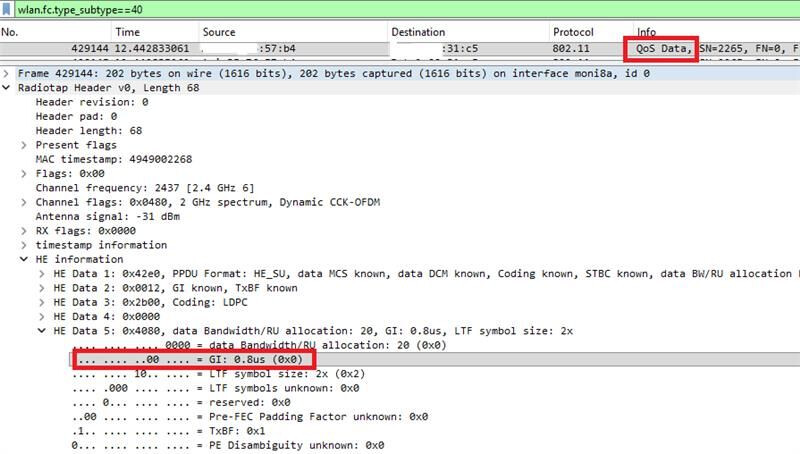
Open any data frame and check the GI value under the Radiotap Header (as shown in the snapshot).
This small field shows how your Wi-Fi manages symbol timing.
 Key Takeaway
The Guard Interval might just be a few hundred nanoseconds,
but it determines whether your Wi-Fi races ahead or keeps tripping over its own echoes.
Because in wireless communication —
performance isn’t only about power or spectrum… it’s about timing.
Your Turn
Have you ever compared throughput with Short vs. Long Gl in your lab or field testing?
What difference did you observe?
LinkedIn: 