In IMS / VoLTE architecture, many nodes handle signaling, media, and sessions — but one node silently controls everything:
 HSS (Home Subscriber Server)
Without HSS, VoLTE cannot function even if all other nodes are perfectly configured.
 What Does HSS Actually Do?
HSS is responsible for:
• Subscriber authentication
• User profile management
• Service authorization
• IMS registration control
It acts as the central database + decision maker.
Where HSS is Used in VoLTE
During IMS registration:
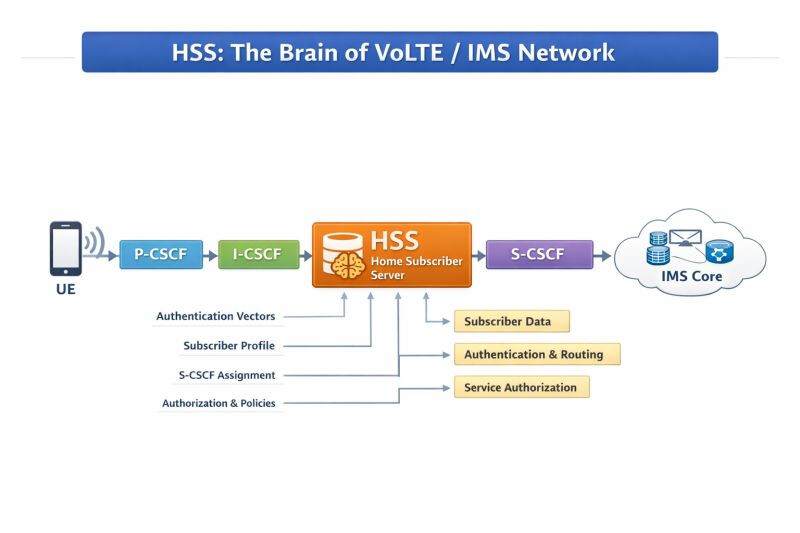
UE → P-CSCF → I-CSCF → HSS → S-CSCF
HSS provides:
 Authentication vectors
Subscriber profile (VoLTE enabled or not)
S-CSCF assignment
If HSS fails → IMS registration fails → VoLTE fails.
Why HSS is Critical
Even if:
• LTE signal is strong 
• IMS nodes are healthy
• SIP signaling is correct
Still, VoLTE will NOT work if:
 HSS is slow
HSS is unreachable
Subscriber profile is incorrect
Because IMS depends on real-time Diameter communication with HSS.
Common Issues Related to HSS
Diameter timeout
Subscriber not provisioned for VoLTE
Wrong user profile
Replication delay between HSS nodes
High latency during peak traffic
These issues directly impact:
• Registration failure
• Call setup delay
• SIP 403 / 401 errors
 Key Learning
In VoLTE:
• CSCF controls signaling
• SBC controls media
• EPC controls bearer
HSS controls the subscriber
No subscriber = No service
 Final Thought
If you want to troubleshoot VoLTE effectively, always ask:
“Is HSS responding correctly?”
Because in IMS networks, decisions are only as good as the data inside HSS.
LinkedIn: 