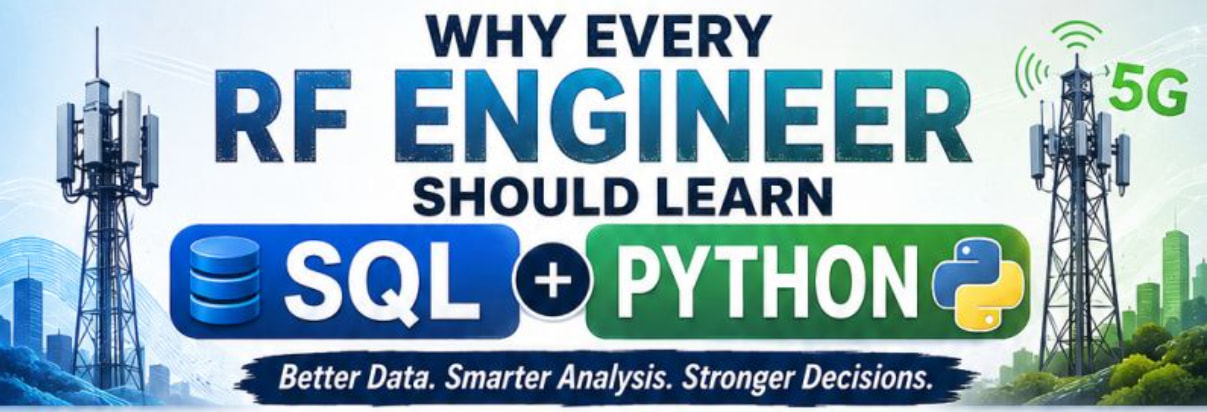
Why Every RF Engineer Should Learn SQL + Python 

RF optimization has always been about understanding the network.
Today, understanding it isn’t enough. We’re dealing with thousands of cells, millions of KPI records, multiple technologies, and networks that change faster than we can manually track them.
That’s where SQL + Python stop being “nice to have” and start being an edge.
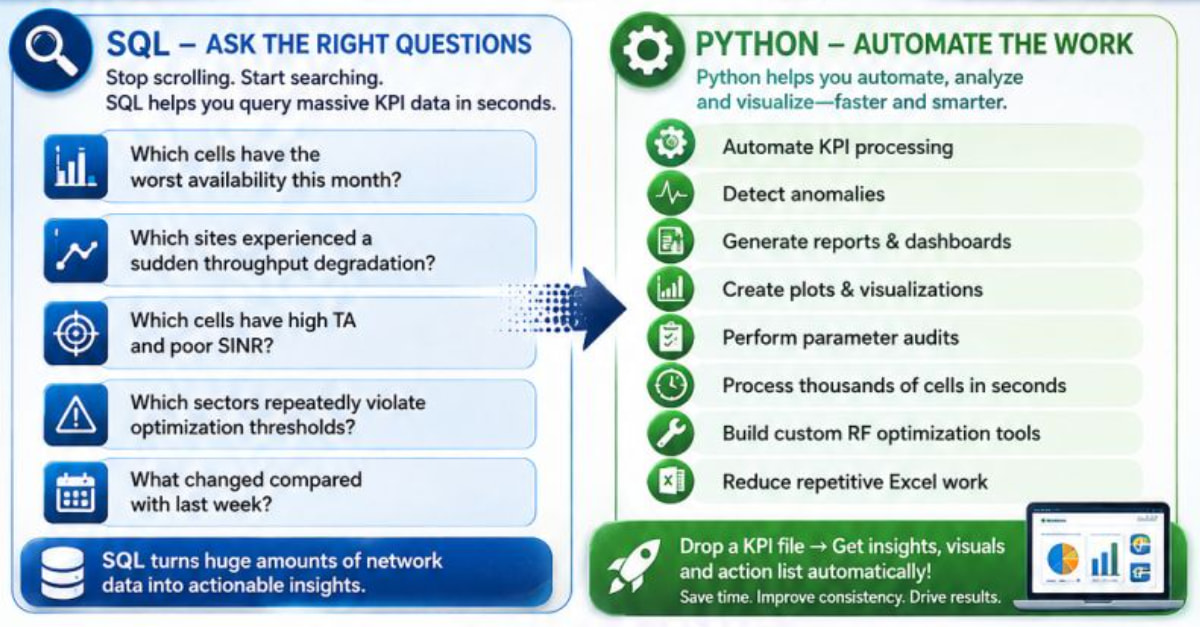
 SQL — ask the network the right questions
Instead of filtering Excel sheets by hand, SQL lets you get straight answers:
• Which cells have the worst availability this month?
• Which sites saw a sudden throughput drop?
• Which cells combine high TA with poor SINR?
• Which sectors keep violating threshold after threshold?
• What actually changed since last week?
SQL turns a mountain of network data into something you can investigate — fast.
Python — automate the repetitive work
Python takes it further. It can:
 Automate KPI processing
Flag anomalies before they become complaints
Generate daily/weekly reports
Build plots and dashboards on demand
Run parameter audits across thousands of cells
Turn one-off scripts into reusable RF tools
Picture this: you drop a KPI file into a folder, and minutes later you have your top degraded cells, a probable cause for each, the supporting KPIs, a visualization, and a prioritized action list — waiting for you.
That’s when RF optimization becomes data-driven optimization.
But here’s the part people miss
Learning SQL and Python doesn’t mean becoming a software developer. Your RF knowledge is still the whole point.
Python can tell you: “These 150 cells have abnormal throughput.”
SQL can tell you: “The degradation started on a specific date and is concentrated in these clusters.”

But it’s your RF knowledge that says: “This looks like interference, poor SINR, congestion, a bad config push, or a mobility issue — and here’s what we check next.”
That’s the combination that actually moves the needle.
RF knowledge + SQL + Python = a sharper, faster RF engineer.
You won’t manually analyze every cell anymore. You’ll build tools that analyze more cells, faster, and more consistently than any manual pass ever could.

If you haven’t started: don’t aim to become a programmer. Start small — learn to query your own KPIs, automate one repetitive task, then the next one.
How much of your daily optimization work is still manual?
LinkedIn: 