Many people think 5G always guarantees blazing-fast speeds. But in reality, your speed depends on the technology and how the network resources are allocated and consumed.
Let’s break it down technically:
-
Shared radio resources: Each cell tower (gNB) has a fixed spectrum block (say 100 MHz in N78). This spectrum is divided into PRBs (Physical Resource Blocks). The more active users, the fewer PRBs each gets.
-
Capacity vs. demand: On weekends, user density spikes. The scheduler at the gNB has to multiplex more UEs within the same time-frequency resources, so per-user throughput reduces.
-
Application consumption: Streaming apps and cloud gaming require sustained high data rates. Unlike web browsing, they hold onto large portions of the spectrum continuously, increasing congestion.
-
Time & location effect: At peak hours (weekend evenings), many UEs connect to the same cell sector. Even with advanced features like Massive MIMO beamforming and scheduling, physics and spectrum limits remain—so higher demand = lower share per user.
An example:
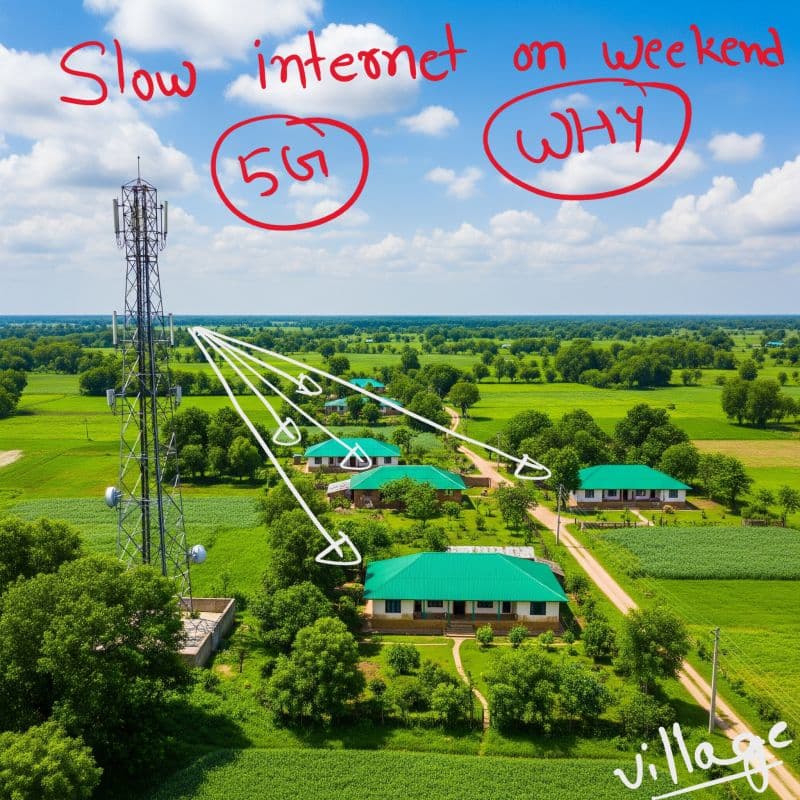
Imagine one cell tower serving 5 houses.
Weekdays: Most people are connected to fiber/Wi-Fi at the office. Only 1–2 houses rely on mobile data. The gNB easily gives them more PRBs and higher MCS levels → fast 5G speeds.
Weekends: All 5 houses are at home, streaming movies and gaming. Now, the gNB divides the same PRBs among all 5, and with high load, modulation/coding may drop to maintain reliability → slower speeds.
Even with 5G’s advanced resource scheduling and MIMO gains, the basic rule holds: fixed spectrum + more demand = lower per-user throughput.
So when your 5G slows on a Sunday night, it’s not the tower being lazy—it’s the load on shared radio resources.
LinkedIn: 