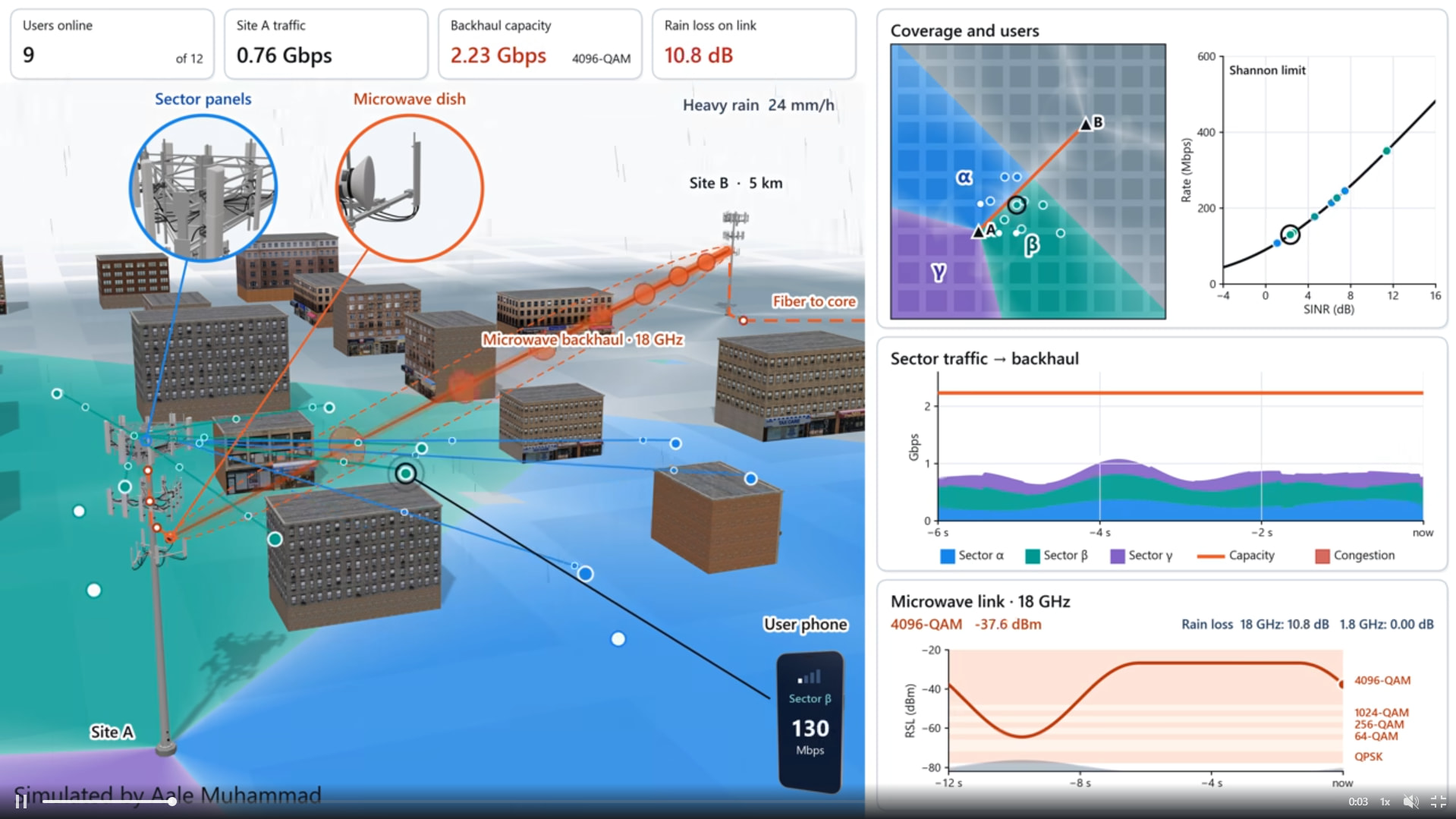
Have you ever noticed that cellular towers often have two completely different antenna shapes? The rectangular panels are generally sector antennas designed to communicate with smartphones and other mobile devices across a geographical area. Behind their protective covers are multiple radiating elements arranged to produce a controlled radiation pattern. Their beams are typically relatively wide horizontally to serve users across a sector but narrower vertically to concentrate RF energy toward the intended coverage region. Modern 4G and 5G panels can also incorporate multiple polarizations, MIMO technology and electronic beamforming to improve network capacity and signal quality.
The round microwave dishes, however, usually perform a completely different task. Instead of communicating with thousands of nearby smartphones, they establish highly directional point to point radio links between communication sites. This function is called microwave backhaul which transports aggregated network traffic from a cellular base station toward another network site or aggregation point. Their parabolic reflector geometry concentrates electromagnetic energy into a narrow beam, producing high antenna gain and reducing unwanted radiation in other directions. Unlike sector antennas which must cover a relatively large geographical area, microwave dishes are carefully aligned toward another antenna, sometimes several kilometers away. Both antennas can operate simultaneously on the same tower because they serve different parts of the communication infrastructure, often using different frequency bands.
The interesting engineering principle is that antenna geometry is determined by what the communication system needs to achieve. Sector antennas prioritize user coverage, spatial capacity and interference management whereas microwave dishes prioritize high directivity, point to point link reliability and efficient transmission over long distances. However, highly directional microwave links require accurate alignment, sufficient Fresnel-zone clearance and protection against propagation losses, including rain attenuation at higher frequencies.
Critical Formulas:
-
a) Electromagnetic Wavelength
*λ = c / f -
b) Parabolic Dish Antenna Gain
G ≈ η(πD / λ)² -
c) Approximate Microwave Dish Beamwidth
HPBW ≈ 70λ / D (degrees) -
d) Received Power for a Line-of-Sight Link
Pr = Pt Gt Gr (λ / 4πR)²
- Ericsson AIR 6419 integrates a 64-transmit/64-receive Massive MIMO radio and antenna array, using electronically controlled beams to improve 5G coverage and serve multiple mobile users.
- Aviat Networks WTM 4800 supports microwave and E-band backhaul, including multiband configurations that combine microwave frequency channels with high-capacity E-band transmission through a shared antenna system.
LinkedIn (with Video): 