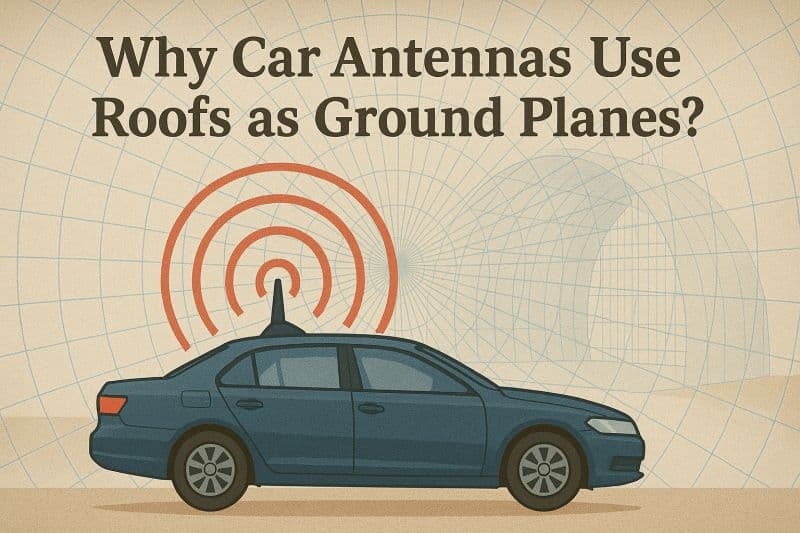
A whip antenna on a car roof looks ordinary but why do designers always prefer the roof over the trunk or bumper? Because the roof isn’t just a mount, it acts as the antenna’s other half. Without it, the whip’s efficiency, pattern and coverage collapse.
-
What the Ground Plane Does and Doesn’t?
A monopole is incomplete without a conductive ground plane. The metal roof reflects currents and forms the “missing half” making the antenna radiate as if it were a dipole. Without it, the match may look fine on a VNA but radiation efficiency and coverage shrink dramatically. -
Matching Doesn’t Mean Radiating:
You can place a whip on fiberglass or plastic, tune it for a neat impedance match and still radiate poorly. That’s because the absence of a real ground plane traps energy in reactive fields or leaks it into nearby structures. Conversely, a roof-mounted whip may not show the “perfect” match but will radiate far better in real driving conditions. -
Cars Are Messy, Not Ideal:
Vehicles are full of variables, body shape, windows, racks and passengers all interact with fields. A roof mount minimizes these distortions, giving a cleaner radiation profile. Move it to the trunk, dashboard or bumper and suddenly body panels shadow signals, directions warp and coverage drops unpredictably. -
Critical Formulas:
a). Effective length with ground plane:
→ L_eff ≈ λ/4
b). Image theory:
→ Monopole + Ground plane ≈ Dipole
c). Efficiency:
→ η = P_rad / P_in
d). Mismatch loss:
→ ML = −10 log₁₀(1 − |Γ|²) -
Real-World Failures from Poor Placement:
- An RV with a fiberglass roof mounted a whip antenna that matched perfectly in tests but delivered almost no highway range due to the missing conductive plane.
- A taxi fleet moved antennas to the trunk for aesthetics and immediately lost 25% of city coverage because of shadowing from the cabin.
- A dashboard-mounted whip in a test car worked indoors but failed on the road as the metal body blocked half the horizon, dropping critical calls.
- A police car fitted with a bumper whip had stable S₁₁ but field radios suffered dead zones since most radiation was absorbed by nearby panels.
The roof isn’t just a surface, it’s half the antenna. Remove or relocate it and even the best whip can lose its voice.
LinkedIn: 