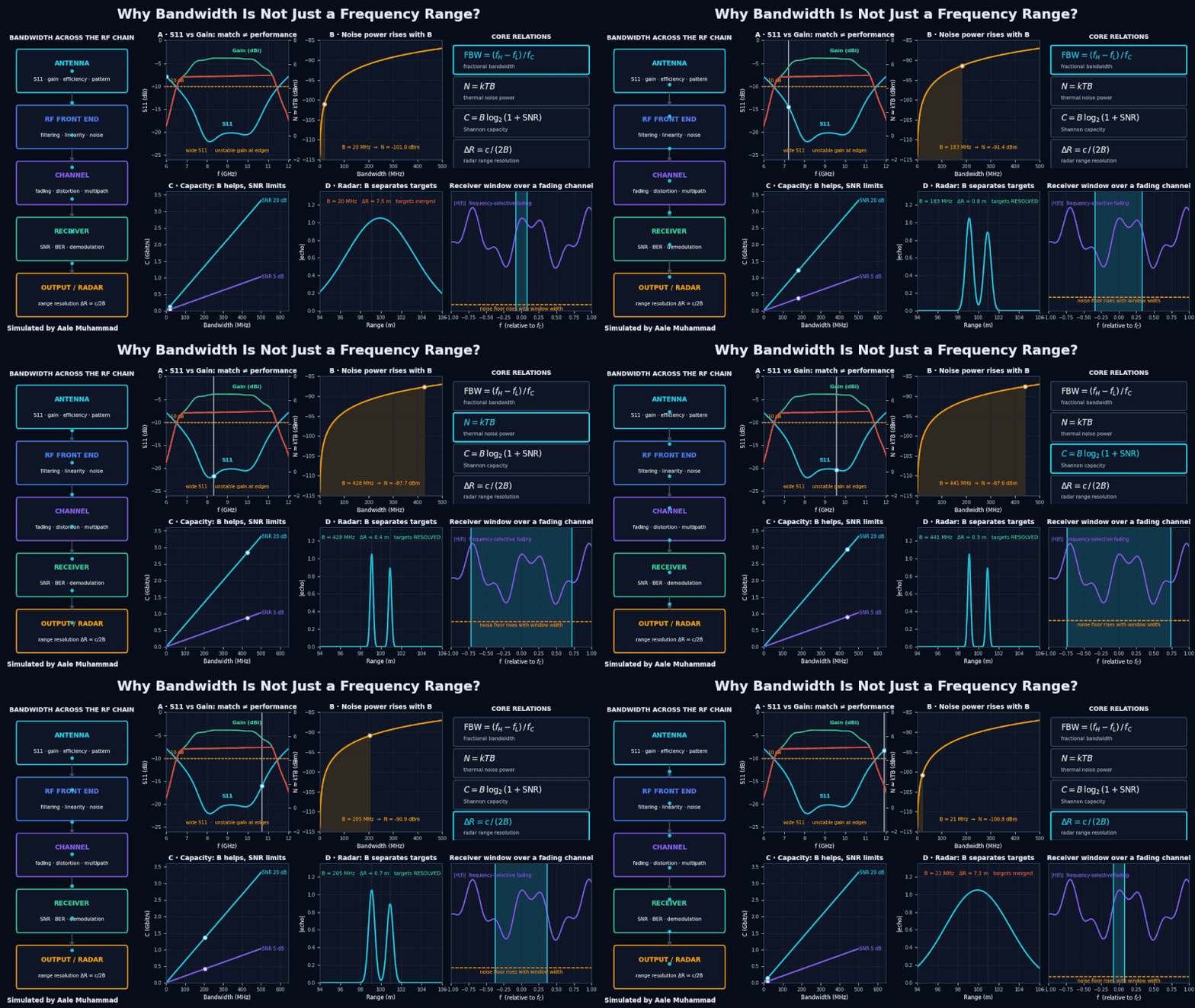
Bandwidth is often explained as the range between the lower and upper operating frequencies but in real RF systems that definition is incomplete. An antenna may show good S11 over a wide frequency range but its gain, radiation efficiency, polarization, axial ratio or radiation pattern may not remain stable across that same range. This is why impedance bandwidth alone does not prove that an antenna is useful across the full band. A wide return-loss curve can still hide poor radiation performance.
In communication systems, bandwidth is directly connected to data rate, noise power and channel behavior. A wider channel can support higher data throughput but it also collects more thermal noise because noise power increases with bandwidth. In multipath environments, the channel may not behave flat across the entire signal bandwidth which can cause frequency selective fading and distortion. This means bandwidth is not only about more spectrum, it’s also about whether the RF front end, antenna, channel and receiver can preserve signal quality across that spectrum.
In radar, bandwidth has another meaning because it controls range resolution. A wider radar waveform bandwidth allows the system to separate two targets that are close in range but it also demands better hardware linearity, timing accuracy, waveform generation and receiver processing. In filters and receivers, bandwidth decides what is accepted, what is rejected and how much unwanted energy enters the system. So bandwidth is not one universal number, it can mean impedance bandwidth, radiation bandwidth, channel bandwidth, noise bandwidth, occupied bandwidth or radar waveform bandwidth depending on what part of the RF system is being discussed.
Critical Formulas:
a) Fractional bandwidth
→ FBW = (f_H − f_L) / f_C
FBW = fractional bandwidth, f_H = upper frequency, f_L = lower frequency, f_C = center frequency
b) Thermal noise power
→ N = kTB
N = noise power, k = Boltzmann constant, T = temperature, B = bandwidth
c) Shannon capacity
→ C = B log₂(1 + SNR)
C = channel capacity, B = channel bandwidth, SNR = signal-to-noise ratio
d) Radar range resolution
→ ΔR = c / (2B)
ΔR = range resolution, c = speed of light, B = radar waveform bandwidth
- A VNA may show wide S11 bandwidth but an anechoic chamber can reveal that gain or radiation pattern becomes unstable near the band edges.
- A spectrum analyzer with wider resolution bandwidth can show more noise power, even when the actual signal source has not changed.
- A 5G or Wi-Fi receiver may use wider channel bandwidth for higher data rate but the receiver must also handle higher noise and frequency selective fading.
- A wideband radar can separate closely spaced targets in range but only if the waveform, receiver and processing chain support that bandwidth correctly.
LinkedIn: 