Unlike cellular, Wi-Fi offers the promise of backward compatibility. A Wi-Fi 7 client device can still connect to a Wi-Fi 4 or earlier generation access point (AP) and work in the presence of older Wi-Fi generation devices. To achieve this backward compatibility, several overheads are involved.
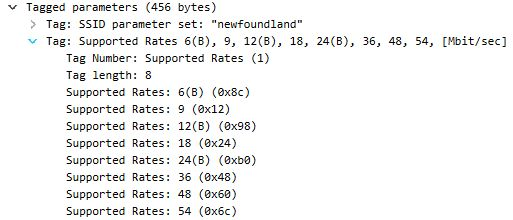
All multicast, management, broadcast frames and ACK/CTS response frames in a Wi-Fi network have to be sent only in basic rates. The AP advertises the list of basic rates in Supported Rates Information Element (IE) in beacons which is usually a subset of 11g/11b data rates. Support for basic rates is a requirement for a client to join an AP.
The 802.11 standard requires the data rate for ACK and CTS frames to be assigned depending on the modulation of the received PPDU.
11b → lowest 11b basic rate
OFDM BPSK → 6 Mbps ACK/CTS
OFDM QPSK → 12 Mbps ACK/CTS
OFDM 16QAM or higher → 24 Mbps ACK/CTS
No matter how much Wi-Fi BW increases (40, 80, 160, 320 MHz) or how much Wi-Fi modulation increases (256, 1024, 4096 QAM), the ACK/CTS data rate is still only 6, 12 or 24 Mbps.
Linkedin: 
 a los creadores grandes éxitos