 In 4G, your IMSI was sent in plaintext. Any Stingray device could capture it.
5G fixed this. But most engineers don’t know exactly how — or where the gaps still exist.
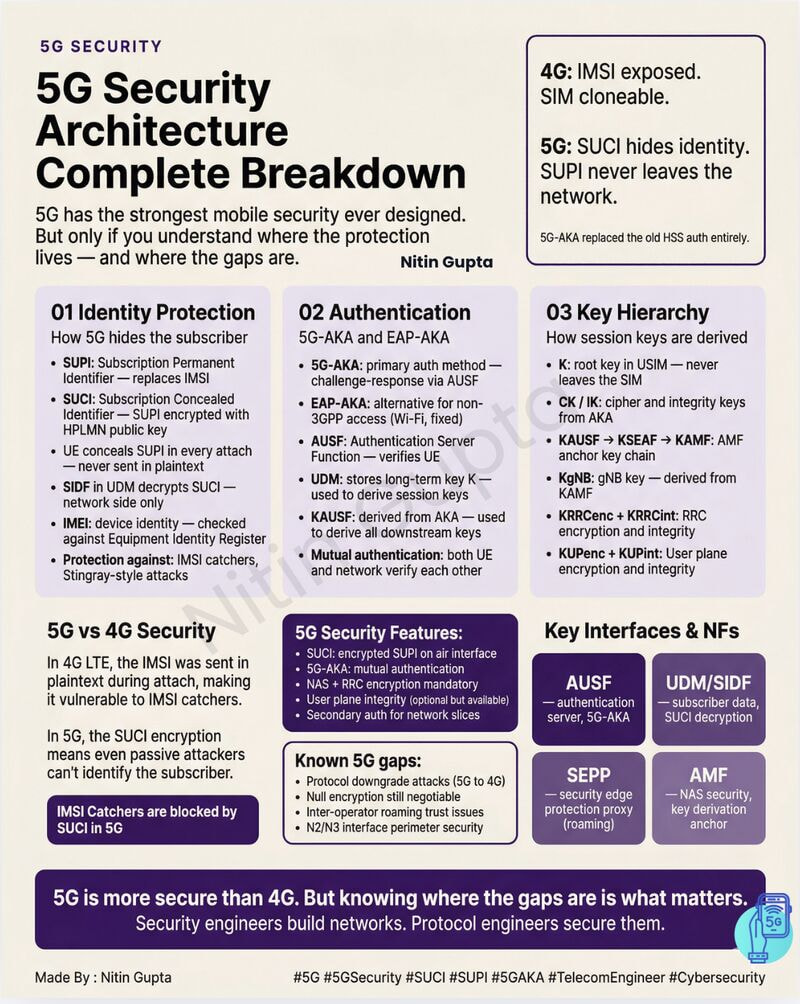
Here’s the complete 5G security breakdown:
 Identity Protection — How 5G Hides the Subscriber:
→ SUPI: Subscription Permanent Identifier — replaces the 4G IMSI
→ SUCI: Subscription Concealed Identifier — SUPI encrypted with HPLMN public key
→ UE encrypts SUPI before every attach — never sent in plaintext over the air
→ SIDF (in UDM) decrypts SUCI — only the home network can reveal the real identity
→ IMEI: device identity — checked against Equipment Identity Register (EIR)
→ Result: IMSI catchers and Stingray attacks are blocked at the identity level
 Authentication — 5G-AKA and EAP-AKA:
→ 5G-AKA: primary authentication — challenge-response via AUSF and UDM
→ EAP-AKA: used for non-3GPP access (Wi-Fi calling, fixed wireless)
→ AUSF: Authentication Server Function — verifies the UE identity
→ UDM: stores the long-term key K — used to derive all session keys
→ KAUSF → KSEAF → KAMF: key chain from auth to AMF anchor
→ Mutual authentication: both UE AND the network verify each other — 4G only authenticated the UE
 The 5G Key Hierarchy:
→ K: root key stored in USIM — never leaves the SIM
→ CK / IK: cipher and integrity keys derived from AKA
→ KgNB: derived from KAMF — the gNB session key
→ KRRCenc + KRRCint: RRC layer encryption and integrity
→ KUPenc + KUPint: user plane encryption and integrity (integrity optional but available)
 Where 5G security gaps still exist:
× Protocol downgrade attacks: UE can be forced to 4G where SUCI doesn’t apply
× Null encryption: still negotiable in some operator configurations — should not be
× Inter-operator roaming: N32 interface between SEPPs relies on operator trust
× User plane integrity: optional by 3GPP — not all operators enable it
× False base station attacks: still possible in some NSA deployments
 Key Security NFs every engineer must know:
→ AUSF — authenticates UE, issues KAUSF
→ UDM/SIDF — stores subscriber key K, decrypts SUCI
→ SEPP — Security Edge Protection Proxy — secures N32 roaming interface
→ AMF — NAS security context holder, derives KgNB for gNB
5G is the most secure mobile generation ever designed. But security only holds if operators enable all features — and engineers understand where the boundaries are.
LinkedIn: 