 The “Form Factor” of Massive MIMO
• The Physics: High order beamforming (64T64R) needs large antenna arrays. Element spacing is nominally ≈0.5λ to suppress grating lobes.
 Commercial AAUs often use wider vertical spacing (e.g., 0.65λ) to maximise effective aperture. Spacing >0.5λ can introduce grating lobes during beam steering, managed via trade-offs in gain, beamwidth, and side lobes.
• The Math: At 3.5 GHz, λ = c/f ≈ 8.57 cm, allowing compact, wind load friendly AAUs.
64T64R = 64 RF transmit chains +64 RF receive chains. Physical radiating elements typically number 96–192 (not 64) these are not interchangeable in gain calculations. Array gain depends on effective aperture and coherent combining; RF chain count directly limits spatial layers.
• The Contrast: At 700 MHz the same aperture becomes impractically large; real world low band sites stop at 4T4R or 8T8R. 3.5 GHz remains the practical sweet spot.
Shannon–Hartley Theorem & Contiguous Spectrum 
C = B · log₂ (1 + S/N)
The above is the SISO formula. For MIMO, the general Foschini–Telatar capacity is:
C = B · Σᵢ log₂ (1 + λᵢ · P / (σ²M))
The simplified form C = M·B·log₂(1+SNR) holds only under Independent and Identically Distributed (i.i.d.) Rayleigh fading, equal gain channels, and uniform power allocation. Optimal capacity requires Water filling across eigenmodes; usable spatial layers are bounded by the rank of channel matrix H.
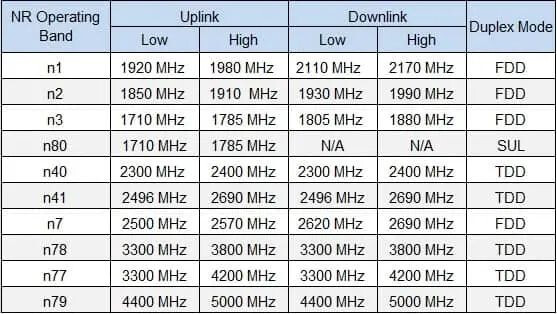
• Band n78 (3300–3800 MHz) supplies up to 100 MHz of contiguous bandwidth per carrier, subject to national licences.
• Theoretical peak throughput ~2.34 Gbps for a single 100 MHz carrier with 4 layers and 256QAM (273 RBs, 30 kHz SCS, Rmax = 948/1024, 14% overhead already embedded). Accounting for TDD UL/DL configuration and scheduler inefficiencies, achievable peak throughput in practical deployments typically ranges 1.5–1.7 Gbps.
• NR supports Carrier Aggregation for capacity beyond a single carrier. Real throughput stays below Shannon capacity due to HARQ overhead and control channels. Inter cell interference further reduces effective SINR at cell edges.
Area Capacity Advantage vs. Low Band 
• Keeps reasonable diffraction and foliage penetration, outperforming FR2 (>26 GHz).
• Practical 64T64R panels achieve strong peak gains on boresight; field gains vary with calibration and environment.
• Ideal coherent combining gives array gain ≈ 10·log₁₀(N). For 64 RF chains: theoretical max ≈ 18.06 dB; practical values typically 12–16 dB after losses (mutual coupling, quantization, multipath), approaching 18 dB only in near ideal conditions.
Physical radiating elements (96–192) and RF chains (64) serve distinct roles; confusing them leads to incorrect gain estimates.
LinkedIn: 