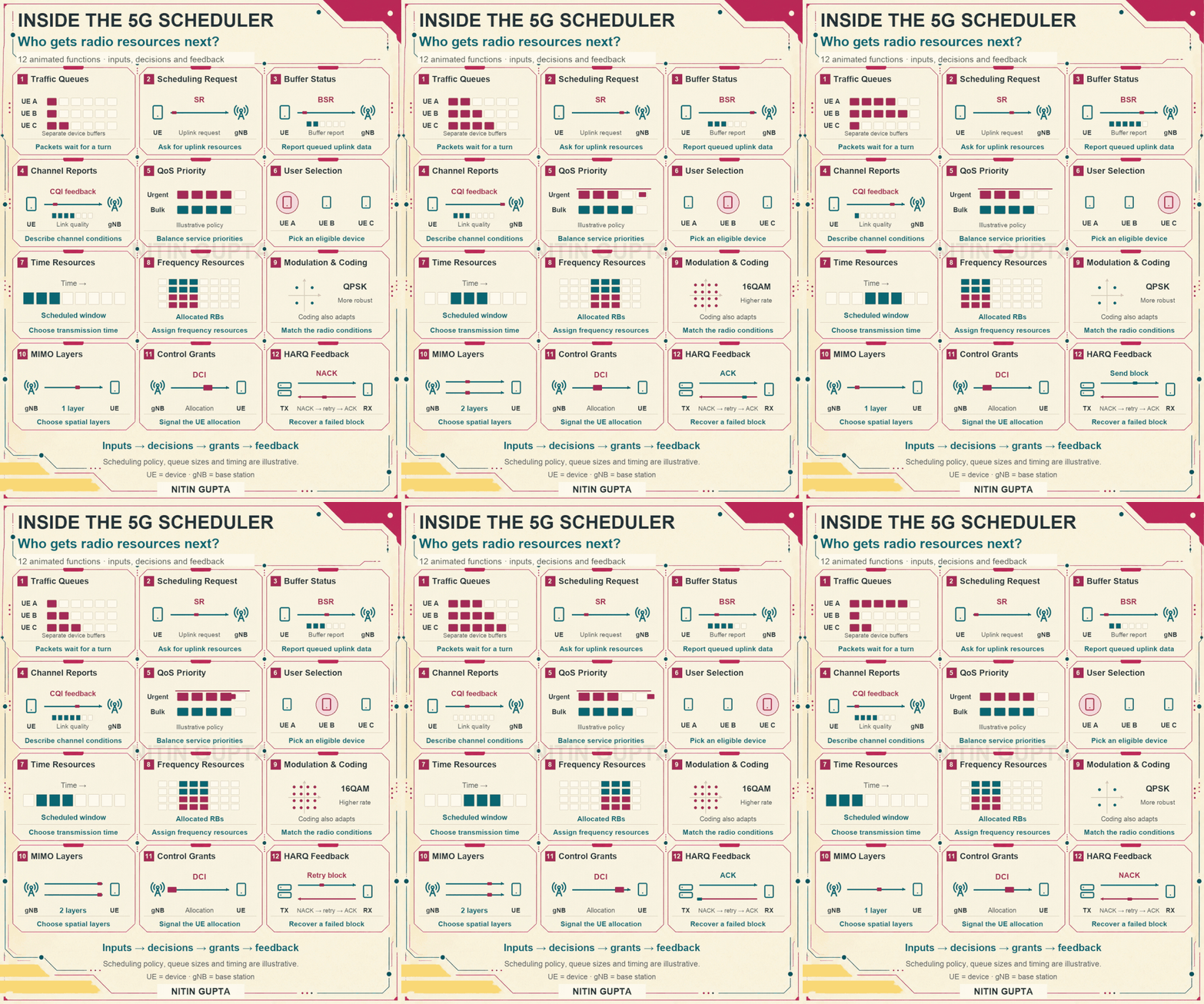
Inside the base station, the scheduler turns traffic demand, channel information and service requirements into transmission opportunities.
⠀
This animation breaks that work into 12 related functions.
⠀
◆ UNDERSTAND DEMAND AND RADIO CONDITIONS
⠀
● Traffic queues: identify data waiting to be transmitted.
● Scheduling Request (SR): a device requests uplink resources.
● Buffer Status Report (BSR): the device reports queued uplink data.
● Channel reports: feedback such as the Channel Quality Indicator (CQI) helps inform downlink transmission settings.
⠀
◆ CHOOSE THE ALLOCATION
⠀
● Quality of Service (QoS): consider different service requirements and priorities.
● User selection: choose eligible devices to serve.
● Time resources: determine when a transmission can occur.
● Frequency resources: assign resource blocks within the available bandwidth.
● Modulation and coding: select transmission settings suited to the radio conditions.
● MIMO layers: choose spatial layers supported by the channel and device capabilities.
⠀
◆ COMMUNICATE THE DECISION AND USE FEEDBACK
⠀
● Control grants: Downlink Control Information (DCI) communicates dynamic scheduling assignments and grants to the device.
● HARQ feedback: Hybrid Automatic Repeat Request supports recovery of failed transport blocks through retransmission. The GIF illustrates a downlink NACK → retry → ACK cycle.
⠀
Each allocation involves trade-offs between throughput, latency, fairness and reliability within a limited pool of radio resources.
⠀
The panels form a conceptual view of related functions. Queue sizes, timing and scheduling policy are illustrative; real implementations use different strategies and constraints.
LinkedIn: 