Dear All.
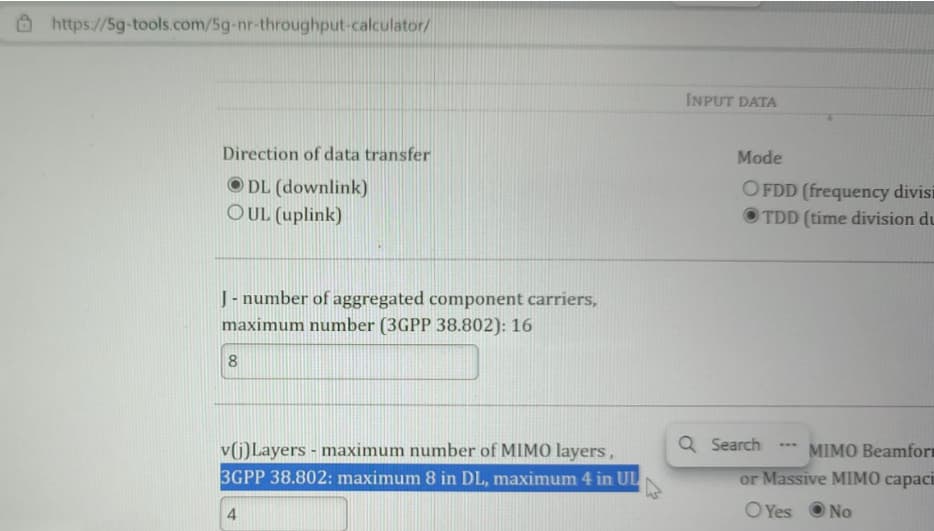
Which 3gpp specs say 5G DL support max 16 layers?
Dear All.
Which 3gpp specs say 5G DL support max 16 layers?
Per UE is max 8 layers.
Per gNodeB can be more than 16.
It basically has no limitation as long as more than 8 UEs can be paired for MU-MIMO.
This is per UE, not per gNodeB.
Yes.
Each layer should have an index, right?
Is it indicated by DMRS port or anything else?
Yes, each layer with its own DMRS for PDSCH.
Imagine if 8 UEs are paired, each can use 2 layers. (this is Nokia)

Max 16 layer as @RFSpecialist said.
ZTE says max DL 32 layers:
“…The 128TR AAU, combined with enhanced software algorithms, supports up to 32 streams for downlink space division and up to 24 streams for uplink space division. It achieves a maximum beamforming gain of 3 dB, thereby enhancing deep coverage in urban areas.”
4.9 GHz is standardized as sub 6G band?
First time I heard this.
Or only demo?
I said that there is no limit as long as users can be paired for MU-MIMO.
It can even be more than 32 if AAU supportts it.
Do you think number of DMRS port has a limitation?
Yes, it is 12.
But can be reused for spatial multiplexing.
12 ports * N times reused?
38.211 says 12 Orthogonal DMRS signals are possible in a single slot.
This requires double symbol dmrs and dmrs configuration type 2.
12 Orthogonal dmrs means 12 orthogonal layers = 12 UEs in MU-MIMO.
Spec doesn’t explicitly talk about 16 layers multiplexing but practically it is possible without telling the UEs.
Please correct me if wrong…
Layer index are specific to UE not specific to gNB.
Spec says 8 layers can be spatially multiplexed for a single user.
SUMIMO max layers = 8
Different uncorrected, network specific DMRS signals can be generated, and we can have more UEs multiplexed in MU-MIMO mode.
We need to make sure DMRS signals are orthogonal and uncorrected for all the layers/UEs
According to my interpretation of 3GPP 38.211 6.4.1.1 (PUSCH DMRS) and 7.4.1.1 (PDSCH DMRS), up to 8 layers and 12 layers are supported, using DM-RS Configuration Type 1 and Type 2, respectively.
DM-RS ports that belong to different CDM groups do not collide by design (since they are transmitting on different REs). Special manipulation is needed when assigning ports of the same CDM group.
DMRS port 1000 has w_f(k’) = (+1,+1) while port 1001 has w_f(k’)=(+1,-1), hence they are orthogonal in the frequency axis. However, ports 1004 and 1005 are not orthogonal to 1000 and 1001 in the frequency but rather in the time axis, since ports 1001 and 1001 have w_t(l’) = (+1,+1) while ports 1004 and 1005 have w_t(l’) = (+1, -1).
So, to enable orthogonal symbols in this direction, there is a need to enable dual DMRS symbols, i.e., pusch.DMRS.DMRSLength = 2 in MATLAB.