The VSWR was perfect. 
The fiber was clean.
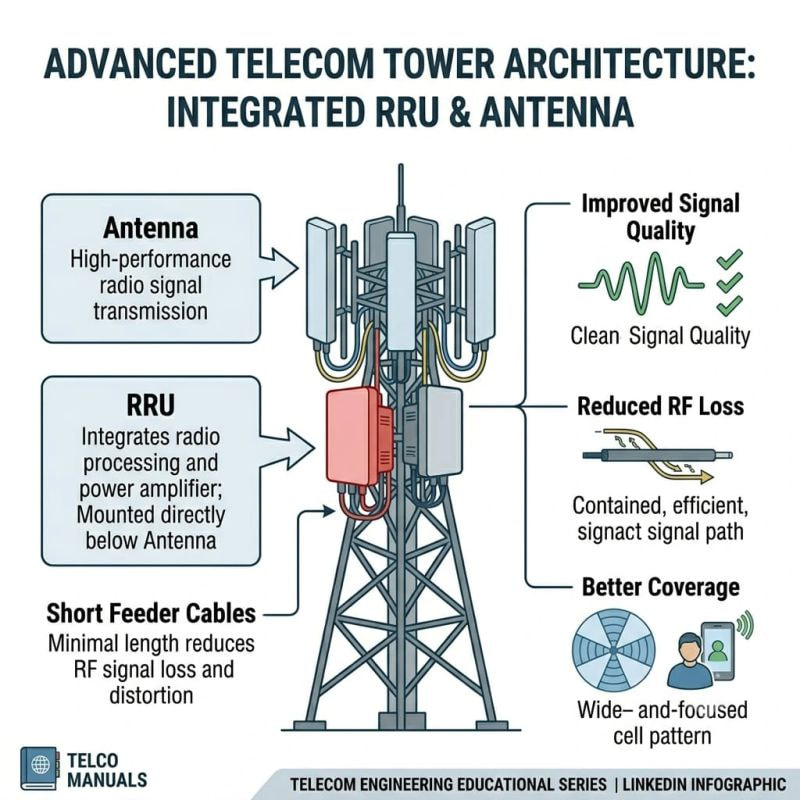
The RRU was mounted right behind the antenna.
But calls kept dropping, and the uplink noise floor was strangely high. 
BODY
I once spent two hours on a rooftop trying to explain why a site with “zero alarms” was delivering such poor uplink performance. The cell-edge users could barely hold VoLTE calls, and the KPI dashboard was turning red.
Everything looked tight. No water, no corrosion, connectors torqued to spec. The field team was ready to close the ticket as “no fault found”.
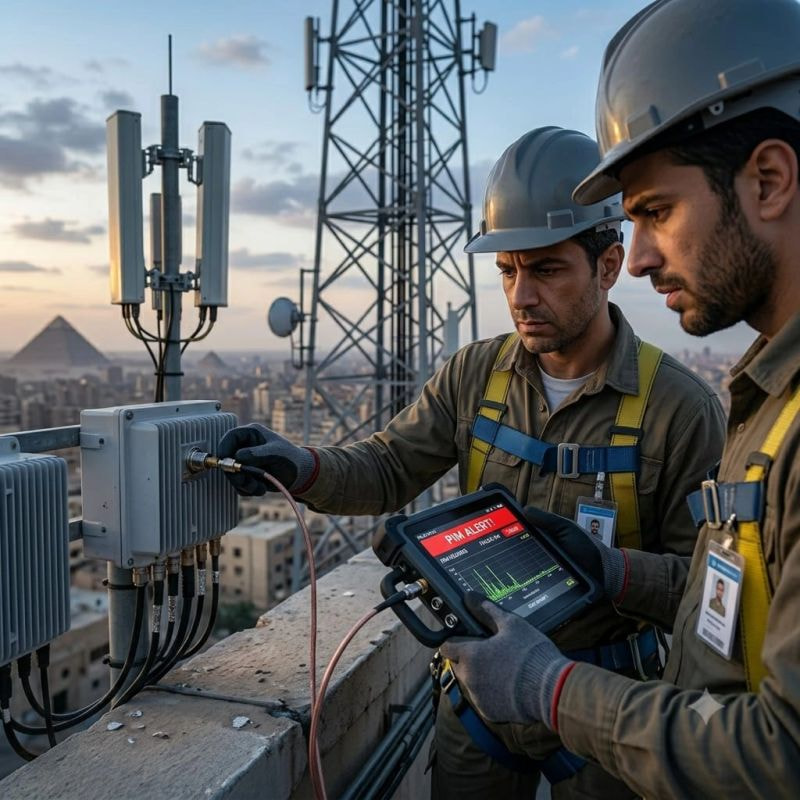
Then we ran a PIM test.
The analyzer showed a clear PIM peak at the connection between the RRU port and the jumper. The level was only -85 dBm @ 2×20W, but that was enough to flood the uplink band with noise in a 4G 1800 MHz system.
What caused it? A tiny metal sliver, invisible to the eye, had been trapped inside the DIN connector during installation. No VSWR alarm. No visual clue. Just a constant degradation of the noise floor.
Why this happens:
When you mount the RRU next to the antenna, you shorten the RF path dramatically, which is great for loss reduction. But you also concentrate all transmitted power into a very small mechanical interface. Any non-linear contact — a loose thread, a dirty surface, a micro gap — becomes a PIM source. And PIM doesn’t announce itself with a simple alarm; it silently eats your uplink budget.
The practical takeaway:
Post-installation, a VSWR sweep is not enough. You need a PIM test, especially in multi-carrier sites (like 4G + 5G sharing the same jumper). Even a single faulty connector can generate intermodulation products that fall right into your receive band.
A quick checklist:
Clean connectors with alcohol before mating
Use a torque wrench, never guess
Run a PIM sweep on the short path at commissioning
If you replace an RRU, test PIM again
KEY TAKEAWAY
A perfect VSWR does not guarantee a clean RF path. PIM is the silent performance killer that lives in the short jumper between RRU and antenna. When you bring the radio close to the antenna, you also bring the non-linearity risk closer to the uplink receiver. Test PIM, not just VSWR.
CTA
Have you ever found a PIM source that VSWR completely missed? Was it a connector, a metal shaving, or something even stranger? Share your experience — it might save someone else from a sleepless night. 
LinkedIn: