 A Normal User Sees Signal Bars.
A Telecom Engineer Sees The Whole Story. 
When your phone shows full 5G signal, you may think:
“Network is perfect!” 
But a Telecom Engineer starts asking:
 What is the RSRP?
How good is the RSRQ?
What is the SINR?
Is the Cell Load high?
What is the Throughput?
Is there any Interference?
How are the Neighbor Cells behaving?
Is Handover working properly?
The same network.
The same tower.
The same phone.
But two completely different perspectives.
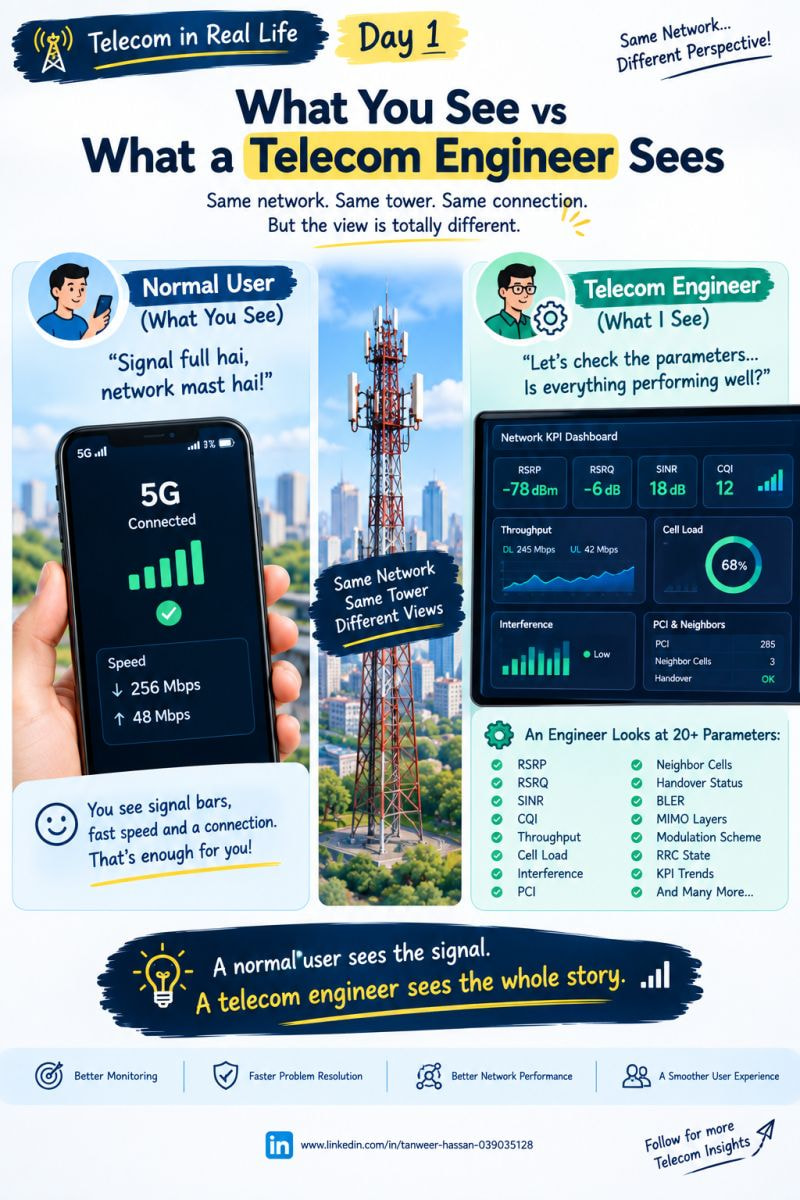
 That’s the difference between using a network and engineering a network.
And this is why telecom engineering is much more than just looking at signal bars.
 If you are a Telecom/RF/RAN Engineer, which KPI do you check first?
RSRP, RSRQ, SINR or Throughput?
Follow me for more Telecom in Real Life posts covering RAN, RF, 4G & 5G. 
Linkedin: