In wireless network optimization, we often look at RF KPIs first:
RSRP
RSRQ
SINR
RSSI
Ec/No
These indicators tell us how good the radio signal is.
But here’s a common question:
 Why do users still complain, even when RF KPIs look good?
 RF KPIs answer only one question:
“Is the signal good?”
They do NOT fully answer:
Can a call be set up successfully?
Does a web page load fast?
Can a video play smoothly without buffering?
This is where Service Testing becomes critical.
 What Is Service Testing?
Service Testing evaluates real user behaviors over the network, such as:
Connecting to a service
Loading a web page
Uploading / downloading data
Streaming video content
Instead of measuring only signal quality, it measures end-to-end service performance.
 Typical Service Tests & KPIs (Examples)
Connectivity & Responsiveness
Ping delay
Data Performance
Average upload speed
Average download speed
Web Experience
Web page loading time
Failed %
Video Experience (e.g. YouTube)
Video connection time
Playback success rate
Video resolution
Buffering count & buffering duration
These KPIs directly reflect what users actually feel.
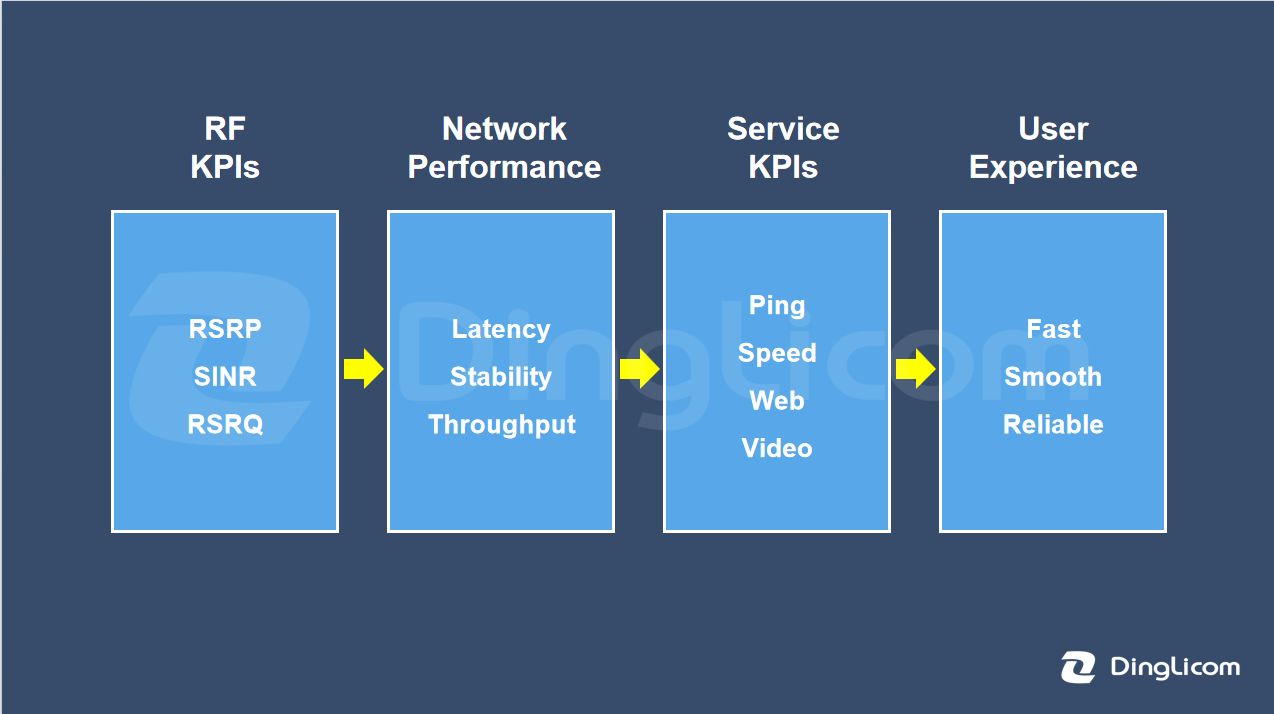
 From RF KPIs to User Experience — The Missing Link
Think of it this way:
RF KPIs are the foundation
Service KPIs are the experience outcome
Good RSRP or SINR is necessary, but not sufficient.
For example:
High SINR + high latency → web still feels slow
Good signal + unstable throughput → video still buffers
Only Service Testing can reveal these gaps.
 Conclusion
If RF KPIs tell you why a network should work,
Service Testing tells you whether it actually works for users.
That’s why modern network optimization must look beyond RF, and focus on service-level KPIs tied to real user experience.