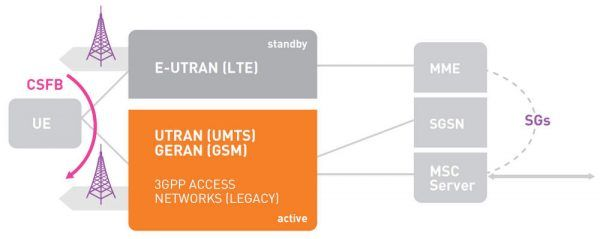
CSFB stands for Circuit-Switched Fallback. It is a technology used in telecommunications networks, specifically in the context of LTE (Long-Term Evolution) or 4G networks.
LTE is an all-IP (Internet Protocol) network that is designed to handle data traffic efficiently. However, it does not natively support voice calls as traditional circuit-switched networks do. CSFB is used as a fallback mechanism to enable voice calls on LTE networks by temporarily switching the device back to a circuit-switched network such as 2G or 3G.
When a user with an LTE-capable device initiates or receives a voice call, the LTE network uses CSFB to redirect the call to a circuit-switched network. The device then connects to the circuit-switched network for the duration of the call. Once the call is completed, the device can switch back to the LTE network for data services.
CSFB allows network operators to leverage their existing circuit-switched infrastructure for voice calls while utilizing the benefits of LTE for data services. It is commonly used during the transition period from 2G/3G to 4G networks when both circuit-switched and packet-switched networks coexist. However, as newer networks like 5G are being deployed, technologies such as Voice over LTE (VoLTE) are becoming more prevalent, providing native support for voice calls over the packet-switched network.