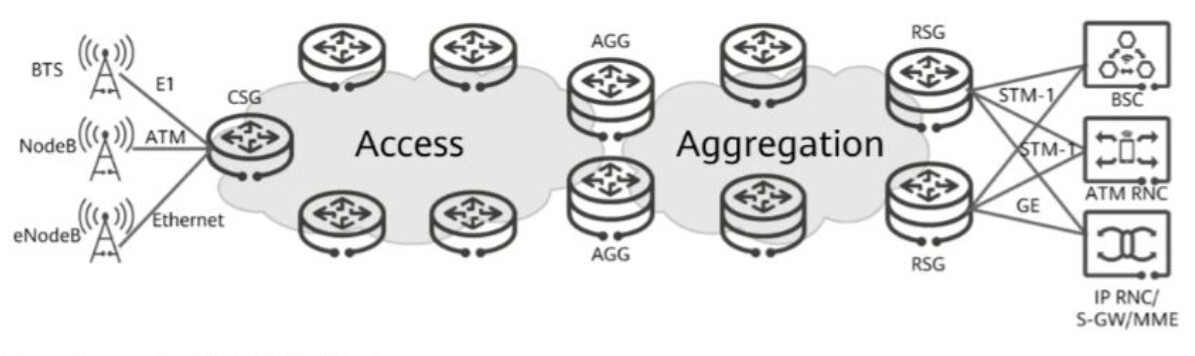
An IP radio access network (IPRAN) is an IP-based wireless access network that uses IP/MPLS at the metro aggregation/core layer and Layer 2 enhanced Ethernet (with or without Layer 3 IP/MPLS) at the access layer. It is an integrated router/switch solution customized for IP-based base station backhaul scenarios. In recent years, IP-based networks — with IP-based mobile transport networks being an essential part — have emerged as a prominent trend in the development of carrier networks. However, traditional solutions are unable to meet future data transportation requirements. As such, IPRAN is proposed as the most direct solution for IP-based wireless access and is now widely adopted.
Why Do We Need an IPRAN?
A radio access network (RAN), also called a base station backhaul network, is a transport network deployed between base stations (BTSs/NodeBs/eNodeBs/gNBs) and base station controllers (BSCs/RNCs/EPC nodes/5GC nodes).
The traditional RANs of mobile carriers are constructed using time division multiplexing (TDM)/synchronous digital hierarchy (SDH). Because SDH — which is based on TDM — provides only rigid pipes (resulting in low bandwidth utilization), it is suited only for the transmission of 2G audio and text information.
To adapt to the development of services such as Asynchronous Transfer Mode (ATM) and Ethernet, SDH-based multi-service transport platform (MSTP) networks are widely applied. An MSTP-based network allows for concurrent access, processing, and transmission of TDM, ATM, Ethernet, and other services, and consists of multi-service nodes that are managed in a unified manner. However, its traffic transmission is still based on rigid TDM pipes. As a result, it is difficult to provide the high bandwidth required by 3G services.
Although an ATM packet switched network (PSN) can enhance bandwidth utilization, the complexity of ATM deployment and O&M hinders the widespread adoption of ATM. In comparison, traditional connection-oriented IP networks are easy to deploy and cost-effective. However, they cannot guarantee the quality and performance of important services, making them unsuitable for carrier-class transport. Against this backdrop, IPRAN emerges as the next-generation transmission technology. It emphasizes the transmission of packet management data and shifts the focus from audio support to data and multimedia support, gradually leading RANs into the IP transport era.
Building upon traditional IP networks, the IPRAN mobile transport solution incorporates OAM and QoS mechanisms to address wireless backhaul needs. And, in addition to providing IP connectivity between base stations and base station controllers, this solution is compatible with various transmission media. IPRAN combines the advantages of SDH and IP networks, offering carriers a flexible, reliable, and cost-effective base station backhaul network solution.
LinkedIn: 