 VoNR = IMS over 5G Core
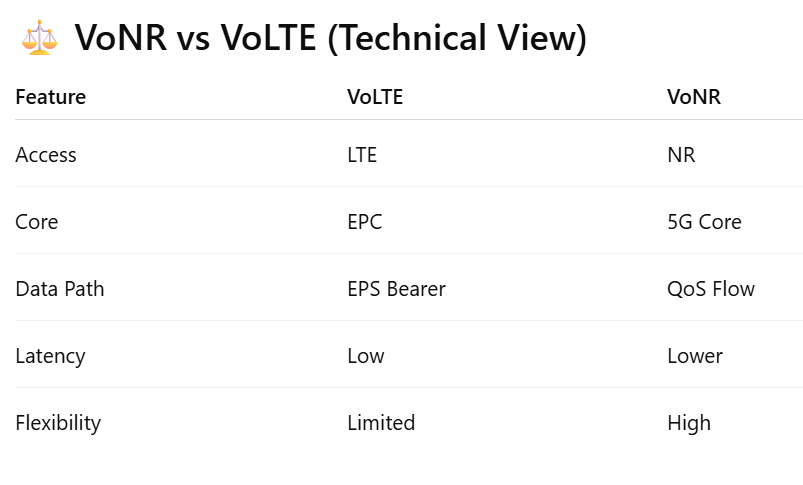
Unlike VoLTE (which uses 4G EPC), VoNR works with:
 5G Radio (NR)
5G Core (AMF / SMF / UPF)
IMS (for call control using SIP)
 This is a fully end-to-end 5G voice solution
 Key Network Elements
 UE (your phone)
- gNodeB (5G base station)
 AMF (access & mobility control)
 SMF (session management)
 UPF (user plane data path)
 IMS (handles call signaling via SIP)
 VoNR Call Flow (Step-by-Step)
 Step 1 — 5G Registration (Precondition)
UE → gNB → AMF
UE is already registered on 5G Core
PDU session is active
Data connectivity exists before the call
Step 2 — IMS Registration
UE → IMS (via UPF)
SIP REGISTER message sent
UE becomes reachable for voice calls
Step 3 — Call Initiation
UE → IMS
SIP INVITE sent
Call setup begins
Step 4 — Call Routing
IMS routes the call
Finds destination UE
Establishes session path
Step 5 — QoS Flow Setup (Critical)
SMF + UPF
Create dedicated QoS Flow
Uses 5QI (e.g., 5QI = 1 for voice)
Guarantees:
- Low latency
- High priority
Step 6 — Voice Path Established
→ gNB → UPF → IMS →
Voice packets flow over 5G user plane
Step 7 — Call Connected
Two-way communication begins
Fully over 5G (no LTE fallback)
 Control vs User Plane
Control Plane:
→ gNB → AMF → SMF → IMS
User Plane:
→ gNB → UPF → IMS →
Clean separation = better performance
 Simple Analogy
Think of VoNR as:
A VIP fast lane created instantly for your call
Your voice doesn’t compete with normal data
It gets priority + guaranteed quality
 Why VoNR is Not Widely Available Yet
Requires:
5G Standalone (SA)
IMS support
Device compatibility
That’s why today:
 Calls still mostly use VoLTE fallback
Initially:
- Voice will remain on VoLTE
- VoNR will come with SA deployment
Future:
Faster call setup
Better voice quality
Lower delay
In Simple Words
VoLTE = Voice on 4G VoNR = Voice on true 5G
Same concept… but more advanced
 Final Insight
Voice is evolving from:
Basic communication

Priority-based, low-latency service
LinkedIn: 