 Simple View First
Think of UPF as:
 The data plane engine of 5G
It is the function that:
 Carries your internet traffic
Connects you to external data networks (DN)
Applies QoS and forwarding rules
 End-to-End Data Path (3GPP)
When you use mobile data:
 UE →
UE →  gNB → UPF →
  Data Network (DN)

 UPF Responsibilities (3GPP View)
According to 3GPP TS 23.501, UPF performs:
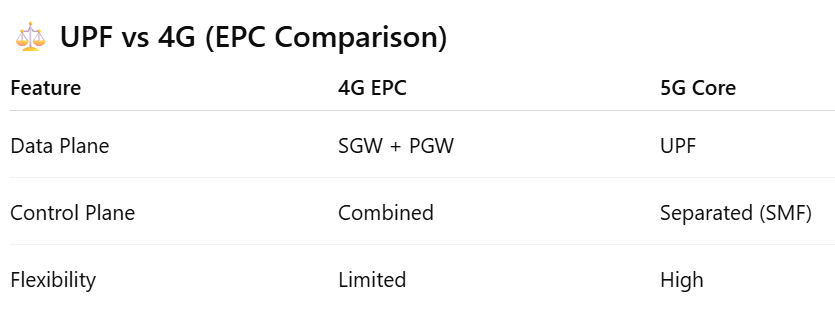
Packet routing & forwarding
Traffic steering (UL/DL)
QoS enforcement
Usage reporting (charging)
Lawful Intercept support
Buffering (for DL data when UE idle)
 How UPF is Controlled (N4 Interface)
UPF is not autonomous—it is fully controlled by SMF.
 Interface: N4 (SMF ↔ UPF)

Inside UPF — Rule-Based Forwarding
SMF programs UPF using:
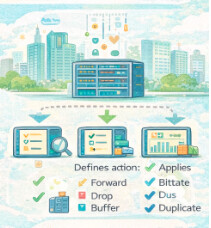
 PDR — Packet Detection Rule
Identifies incoming packets (UL/DL)
FAR — Forwarding Action Rule
Defines action:
- Forward
- Drop
- Buffer
- Duplicate
QER — QoS Enforcement Rule
Applies:
- Bitrate limits
- QoS Flow mapping (5QI)
 Uplink & Downlink Flow (Simplified)
Uplink (UL)
UE → gNB → UPF → DN
UPF classifies traffic using PDR
Applies QoS via QER
Forwards via FAR
Downlink (DL)
DN → UPF → gNB → UE
UPF may buffer DL packets if UE is idle
Paging triggered via AMF
 Advanced Concept — Distributed UPF
3GPP allows multiple UPFs in a session:
Central UPF (core)
Edge UPF (closer to user)
 Why?
Why?
Enables:
Low latency (URLLC)
Local breakout
Traffic steering
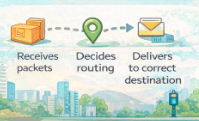
Simple Analogy
UPF = Courier Network
- Receives packets
- Decides routing
- Delivers to correct destination

For 5G deployment (especially in Pakistan):
UPF design directly impacts:
Latency
Throughput
User experience
In Simple Words
UPF = Actual data movement in 5G
LinkedIn: 