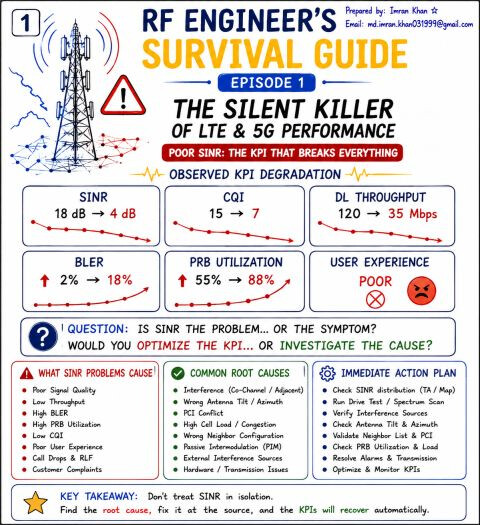
One of the most important lessons in RF Optimization is that SINR is usually a symptom, not the root cause.
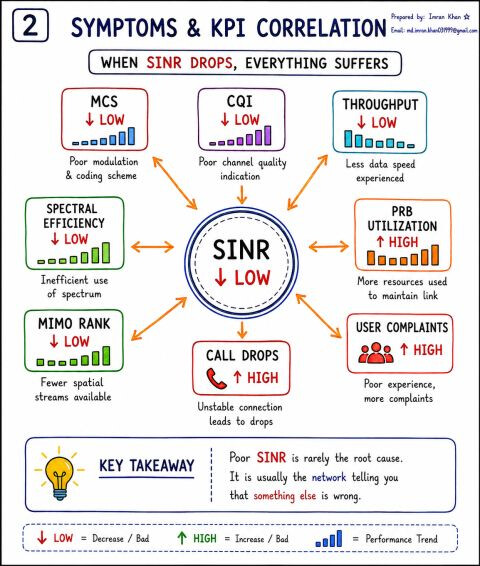
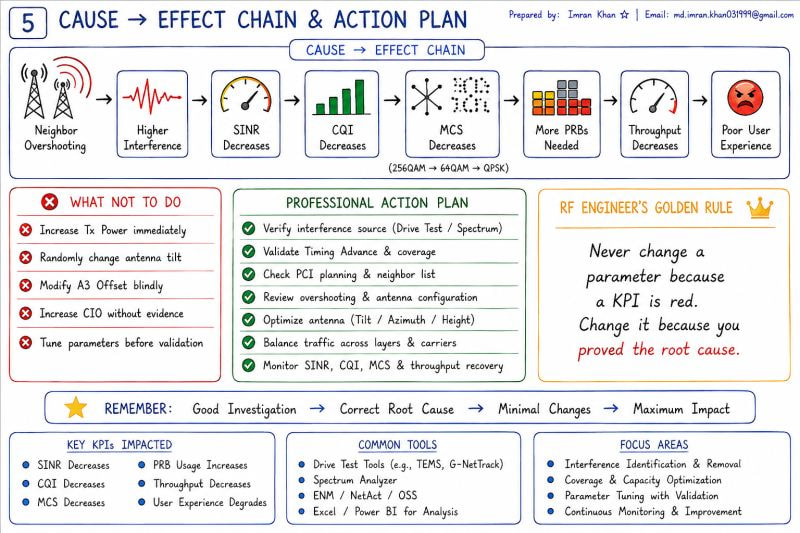
When SINR decreases, it impacts several network KPIs:
 CQI ↓ – Poor channel quality reported by the UE.
MCS ↓ – Lower modulation and coding scheme is selected.
Throughput ↓ – Users experience slower download/upload speeds.
Spectral Efficiency ↓ – Less data transmitted per Hz of spectrum.
MIMO Rank ↓ – Fewer spatial streams reduce network capacity.
PRB Utilization ↑ – More radio resources are required to maintain service.
Call Drops ↑ – Voice and data sessions become unstable.
User Complaints ↑ – Poor Quality of Experience (QoE).
 Key Takeaway
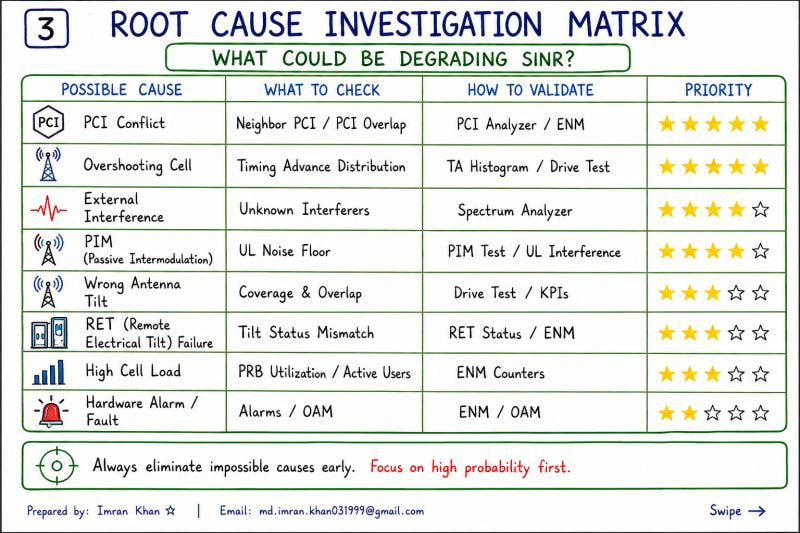
Never optimize a KPI blindly. Always identify the root cause first—such as interference, PCI conflict, overshooting cells, antenna tilt issues, PIM, hardware alarms, or congestion—before changing RF parameters.
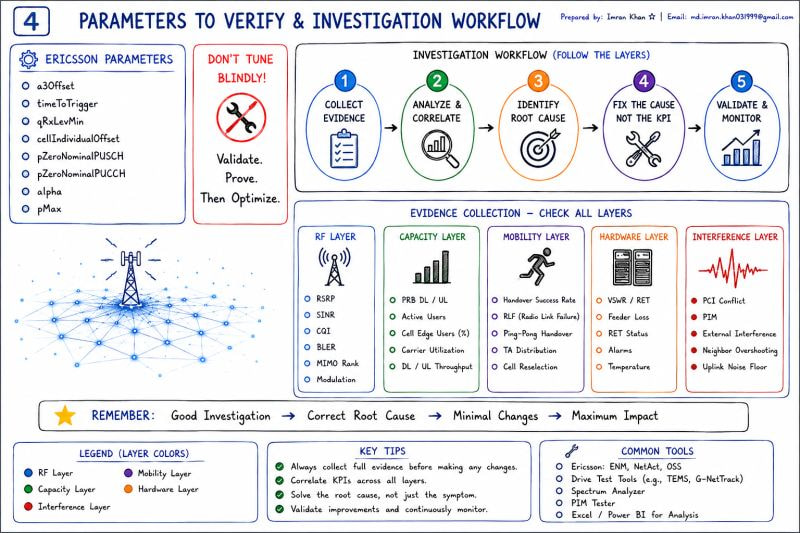
A successful RF Engineer focuses on Root Cause Analysis (RCA) rather than simply improving KPI numbers.
1. Observed KPI Degradation
2. Symptoms & KPI Correlation
3. Root Cause Investigation Matrix
4. Parameters to verify & Investigation Workflow
5. Cause → Effect Chain & Plan Action
LinkedIn: 