In 5G networks, handover success is critical for seamless mobility, especially for services like VoNR calls, video streaming, and real-time applications. When handover KPIs drop, engineers typically analyze two major stages where failures can occur: Preparation and Execution.
Understanding the difference between these two stages is essential for faster Root Cause Analysis (RCA) and effective network optimization.
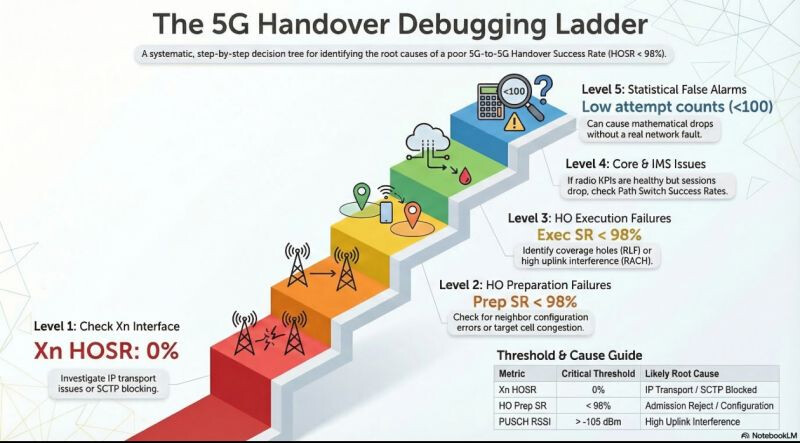
 Handover Preparation Failures
Preparation failures occur before the UE (User Equipment) moves to the target cell.
In this stage, the source gNB sends a handover request to the target cell. If the target cell rejects the request or the signaling fails to reach the target, the handover never begins.
 Typical KPI Symptom
- Handover Preparation Success Rate < 98%
- Handover Execution Success Rate remains normal
 Common Root Causes
• Missing or incorrect neighbor configuration
• Incorrect PCI / CGI / TAC / NRARFCN mapping
• Target cell congestion or capacity limitation
• License or resource limitations
• Lack of GBR resources for VoNR users
• Xn / N2 signaling issues between gNBs
In short, Preparation failures are usually configuration or network resource problems.
 Handover Execution Failures
Execution failures occur after the handover command has already been sent to the UE.
Here, the UE attempts to connect to the target cell but fails during the actual radio transition.
Typical KPI Symptom
- Preparation Success Rate healthy (>98%)
- Execution Success Rate drops below 98%
Common Root Causes
• Radio Link Failure (RLF) due to weak signal or coverage holes
• Late handover triggers caused by incorrect mobility parameters
• Random Access (RACH) failures on the target cell
• High uplink interference (PUSCH RSSI > -105 dBm)
• Weak uplink coverage
• Incorrect PRACH configuration
Execution failures are therefore mainly radio environment or mobility tuning problems.
Quick Troubleshooting Logic
If Preparation HOSR is low → Check configuration & capacity.
If Execution HOSR is low → Check radio conditions & mobility parameters.
This simple rule helps engineers perform rapid field RCA without needing drive tests immediately.
 In dense urban deployments and 5G mid-band networks, combining mobility KPIs, RLF counters, and RACH statistics can quickly reveal the exact root cause of handover failures.
If you’re working in 5G RAN optimization, what are the most common handover issues you see in your network?
LinkedIn: 