Wireless communication signals might not reach the intended receiver, particularly when blocking objects exist.
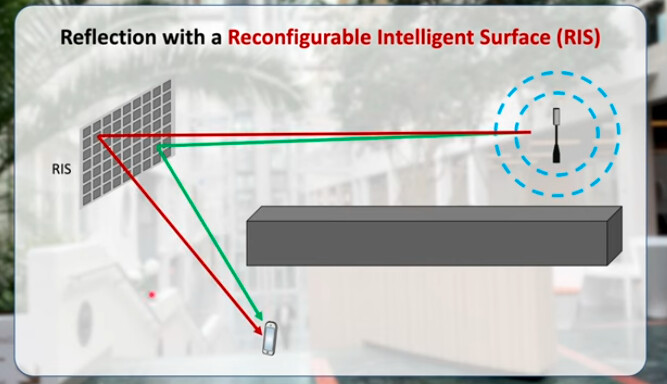
A reconfigurable intelligent surface (RIS) is a new kind of controllable mirror for wireless signals that can support the wave propagation from the transmitter to the receiver, e.g., around an object.
The RIS rotates the reflection direction without being physically rotated. In this video, Prof. Emil Björnson shows theory and experiments to demonstrate how an RIS is built and operated, and how it differs from conventional reflecting surfaces.
The experiments were carried out in a large room using mmWave signals, and the concepts of near-field propagation and spherical wavefronts play an essential role.
The RIS technology has been developed for potential use in 6G systems.
Watch Video on YouTube:  https://www.youtube.com/watch?v=SQXBEjgvFx4
LinkedIn: 
Chapters:
00:00 Improving coverage for mmWave communications
00:44 How surfaces reflect wireless signals
02:33 Why use a reconfigurable intelligent surface?
05:27 The reconfigurable intelligent surface we used
07:14 Near-field propagation effects
08:46 The experimental RIS setup
10:33 Our experimental results
11:58 Comparison with a normal mirror
12:34 Summary and conclusions
Corrections:
08:00 The correct Fraunhofer distance formula is 4Area/lambda for a square array, or 2^D/lambda for an arbitrary array with the largest dimension being D.
08:19 10 m is correct, but the formula should have been 4Area/lambda.