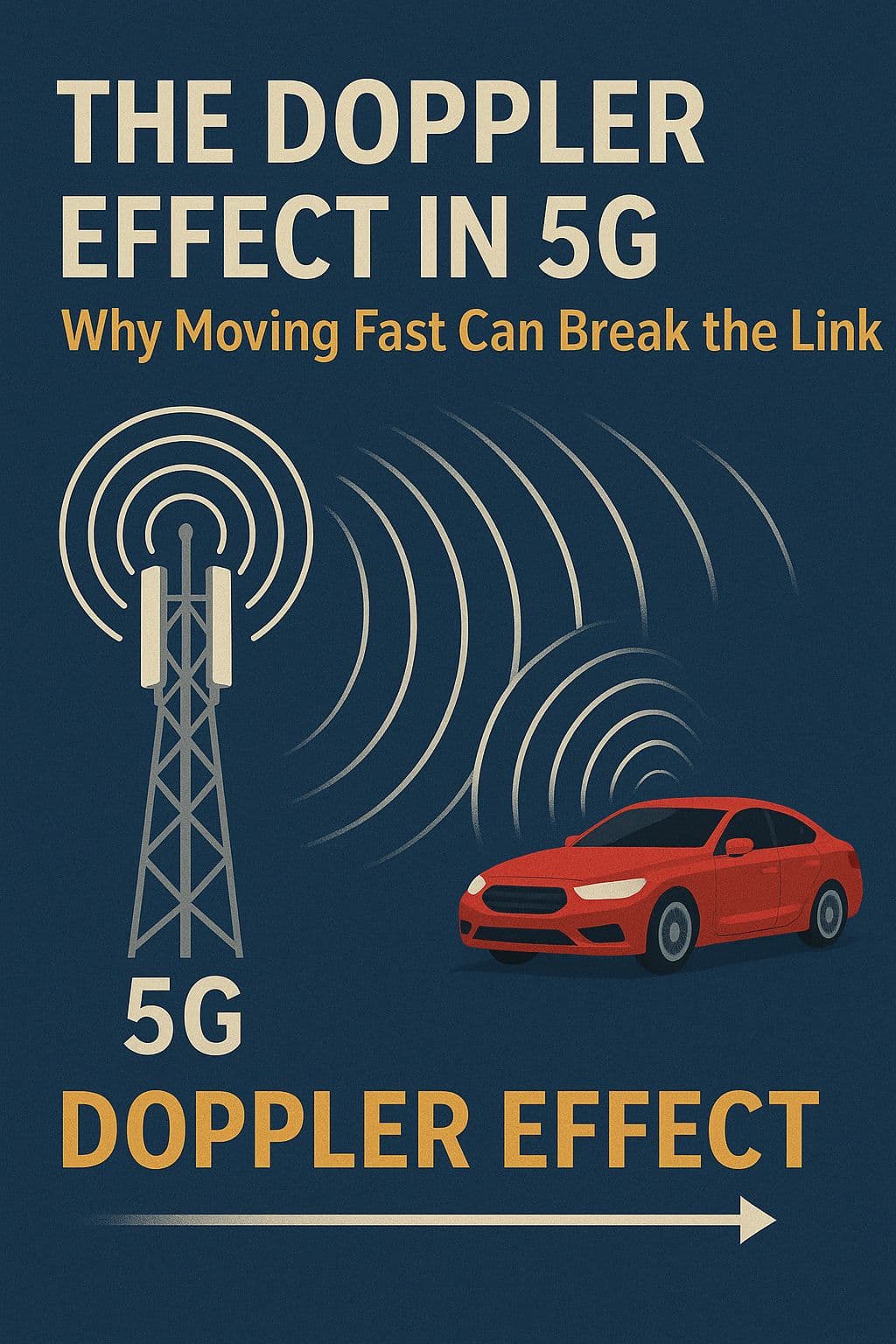
You’ve seen it before, a car speeds by and the pitch of the siren drops. The same physics governs wireless links. When a transmitter or receiver moves, the signal frequency shifts slightly. At low speeds, it’s harmless but at 5G and mmWave frequencies, motion changes the very timing and alignment that keep your link alive. The result? A strong signal that suddenly stops making sense.
-
Why Motion Changes Frequency?
When you move toward a wave source, each new crest arrives a little sooner meaning higher frequency, move away and the opposite happens. This frequency change is called the Doppler shift, proportional to velocity and inversely proportional to wavelength. In 5G systems operating above 3 GHz, even small motions (like a vehicle turning) can shift frequencies by hundreds of hertz, enough to offset symbol timing and confuse demodulators. -
What Really Happens in a 5G Link?
5G and OFDM systems rely on precise frequency spacing between subcarriers. When motion introduces a Doppler shift, these subcarriers start overlapping, causing inter-carrier interference (ICI). The faster the user moves, the more severe the distortion. High-speed trains, UAVs and satellites experience fading patterns called Doppler spreads where different multipath components arrive with slightly shifted frequencies, the wireless equivalent of out-of-tune harmony. -
Why Designers Care?
At 28 GHz or higher, the wavelength is tiny so the same speed creates a much larger Doppler shift. 5G base stations compensate using channel estimation, adaptive equalization and beam tracking but these techniques have limits. Designers test systems at speeds up to 500 km/h to ensure handovers and synchronization survive real-world dynamics. The Doppler effect isn’t just about motion, it’s the hidden clock drift that decides whether your data arrives decoded or distorted. -
Critical Formulas:
a) Doppler shift:
→ f_d = (v / c) × f_c
b) Effective received frequency:
→ f_r = f_c ± f_d
c) Coherence time (approximation):
→ T_c ≈ 1 / f_d
d) Maximum vehicle speed before ICI (OFDM):
→ v_max ≈ (Δf_sub × c) / f_c -
Real-World Examples:
- A 3.5 GHz 5G link at 100 km/h experiences ≈ 325 Hz Doppler shift, enough to blur OFDM carriers.
- In high-speed trains, frequent handovers and beam realignment combat continuous Doppler spread.
- Satellite downlinks use Doppler pre-compensation so that received signals align perfectly on Earth.
- Drone telemetry links at 28 GHz use adaptive beam tracking to maintain synchronization under rapid motion.
Doppler shift doesn’t just change pitch, it bends time and frequency together. At GHz speeds, even the wind or your motion can decide whether bits arrive or vanish mid-flight.
LinkedIn: 