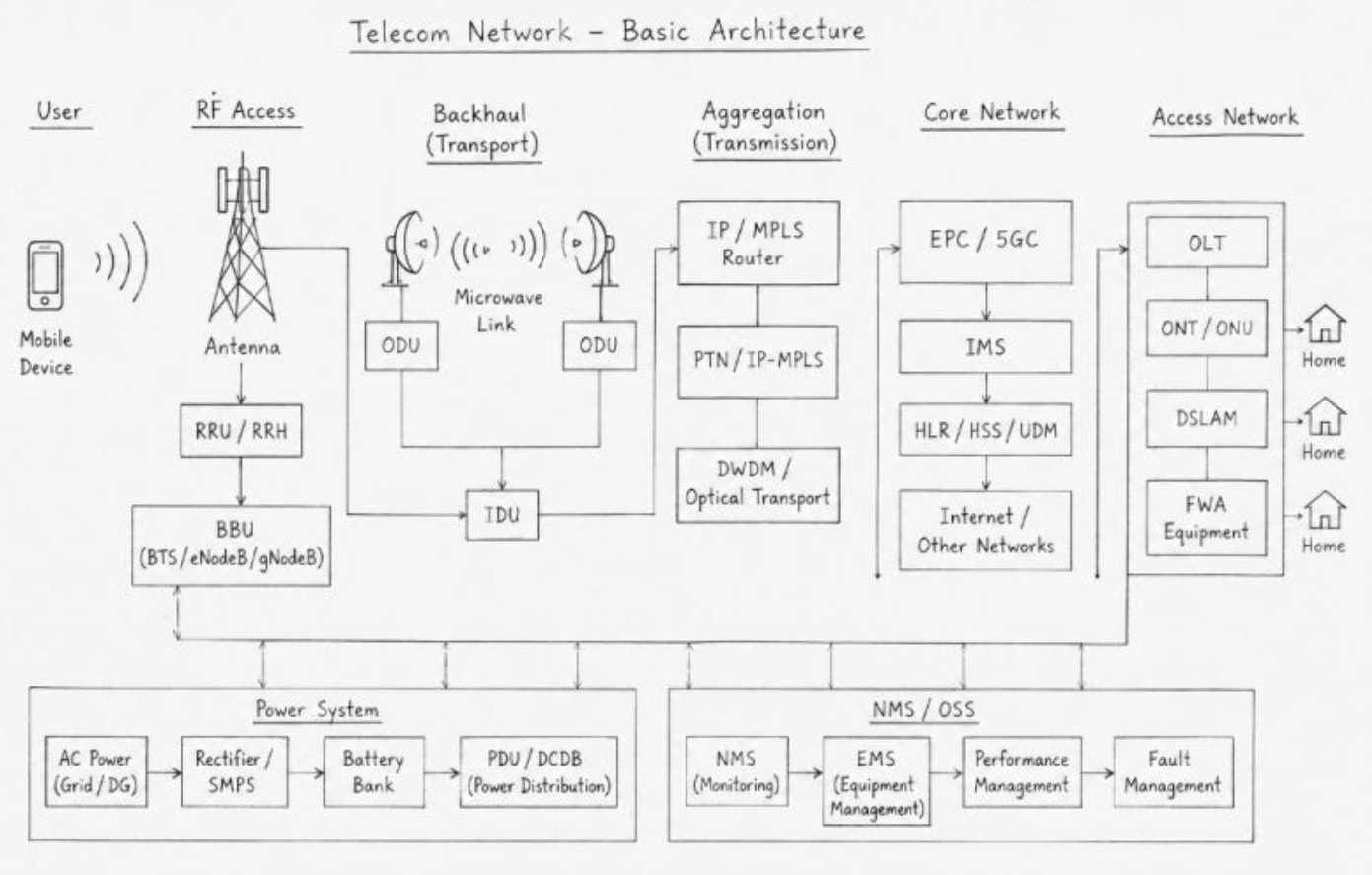
A telecom network is not just a tower and an antenna.
Behind every successful call, video call, WhatsApp message or internet session, there is a complete chain of Power → RF → Access → Transport → Core.
Here’s a simple overview of the basic telecom equipment
 1. POWER SYSTEM — To Keep Everything Alive
- SMPS / Rectifier — Converts AC power into DC power required by telecom equipment
- Battery Bank — Provides backup during power failure
- DG Set — Backup power for longer outages
- PDU / DCDB — Distributes DC power to different equipment
- UPS — Provides uninterrupted power for critical systems

Without a reliable power system, the entire telecom network goes down.
 2. RF EQUIPMENT — To Connect the User
- BTS / eNodeB / gNodeB — Provides wireless connectivity to mobile users
- RRH / RRU — Converts and processes RF signals closer to the antenna
- Antenna — Transmits and receives RF signals
- Feeder / Jumper — Connects radio equipment with antenna
This is the radio access layer that connects your mobile phone to the network.
 3. MICROWAVE — To Transport Traffic Wirelessly
- Microwave IDU — Handles baseband/modem processing
- Microwave ODU — Converts traffic into RF and transmits it
- Microwave Antenna — Provides point-to-point wireless connectivity
- E-Band Radio — High-capacity short-distance microwave transport
When fiber is unavailable, difficult or expensive to deploy, MW can provide a fast wireless backhaul.
 4. OPTICAL / TRANSMISSION — To Carry Huge Traffic
- Fiber Optic Cable — High-capacity physical transmission medium
- OLT — Connects the access network with optical fiber
- PTN / IP-MPLS — Carries and manages telecom traffic
- DWDM — Enables multiple high-capacity wavelengths over the same fiber
To transport massive amounts of traffic bw sites, aggregation points and the core network.
 5. ACCESS NETWORK — To Reach the Customer
- OLT — Used in FTTH networks
- ONT / ONU — Installed at the customer side
- DSLAM — Used in DSL-based broadband networks
- FWA Equipment — Provides broadband using wireless access
Its provides the last-mile connectivity to customers.
 6. CORE NETWORK — The Brain of the Network
- EPC — 4G packet core
- 5G Core — Handles 5G services and sessions
- IMS — Supports VoLTE / VoNR and multimedia services
- HLR / HSS / UDM — Subscriber-related information and authentication
- MME / AMF — Mobility and signalling functions
- SGW / UPF — Handles user-plane traffic
Its manages authentication, mobility, sessions, routing and services.
 7. NMS / OSS — To Monitor Everything
- NMS — Network monitoring and management
- OSS — Operations and service management
- EMS — Equipment-level management
- Performance Management — Monitors KPIs and network health
- Fault Management — Detects and manages alarms
These systems help engineers monitor, troubleshoot and optimize thousands of network elements.
LinkedIn: 