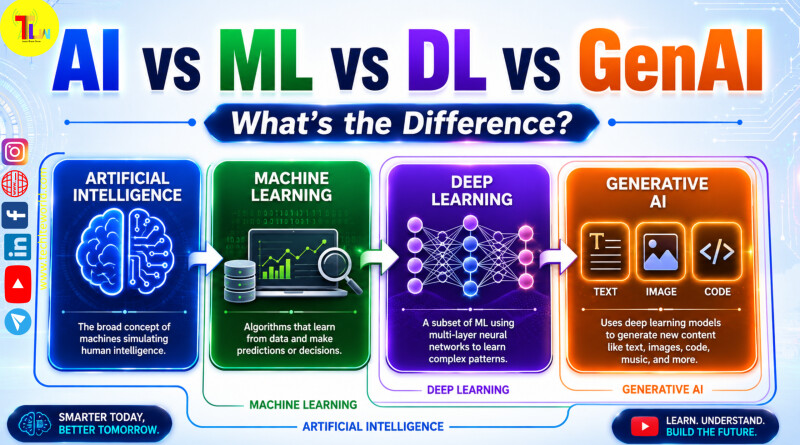
We keep hearing these terms — AI, ML, Deep Learning, Generative AI — used almost interchangeably, but they’re not the same thing. Sharing a quick breakdown, especially with telecom/network use-cases in mind, since a lot of us are now dealing with AI-driven RAN optimization, fault detection, and log analysis in our daily work.
1. Artificial Intelligence (AI) — the broadest term. Any system designed to perform tasks that normally need human-like intelligence (reasoning, decision-making, prediction). Doesn’t have to involve learning from data — even a simple rule like “IF packet loss > threshold AND signal quality poor → trigger recovery” counts as AI.
2. Machine Learning (ML) — a subset of AI where instead of hardcoding rules, the system learns patterns from historical data. Example: predicting poor network quality using RSRP, RSRQ, SINR, throughput, etc., instead of writing hundreds of manual rules. Includes Supervised, Unsupervised, and Reinforcement Learning.
3. Deep Learning (DL) — a specialized branch of ML using multi-layer neural networks. It can automatically learn features from raw data (like images or signals) without engineers manually defining them. Powers things like image recognition (spotting a telecom tower in a photo) and modern NLP.
4. Generative AI — instead of just predicting/classifying, it creates new content — text, code, images, audio. Example: instead of “Cell failure probability = 82%”, a GenAI system can explain “SINR degradation started ~5 min before throughput drop, check uplink interference.” Mostly powered by Deep Learning + Transformer architecture (same tech behind modern LLMs).
Quick summary table:
| Tech | Purpose | Example |
|---|---|---|
| AI | Broad goal — intelligent behavior | Automated network decision system |
| ML | Learn patterns from data | Network failure prediction |
| DL | Learn complex representations via neural nets | Image/signal recognition |
| Generative AI | Generate new content | Log explanation, text/code generation |
As AI-native 5G/6G networks evolve, understanding where each of these actually fits (rather than clubbing everything as “AI”) is going to matter more for engineers.
Full detailed article with diagrams, ML algorithm types, and reference papers here:  AI vs Machine Learning vs Deep Learning vs Generative AI