When we talk about VoLTE call setup delay, many engineers rush to check radio or core KPIs.
But sometimes the real culprit is hidden in the SIP timers.
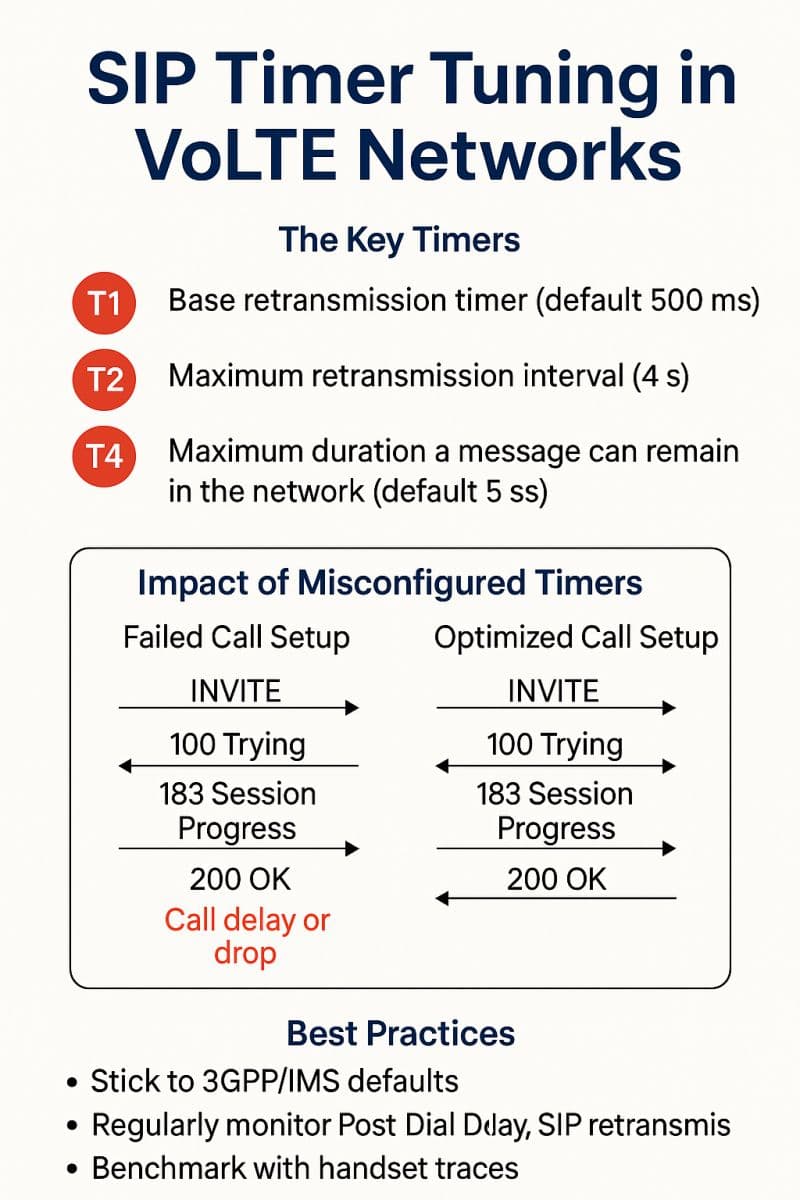
 The Key Timers
- T1 → Base retransmission timer (default 500 ms).
- T2 → Maximum retransmission interval (default 4 s).
- T4 → Maximum duration a message can remain in the network (default 5 s).
 Impact on VoLTE
- If T1 is too high → Initial INVITE or provisional response retransmissions are delayed → call setup feels “slow.”
- If T1 is too low → Excessive retransmissions overload the network → increased signaling storm.
- If T2/T4 misconfigured → Certain SIP messages (like 200 OK / BYE) may be retransmitted too late → leading to dropped or “stuck” calls.
 Example: Real Case
One operator had T1 tuned at 1 second instead of 500 ms.
Result → Call setup delay increased by ~2 seconds on average, and MOS scores dropped.
Once corrected, Post Dialing Delay (PDD) improved by ~25%.
 Best Practices
- Stick to 3GPP/IMS defaults unless you have proven congestion reasons.
- Regularly monitor PDD, SIP retransmissions, and Call Setup Success Rate (CSSR).
- Benchmark with handset traces — some OEMs behave differently under tight timer configs.
 Takeaway:
SIP timers may look small, but their impact on user experience is massive.
Tuning them wrong can make the difference between a snappy VoLTE call and a frustrating delay or drop.
 Have you tuned SIP timers in your network? Did you notice improvements in PDD or CSSR?
LinkedIn: 