The network was designed to build connections, not to destroy them. Transforming a tower into an electronic warfare device requires hardware changes, not just software adjustments or power increases.
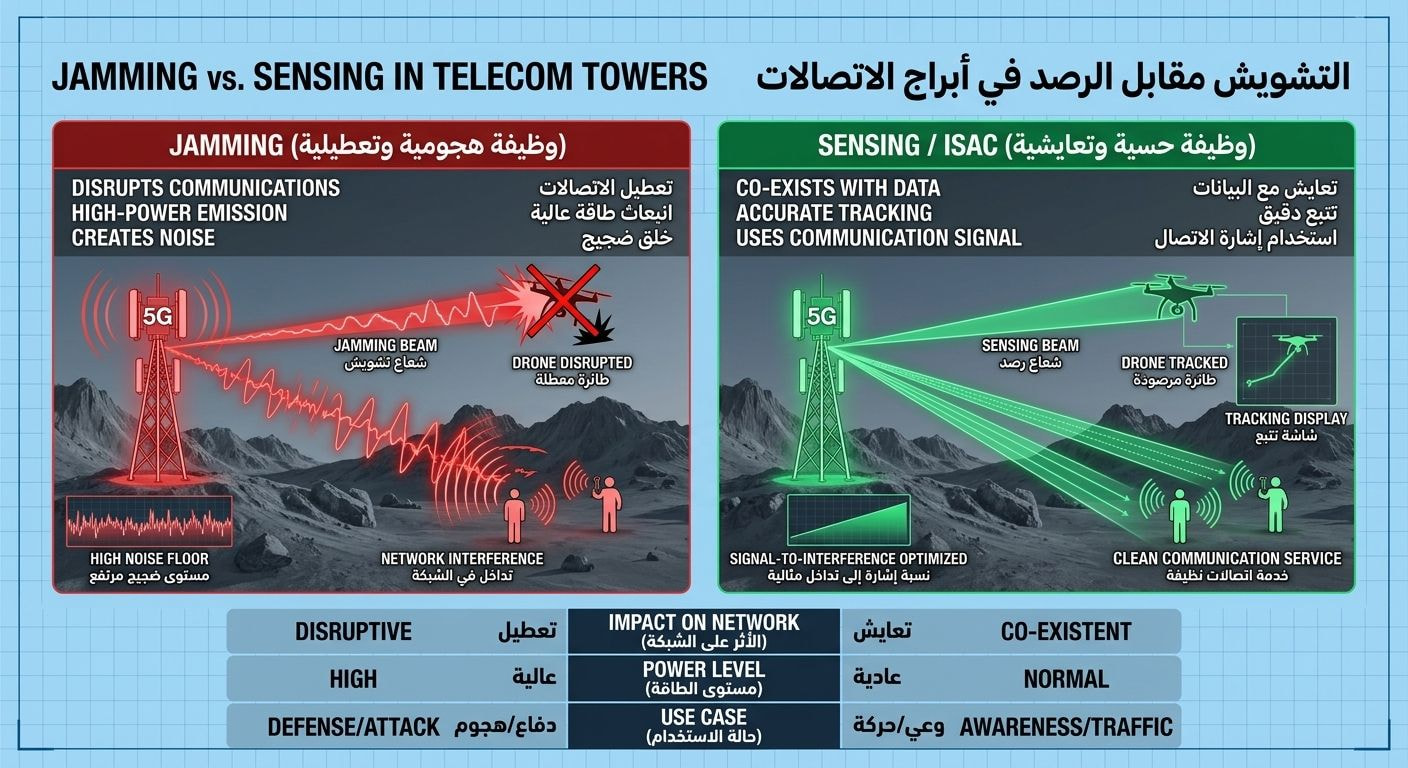
The concept of the network becoming “aware” of its surroundings (radar-like capabilities) is a stunning development in the world of telecommunications.
-
Difference in Frequency Bands
- 4G and 5G networks operate in specific bands.
- Most commercial and military drones rely on dedicated military frequencies far removed from civilian communication bands.
- Raising the power of a tower operating at 3.5 GHz (5G) will not technically affect a drone operating at 2.4 GHz unless the tower emits wideband “White Noise,” which telecommunications towers do not do.
-
Antenna Engineering and Signal Direction
- Cell towers are designed to direct signals toward the ground to serve users at specific tilt angles.
- Drones fly at altitudes and angles not efficiently covered by the main beams of tower broadcasts.
- While 5G Beamforming technology directs signals precisely to a user’s device, the tower must first “recognize” the drone as a user device to jam it.
- This is impossible because drones do not possess network connection protocols.
-
Connection Issues and Frequency Hopping Protocols (FHSS)
- Modern drones do not use a fixed frequency; they use Frequency Hopping Spread Spectrum (FHSS).
- The drone changes its frequency hundreds of times per second within a wide range.
- Telecommunications towers are restricted to a narrow, licensed bandwidth and cannot legally or physically hop outside their range to jam a drone.
-
Immunity to Jamming and AI
- The claim that cutting the connection via a cell tower will down a drone is outside the technical scope of the tower’s intended mission.
- Modern drones (especially loitering munitions or military types) are equipped to complete missions without the need for GPS or operator connection.
- They can visually identify and track targets even if the signal is completely lost.
- The Return to Home (RTH) protocol allows them to return automatically to the launch point upon signal loss.
-
Why Drones Do Not Monitor 4G/5G
- Military and professional drones use MIMO and OFDM technologies similar to mobile phones but in “military” or “unlicensed” bands.
- To jam them, a tower would need to generate a signal in their frequency range, which tower filters (designed to prevent frequency leakage outside licensed bands) do not allow.
- Therefore, sensing and detection is a completely different concept from jamming and disruption. This highlights the fundamental difference between using a tower as a “radar” versus using it as an “electronic weapon”.
LinkedIn: 