When we talk about LTE performance, we often focus on signal strength (RSRP) and quality (SINR). But there’s another critical factor working behind the scenes — Scheduling.
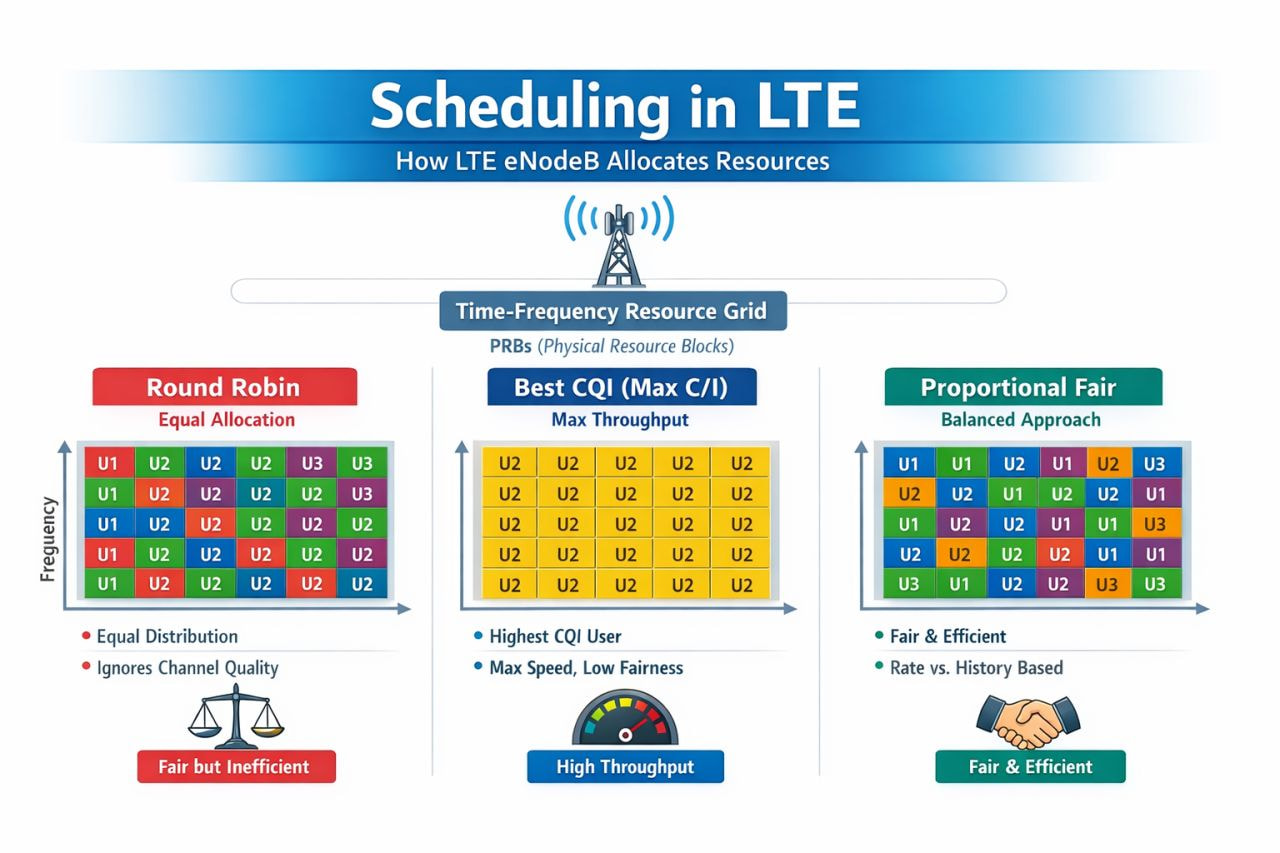
In LTE, the eNodeB scheduler decides how radio resources (PRBs) are allocated to users every 1 ms.
Key Goal
Balance throughput, fairness, and user experience
Common Scheduling Algorithms
Round Robin
Resources are equally distributed among users. Fair, but not efficient.
Best CQI (Max C/I)
Gives priority to users with the best channel conditions. High throughput, but poor fairness.
Proportional Fair (PF)
A smart balance between fairness and throughput by considering both current channel quality and past user data rates. This is the most widely used approach in real networks.
Real Insight
Even with good signal strength, users may experience low speeds due to scheduling decisions, network congestion, or QoS priorities.
In simple terms, your speed doesn’t just depend on signal — it depends on how the network chooses to serve you.
Scheduling is a process through which eNodeB decides which UEs should be given resources (RBs), how much resource (RBs) should be given to send or receive data .In LTE, scheduling is done at per subframe basis i.e. every 1 mili second. The entity which is govern this is know as scheduler.
 Key Goal
 Real Insight
 In simple terms, your speed doesn’t just depend on signal — it depends on how the network chooses to serve you.