RSRP vs RSRQ vs SINR – The Signal Trio That Powers 5G Decisions

:signal_strength: RSRP vs RSRQ vs SINR – The Signal Trio That Powers 5G Decisions

In the world of 4G/5G, signal strength isn’t everything.
Understanding these three key metrics helps you make smarter mobility, scheduling, and optimization decisions:

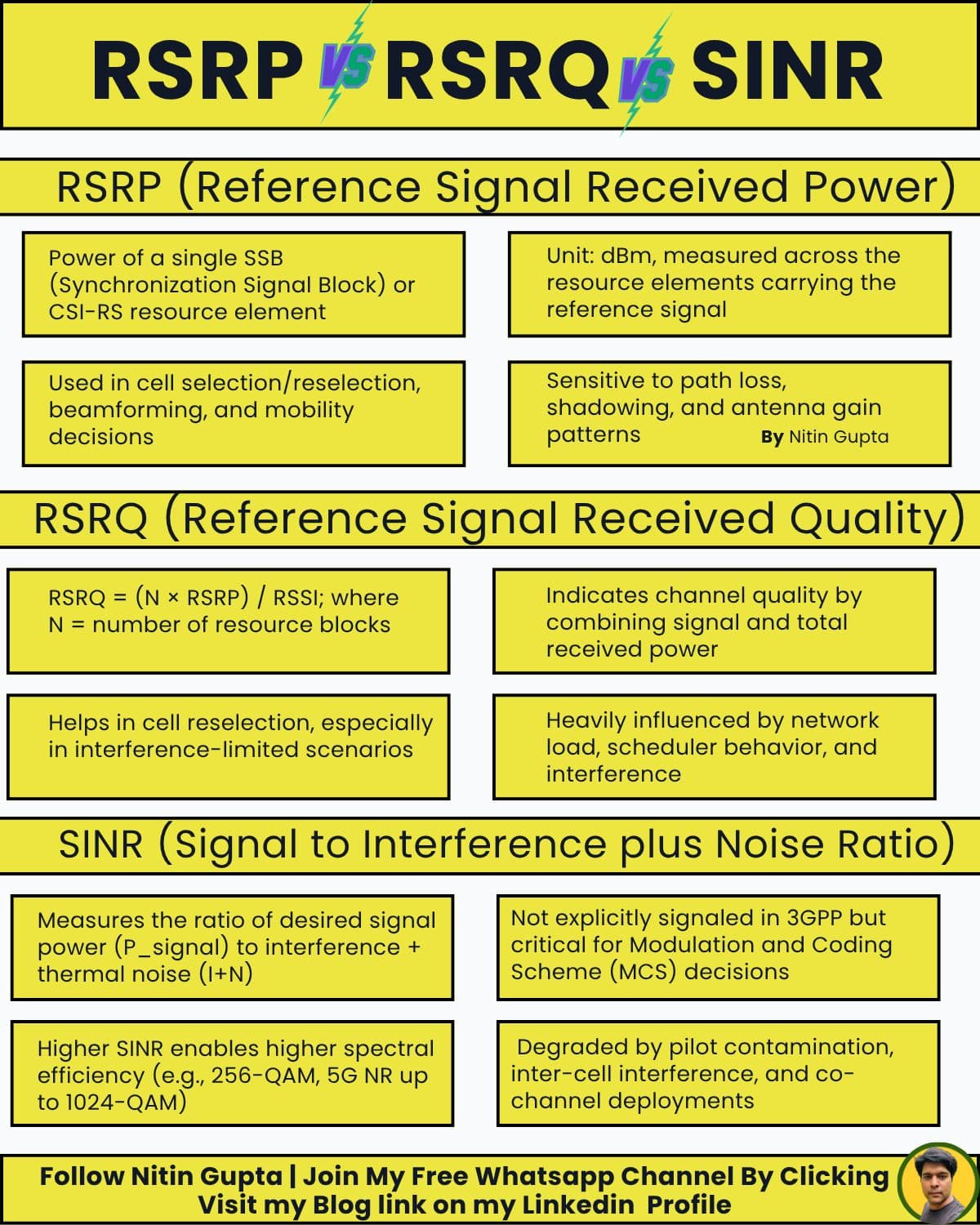
:rocket: RSRP (Reference Signal Received Power)
:small_orange_diamond: Power of the reference signal (SSB or CSI-RS)
:small_orange_diamond: Helps in cell selection, beamforming & handovers
:small_orange_diamond: Measured in dBm
:small_orange_diamond: Affected by distance, path loss & antenna gain

:satellite: RSRQ (Reference Signal Received Quality)
:small_orange_diamond: Combines signal & interference for quality insight
:small_orange_diamond: Crucial for cell reselection in noisy environments
:small_orange_diamond: Highly sensitive to network load & interference

:gear: SINR (Signal to Interference plus Noise Ratio)
:small_orange_diamond: Tells you how clean your signal is
:small_orange_diamond: Not signaled in 3GPP but vital for MCS decisions
:small_orange_diamond: Higher SINR → better throughput (think 1024-QAM!)

:bulb: Summary:

RSRP = Strength
RSRQ = Quality under noise
SINR = Clarity for data speed

:link: Save this post for your next network tuning session!
LinkedIn: :point_down:

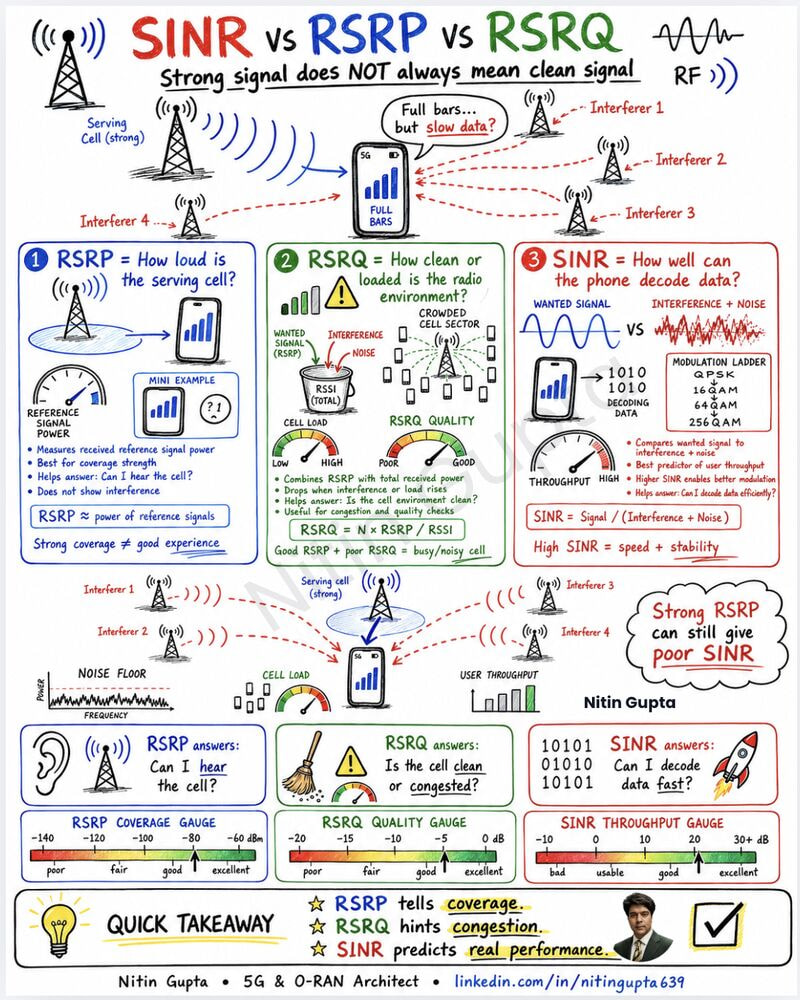
Strong signal does not always mean clean signal.
This is one of the most important RF lessons in 4G and 5G.

Many users see full bars and still complain:

Slow data
Poor video quality
High latency
Call drops
Low throughput

Why?

Because full bars usually tell you only one part of the story.

To understand radio quality, engineers must look at three different KPIs:

RSRP
RSRQ
SINR

RSRP answers:
Can the UE hear the serving cell?

It measures received reference signal power.

Good RSRP usually means good coverage.

But RSRP does not tell you whether the signal is clean.

RSRQ answers:
Is the radio environment clean or congested?

It combines signal strength with total received power.

If interference, noise or cell load increases, RSRQ drops.

RSRQ is useful for understanding congestion and quality.

SINR answers:
Can the UE decode data efficiently?

It compares wanted signal against interference and noise.

High SINR means the UE can use better modulation, higher coding efficiency and achieve better throughput.

This is why SINR is often the best predictor of real user experience.

Simple memory:

RSRP = coverage
RSRQ = congestion / quality
SINR = real performance

A strong RSRP with poor SINR means:

The UE hears the cell loudly
But the environment is noisy or interfered
So data performance can still be poor

That is why “full signal” does not always mean “fast internet.”

For troubleshooting, never check only signal bars.

Check:

RSRP for coverage
RSRQ for radio cleanliness
SINR for throughput potential

In RF optimization, the goal is not only strong signal.

The goal is strong, clean and decodable signal.

What RF KPI should I explain next?

LinkedIn: :backhand_index_pointing_down: