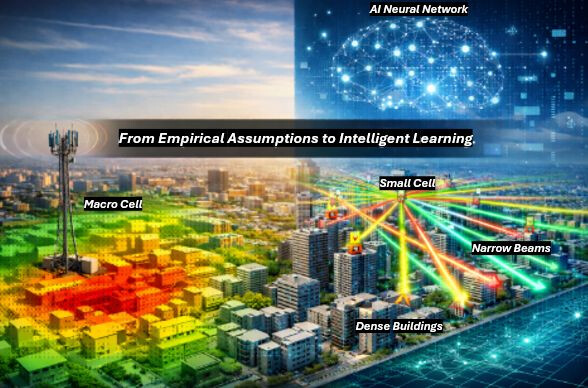
The future of RF planning isn’t just about better maps; it’s about shifting from static predictions to an AI-driven “learning loop” that senses the environment in real time.
 RF Propagation — From Empirical Assumptions to Intelligent Learning
 As mobile networks evolved from 1G to 5G, operating frequencies have steadily increased — and so has the complexity of RF propagation.
Traditional models such as Free Space model, Empirical path loss models, and advanced 3D ray tracing models have supported RF planning for decades.
 However, as we move toward higher frequencies with narrow-beam transmissions, and ultra-dense deployments — prediction errors are becoming more significant — and minimizing these errors will define next-generation RF planning.
 At mmWave and future 6G bands, the following factors critically impact coverage accuracy:
• Digital terrain resolution
• Clutter type
• Building height, density and spacing
• Precise antenna configuration (height, tilt, azimuth, beam pattern)
 High-resolution geographical maps combined with optimized cell-level planning can reduce prediction errors — but only up to a certain extent.
 Network planners must now rethink propagation modeling itself.
The question is no longer which model to use — but how intelligently we can evolve these models.
 Current Trade-off:
• Empirical models → Remain widely used due to their simplicity and low computational requirements, but they often result in higher prediction errors, especially in dense urban and high-frequency deployments.
• Deterministic models → Offer improved accuracy by explicitly modeling propagation mechanisms such as reflection, diffraction, and scattering, but they require detailed environmental data and involve significantly higher computational complexity.
 The future lies in AI/ML-based propagation models that can:
 Deliver higher accuracy than empirical models
Reduce computational burden compared to deterministic approaches
Continuously learn from real network data
As frequencies rise in mobile communication, intelligent propagation modeling will become a strategic necessity — not just a planning tool.
LinkedIn: 