Why Does Fibreglass Seem to Disappear?
The answer lies in optical physics,
molecular structure, and materials engineering.
At first glance,
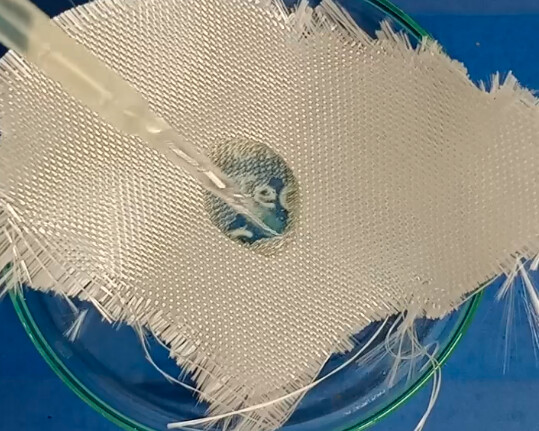
fibreglass appears as an opaque white fabric,
yet the individual glass fibres
themselves are almost completely transparent.
The visible appearance originates
not from the material itself,
but from how light interacts
with thousands of microscopic interfaces.
The phenomenon is governed by a combination of
optical physics,
surface chemistry,
and material architecture.
At the molecular level, transparency is controlled by:
↳ Refractive index matching, where reducing the difference between glass (n ≈ 1.5) and the surrounding medium minimizes light scattering.
↳ Electromagnetic wave propagation, described by Maxwell’s equations, determining how photons interact with dielectric materials.
↳ Silicon-oxygen (Si–O–Si) network structure, the amorphous molecular framework responsible for the intrinsic transparency of glass.
↳ Interfacial scattering, caused by abrupt changes in refractive index at every glass air boundary.
From a materials science perspective, fibreglass consists of:
↳ A high surface area woven architecture creating thousands of microscopic optical interfaces.
↳ Polymer compatible reinforcement fibres designed for composite materials.
This principle forms the scientific foundation of:
↳ Fibre-reinforced polymer composites (FRP)
↳ Transparent composite materials
↳ Optical encapsulation technologies
↳ Advanced structural laminates
From a Molecular Biology and Biotechnology perspective,
refractive index matching is also widely applied in biological imaging.
Modern tissue clearing techniques
use specialized chemical solutions
to minimize light scattering inside biological tissues,
allowing researchers to visualize
intact organs in three dimensions.
It is a remarkable reminder that
what we perceive is often determined
not by the material itself,
but by how light interacts
with its microscopic structure.
Linkedin (and watch Video!  ):
): 