You’d expect voice in 5G to always get top priority, right?
But in many real-world 5G SA networks, voice QoE still drops — even when coverage and bandwidth look perfect.
The hidden reason?
 The QoS flow isn’t doing what it’s supposed to.
Quick Recap: What’s a QoS Flow?
- In 4G EPC, QoS was managed through bearers (default and dedicated).
- In 5G Core, it evolved into QoS Flows — each identified by a QFI (QoS Flow Identifier) and governed by 5QI values.
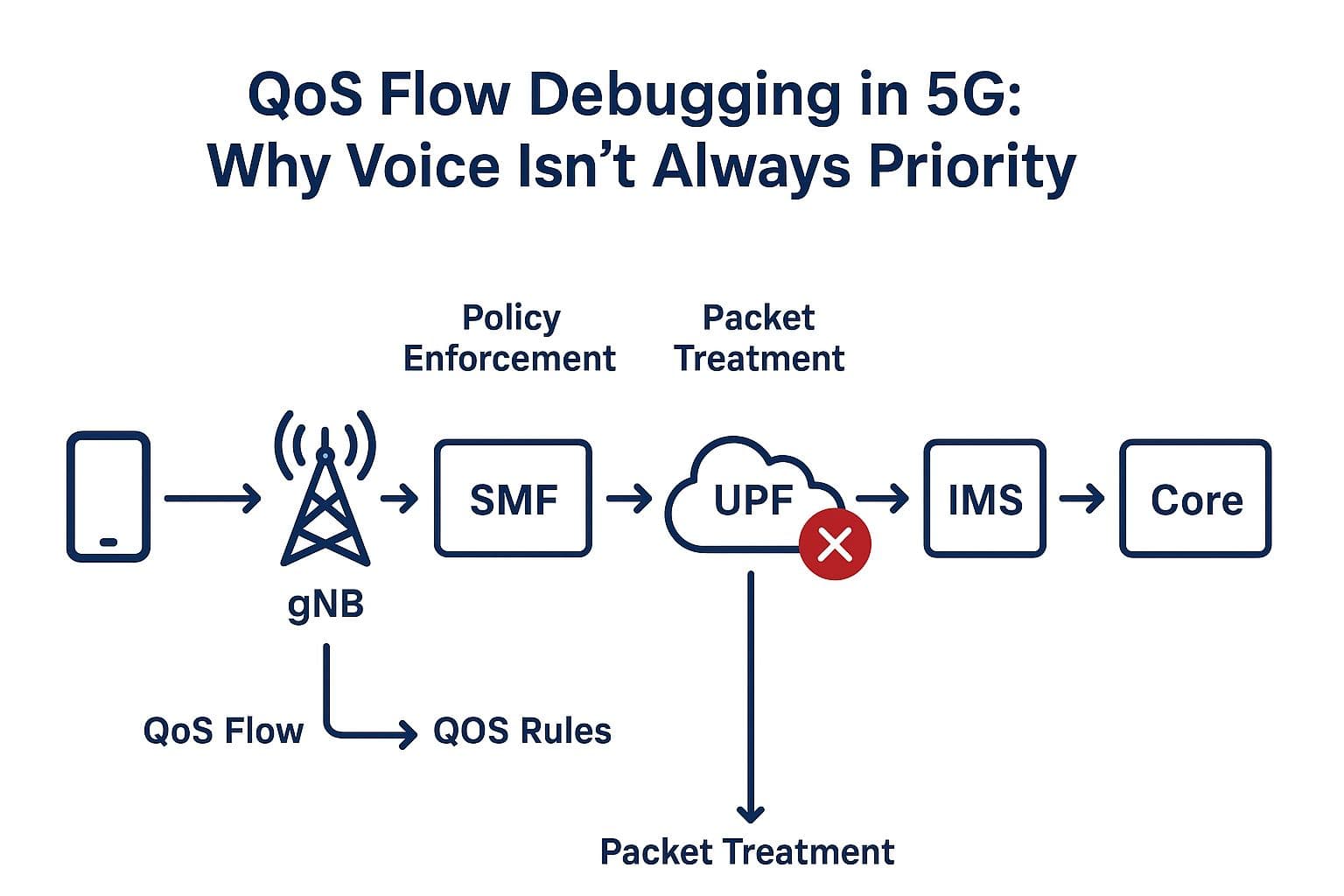
But here’s the catch — these flows only work if the SMF, UPF, and PCF all stay in sync:
- SMF defines the QoS rules.
- PCF enforces the policy (priority, GBR, ARP).
- UPF executes the packet-level treatment.
If any of those fail to align → your voice packets are treated like best-effort data.
Common QoS Flow Issues in 5G
- Missing 5QI Mapping → SIP/RTP flows assigned wrong 5QI (e.g., 9 instead of 1 or 5).
- PCF Policy Not Applied → Policy rules not pushed to SMF.
- UPF Rule Conflict → Incorrect PDR/FAR pair causing packet drop.
- QoS Re-establishment Failure → UE moves cells, but flow isn’t recreated.
- GBR Bearer Not Honored → Voice marked as GBR but handled as non-GBR.
KPIs to Watch
- VoNR MOS / Jitter / Packet Loss
- 5QI Flow Creation Success Rate
- PDU Session Modification Success Rate
- QoS Re-establishment Ratio
When QoS is broken, you’ll see normal data KPIs fine — but voice QoE plummets.
Troubleshooting Checklist
- Verify QFI and 5QI assignments from SMF logs.
- Check PCF for missing IMS policy enforcement.
- Trace UPF PDRs/FARs → ensure SIP and RTP traffic are prioritized.
- Monitor QoS setup events during mobility (handover or reattach).
Takeaway:
- In 5G, QoS isn’t automatic — it’s negotiated, signaled, and enforced dynamically.
- If the SMF, PCF, and UPF don’t talk perfectly, even premium voice flows end up behaving like background data.
Have you seen QoS-related voice degradation in your 5G network?
Was it a missing 5QI, policy issue, or UPF enforcement bug?
LinkedIn: 