The fastest-growing 5G deployment model isn’t at a carrier — it’s inside factories, ports, airports, and campuses.
Here’s the complete Private 5G architecture breakdown:
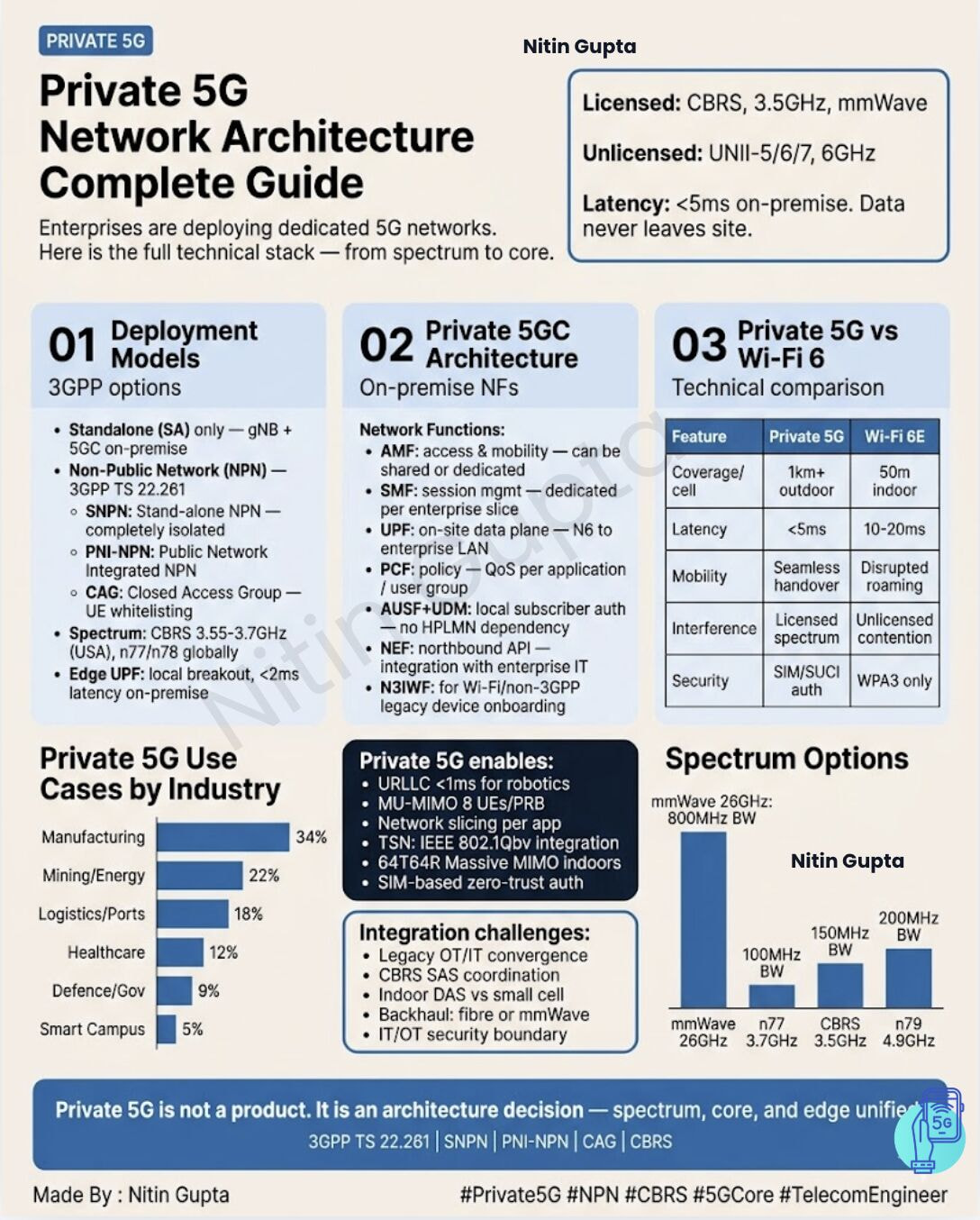
 Deployment Models (3GPP TS 22.261):
→ Model 1 — Standalone Private: Dedicated gNB + 5G Core, no MNO dependency
→ Model 2 — Shared RAN: Private core, shared RAN with MNO
→ Model 3 — Sliced Public: Network slice leased from MNO (vNPN)
→ Model 4 — Hybrid: Combination of private + public coverage
 Spectrum Options:
→ Licensed CBRS (3.5 GHz, USA) — PLMN-based, SAS managed
→ Licensed mmWave (26/28/39 GHz) — high throughput, low range
→ Shared/unlicensed: DECT-2020 NR (Europe), MulteFire
→ Private spectrum allocations (country-specific, growing globally)
 Security Architecture (3GPP TS 33.501):
→ Dedicated PLMN ID (SNPN — Standalone Non-Public Network)
→ SUCI/SUPI identity concealment same as public 5G
→ Air interface: 128-bit encryption (128-NEA2/NIA2)
→ Local authentication: can use enterprise credentials (EAP-TLS)
→ Data sovereignty: UPF on-premises, traffic never leaves site
 Key NFs in Private 5G Core:
→ AMF — access & mobility (often lightweight/embedded)
→ SMF — session management
→ UPF — user plane, on-site data breakout (N6 to local network)
→ UDM/AUSF — local subscriber database
→ PCF — local QoS & policy
 Industry Use Cases & Performance:
→ Smart factory: 1ms latency, 99.9999% reliability (URLLC)
→ Automated guided vehicles (AGVs): deterministic scheduling
→ Real-time video analytics: local UPF keeps data on-site
→ Mining & energy: ruggedised CPE, licensed spectrum
→ Port automation: mmWave for crane & container tracking
Private 5G is not a product — it’s an architecture decision. And the enterprises that get it right are building their own sovereign connectivity layer.
LinkedIn: 