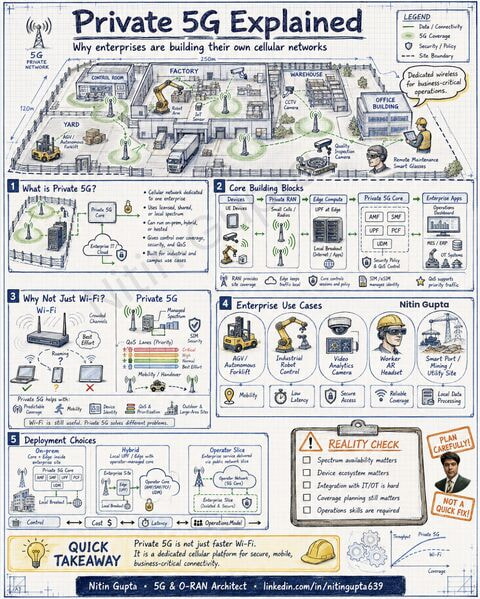
It is a dedicated cellular network built for business-critical operations.
Enterprises are exploring Private 5G because some environments need more than best-effort connectivity.
Factories, ports, mines, warehouses, utilities and campuses often need:
- Reliable coverage
- Secure device identity
- Mobility and handover
- Low latency
- QoS prioritization
- Local data processing
- Operational control
That is where Private 5G becomes powerful.
A typical Private 5G setup includes:
- Devices
- Private RAN
- Small cells / radios
- Edge compute
- Private 5G Core
- Enterprise applications
- Security and policy control
The goal is not only connectivity.
The goal is predictable connectivity for critical workflows.
Use cases include:
- AGV / autonomous forklifts
- Industrial robot control
- Video analytics cameras
- Worker AR headsets
- Smart ports
- Mining sites
- Utility operations
- Private campuses
But Private 5G is not a quick fix.
A successful deployment depends on:
- Spectrum availability
- Device ecosystem
- Coverage planning
- IT / OT integration
- Security design
- Operations skills
- Enterprise application readiness
This is also why Private 5G and Wi-Fi should not be treated as enemies.
Wi-Fi is still useful.
Private 5G solves different problems:
- Wider area coverage
- Better mobility
- SIM / eSIM-based identity
- QoS lanes
- Outdoor and industrial environments
- Controlled enterprise connectivity
Deployment choices can vary:
- On-prem private core
- Hybrid edge model
- Operator-provided slice
- Managed private network
The best model depends on cost, latency, control, security and operations capability.
Quick takeaway:
Private 5G is a dedicated cellular platform for secure, mobile and business-critical connectivity.
It is not about replacing every Wi-Fi network.
It is about connecting the use cases where reliability, mobility, QoS and control really matter.
Which enterprise use case do you think will drive Private 5G adoption fastest?
LinkedIn: 