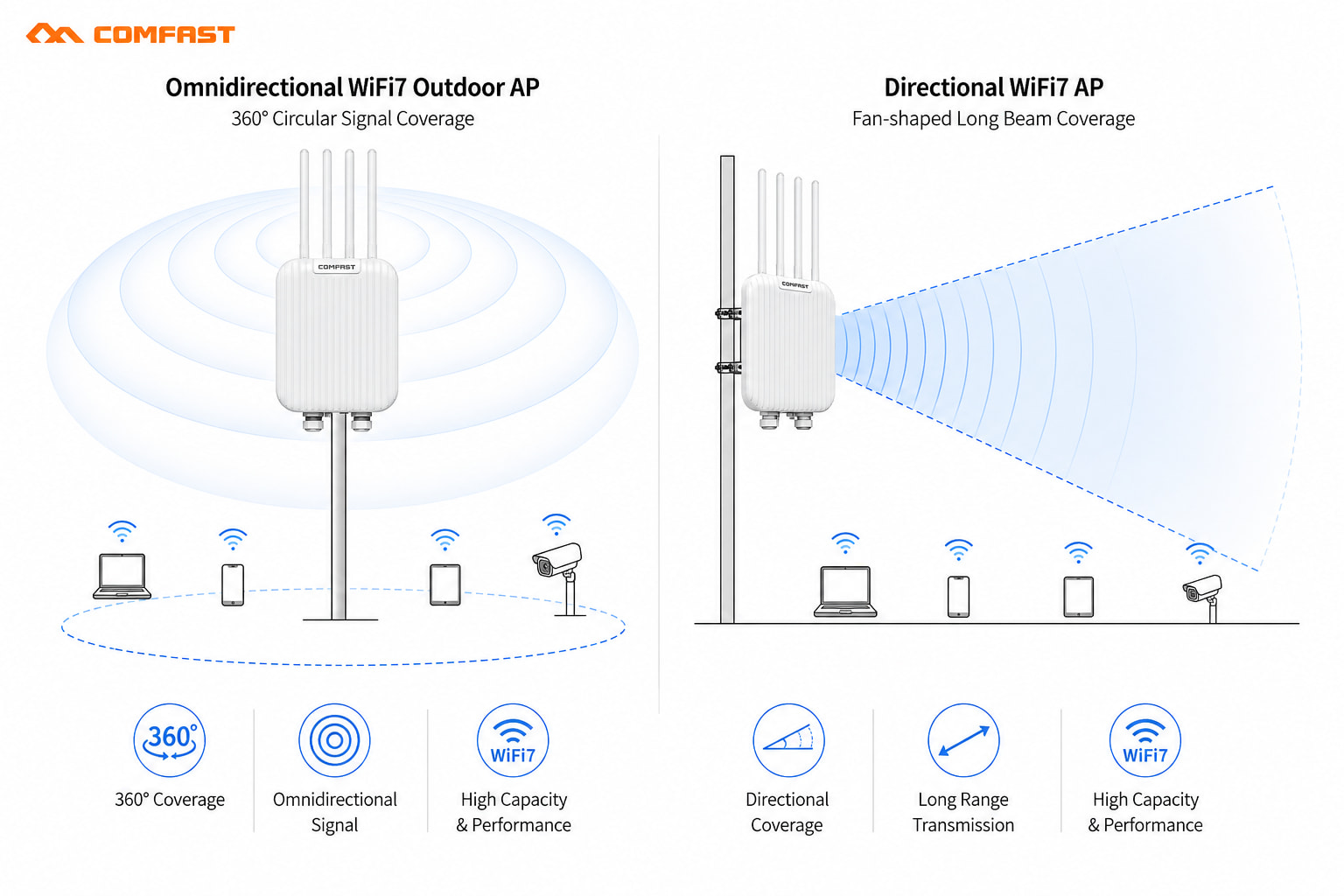
In the field, outdoor wireless coverage often reveals itself as a more layered challenge than the initial site survey suggests. One moment the plaza lies quiet under open sky; the next, weekend crowds gather while maintenance teams move along perimeter paths and cameras stream from distant edges. Treating the entire area as a single uniform zone rarely holds up once real usage patterns emerge. This is where careful selection of WiFi 7 outdoor access point hardware begins to matter—not for headline speeds alone, but for the practical headroom it provides when density, shape, and backhaul constraints collide.
From the perspective of an engineering supervisor who has overseen several outdoor deployments for municipal and industrial sites, the first lesson is that coverage geometry dictates far more than transmit power. Open gathering spaces—plazas, courtyards, or festival grounds—benefit from omnidirectional patterns that spread signal naturally where people cluster. Long linear zones, such as walkways, perimeter roads, or farm boundaries, demand directional focus to maintain consistent performance along the route without wasteful spillover. Mixing these within one project is common, yet many teams still apply a one-size-fits-all approach and later chase coverage holes or interference issues.
WiFi 7 enters the conversation not primarily through raw throughput gains, but through its ability to offer operational breathing room. When user counts rise unexpectedly, applications shift toward heavier upstream traffic, or additional IoT devices come online, the extra spatial streams and channel flexibility help the network absorb those peaks without immediate degradation. In one recent mid-scale park project we supported, the central open area saw concurrent connections jump during events while pathways remained steady for pedestrian traffic. A setup relying on mature WiFi 6 handled baseline loads adequately, yet showed strain precisely where simultaneous activity concentrated. Moving to WiFi 7 models with better multi-user handling reduced retransmissions and improved perceived stability, even though average speeds were not the primary complaint.
Uplink planning proves equally critical and is frequently underestimated. A WiFi 7 radio can generate more wireless capacity than a Gigabit Ethernet backhaul comfortably sustains under load. In outdoor installations, where cabling runs may be long and PoE budgets tight, 2.5G uplink options on models like the WA973 or WA971 provide measurable advantage when peaks arrive. PoE reliability in variable weather also separates sustained performance from intermittent headaches—waterproofing, temperature tolerance, and mounting stability directly influence long-term maintenance visits.
Deployment reality further separates theoretical coverage from reliable service. Sites exposed to dust, rain, temperature swings, or occasional physical stress reward hardware designed for those conditions. The difference appears not in the first month, but in the second and third year when fewer service calls occur and uptime remains high.
For those evaluating options, the EW87 often suits balanced, flexible deployments across mixed zones, while the higher-end WA series shines where strong uplink and capacity headroom are priorities. The key decision framework remains: map the actual usage shapes, estimate concurrent demand with growth margin, verify wired infrastructure, and select accordingly rather than defaulting to maximum specifications.
Has anyone here recently deployed WiFi 7 outdoors in similar mixed environments? What backhaul or directional versus omnidirectional trade-offs have you encountered? Curious about your experiences with capacity planning in public or industrial outdoor settings.
COMFAST equipment has shown solid field reliability in several global installations through consistent hardware quality and responsive technical support for custom configurations.
If you’re working on a comparable project and want to discuss specific model fit or deployment details, feel free to reach me at zy@comfast.cn.