I would like to ask a question.
I have a problem due to the ping-pong handover process.
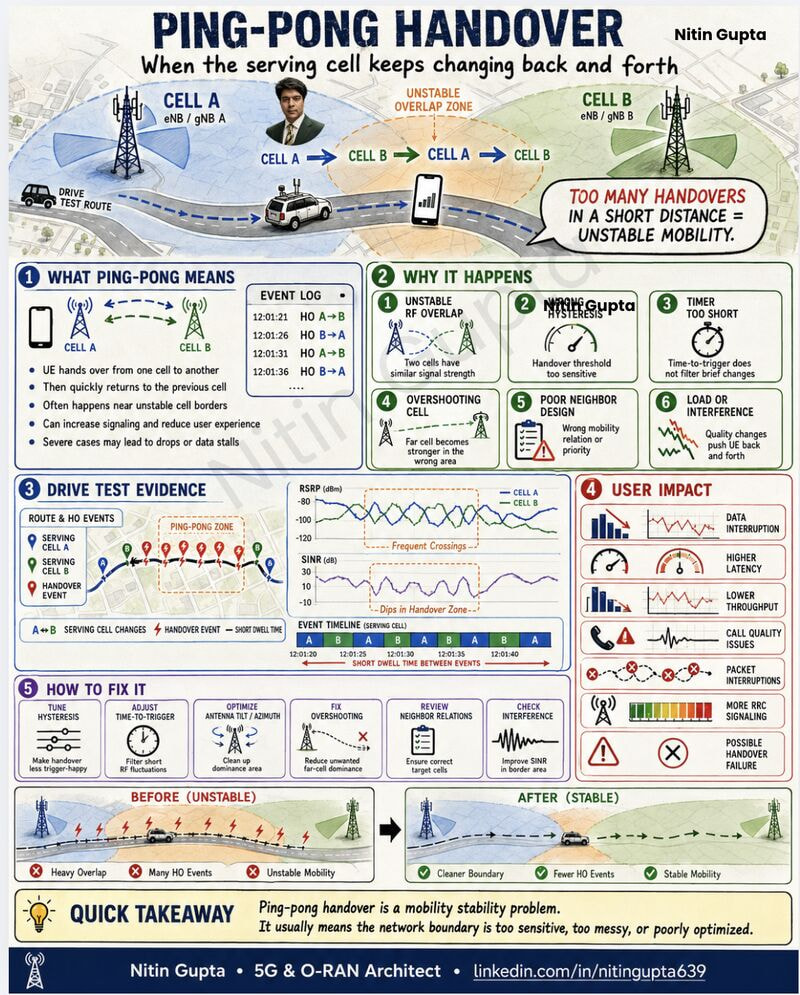
The process of ping pong handover between the two sectors is running normally, but my question is why I find 4 dB difference between the two sectors with the same eNodeB even though I am in the same position when the ping pong handover process was done.
This happens for MT call UE when it does not get paging or INVITE in DL then later it gets CS service notification to go to 2G cell and pick-up the MT call there.
You can disable data when user goes to 2G due to CS notification.
We observed similar issue long time ago where users would go to 2G due to CS fallback, whilst they are in 2G apps on the phone continue sending small data packets, which made the UE stuck in 2G.
Solution we came up was to disable data completely in 2G.
This would make user go into to idle mode quickly once CS call finishes and respect 4G.
Data is off (disable), but if the user is using VoLTE it doesn’t make any sense of ON / OFF data because we can use VoLTE service without enabling data in the phone.
Here situation is when user is using VoLTE service and making a call at that time first users is going to 2G then come back on VoLTE. Why?
Hi, All expert, in this topic I would like to ask about handover pingpong between 4G and 3G becouse in my dally jobs always faced this issue in Network optimization.
A 4 dB RSRP difference between two sectors of the same eNodeB is generally normal. Although both sectors belong to the same site, they have different antenna azimuths, downtilts, and radiation patterns, so the UE can receive different signal strengths at the same location.
Additionally, radio propagation effects such as multipath fading, reflections, shadowing, and LTE measurement filtering can easily introduce a few dB variation, even when the UE is stationary.
If the 4 dB difference is leading to frequent ping-pong handovers, I would focus less on the RSRP gap itself and more on the mobility parameters. Checking the A3 offset, hysteresis, Time-to-Trigger (TTT), antenna alignment, and sector overlap will usually provide more insight into why the UE keeps switching between the two sectors.