By now, we know why OTN exists and what OTN really is.
The next confusion is common and dangerous.
“Isn’t OTN just Ethernet carried over DWDM?”
The short answer is no. The useful answer requires understanding what each layer is designed to optimize.
Ethernet Is a Traffic System
OTN Is a Transport System
Ethernet was designed to:
- aggregate traffic
- share bandwidth
- recover statistically
It assumes:
- traffic is bursty
- congestion is temporary
- retransmission is acceptable
This works extremely well in LANs, data centers, and edges.
It breaks down when you demand determinism at scale.
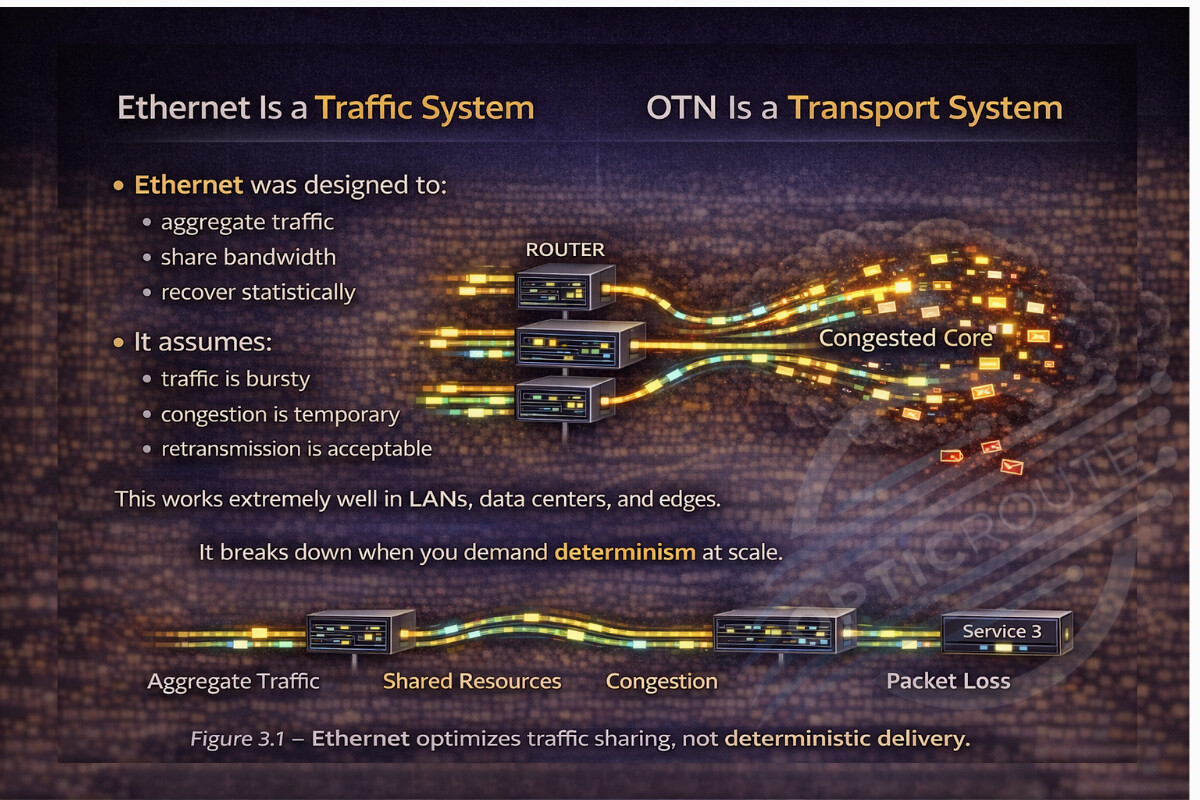
Figure 3.1
Figure 3.1: Ethernet optimizes traffic sharing, not deterministic delivery.
OTN Is Built for Determinism
Not Flexibility
OTN makes a very different assumption.
TRAFFIC IS NOT SHARED. BANDWIDTH IS RESERVED.
Once a service enters OTN:
- its rate is fixed
- its path is known
- its behavior is predictable
There is no congestion avoidance because there is nothing to avoid.
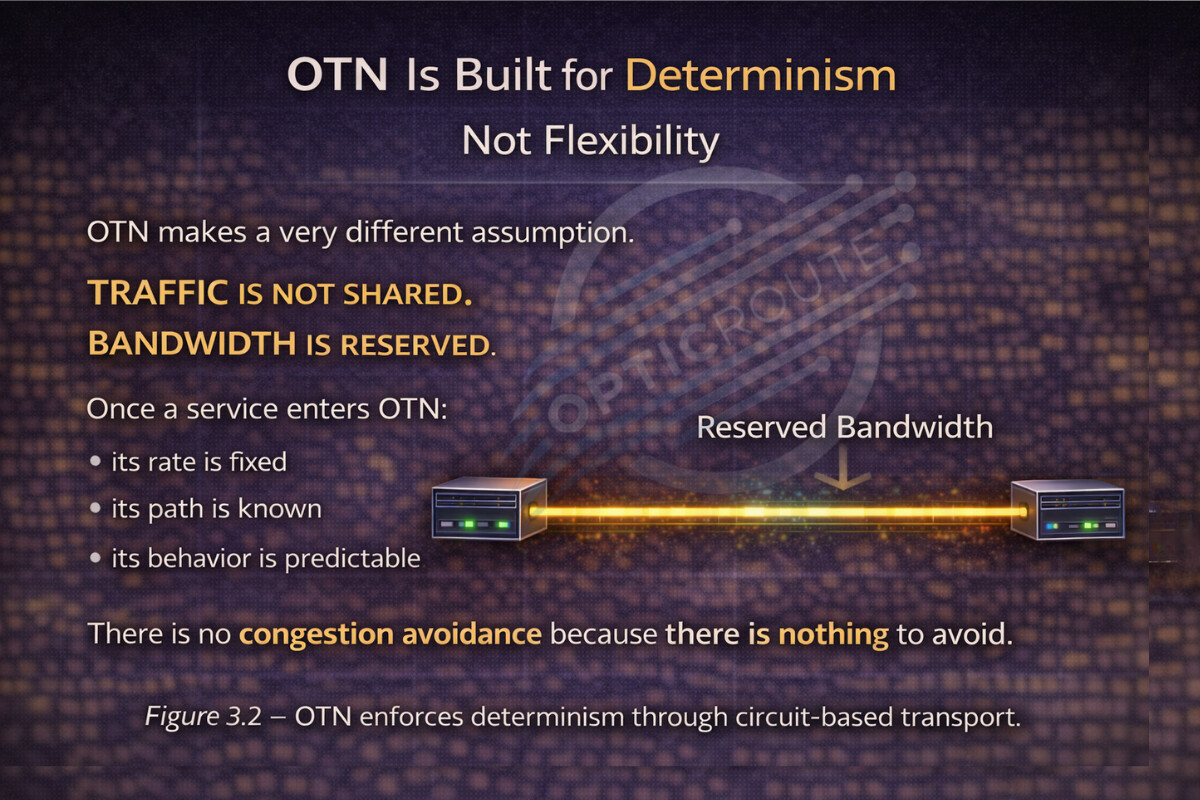
Figure 3.2
Figure 3.2 — OTN enforces determinism through circuit-based transport.
A Direct Comparison
This is where the difference becomes obvious.
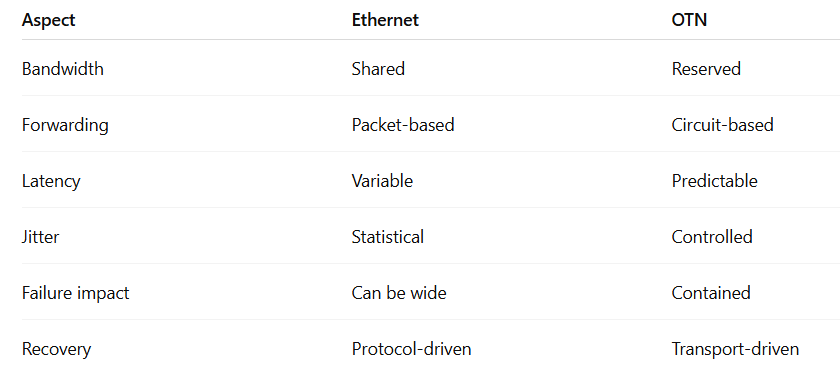
This is not about one being better.
It is about each being built for a different job.
Why Ethernet Thinking Breaks in the Core
When Ethernet is pushed into the optical core without structure:
- oversubscription increases
- failure domains grow
- recovery becomes opaque
The network still works. It just becomes fragile.

Figure 3.3
Figure 3.3 — Ethernet scales traffic well but struggles with failure containment in the core.
Why OTN Thrives in the Core
OTN does not try to be flexible.
It tries to be boring.
And in transport engineering, boring is good.
With OTN:
- services are explicit
- failures are localized
- recovery is deterministic
This is why operators place OTN below Ethernet and IP, not instead of them.
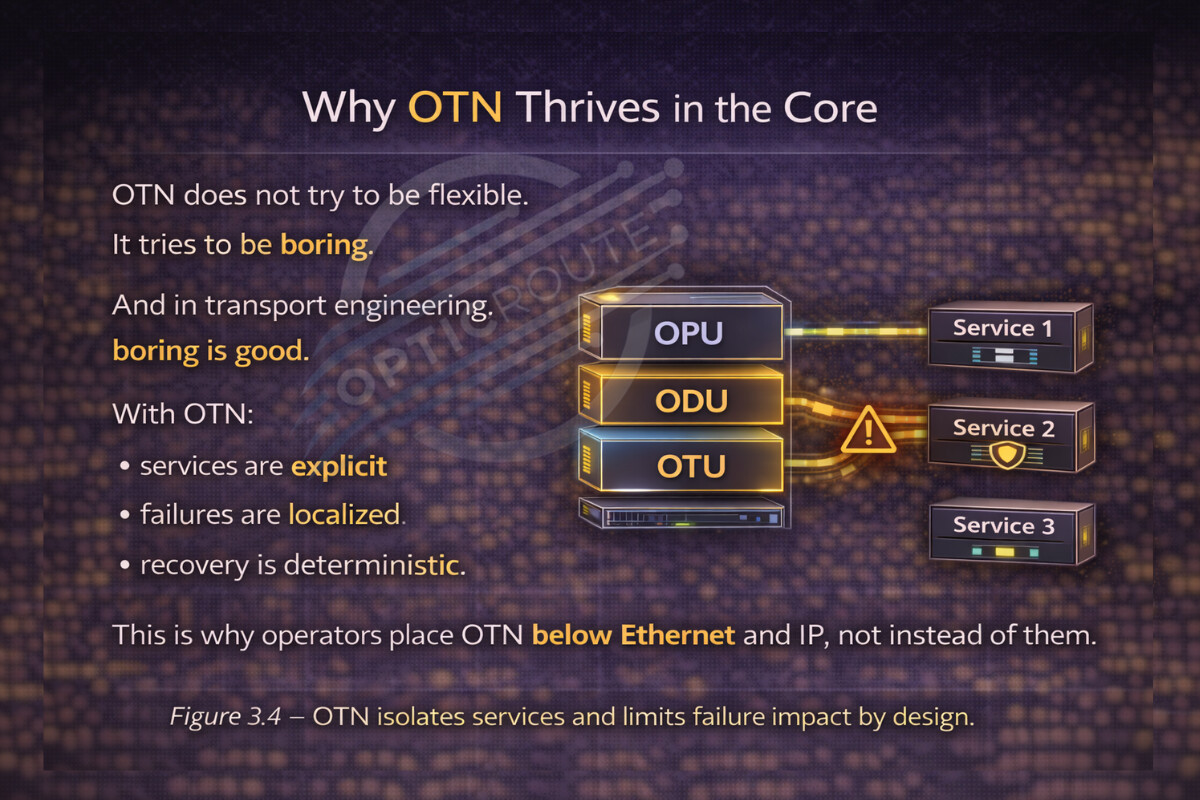
Figure 3.4
Figure 3.4 — OTN isolates services and limits failure impact by design.
The Key Takeaway
ETHERNET MOVES TRAFFIC. OTN MOVES SERVICES.
Ethernet optimizes efficiency. OTN optimizes certainty.
Confusing the two leads to designs that work in the lab but feel unstable in production.
What Comes Next
Now that we’ve separated Ethernet thinking from OTN thinking, it’s time to go deeper into how OTN actually does its job.
In Part 4, we break down OPU, ODU, and OTU in detail and explain who does what inside an OTN system.
Next part: OPU, ODU, and OTU Explained Simply