What OTN Really Is
And What It Is Not
After understanding why OTN exists, the next confusion usually appears fast.
People call OTN:
- a protocol
- a wrapper
- an Ethernet replacement
- or just framing
None of those are fully correct.
To understand what OTN really is, we need to be precise about what job it was designed to do.
OTN Is a Transport Layer
Not a Packet Layer
The most important clarification comes first.
OTN IS NOT A PACKET NETWORK.
It does not route packets. It does not make forwarding decisions. It does not rely on congestion avoidance.
OTN IS A CIRCUIT-BASED TRANSPORT SYSTEM.
Once a service is placed into OTN, its:
- bandwidth is reserved
- path is fixed
- behavior is deterministic
This is fundamentally different from Ethernet and IP.
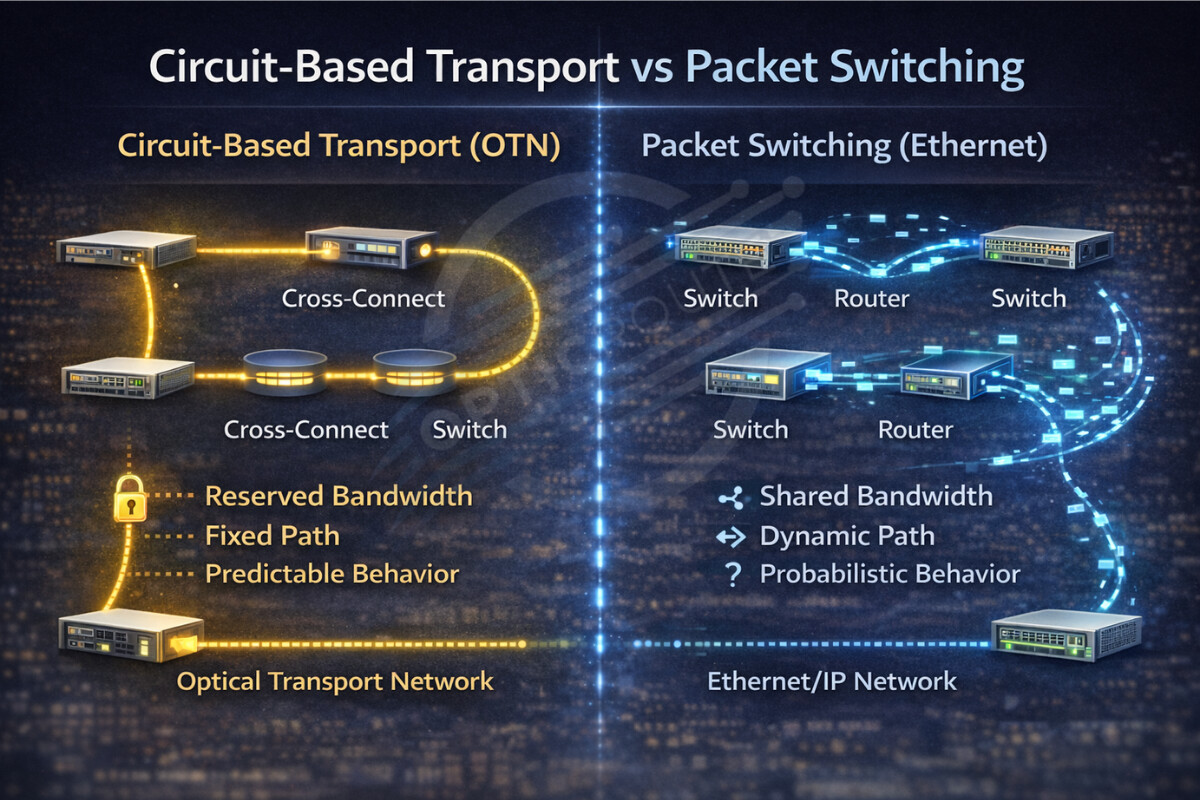
Figure 2.1
Figure 2.1: OTN uses circuit-based transport while Ethernet relies on packet switching.
OTN Is Not Just Framing
It Is a Container System
Calling OTN “just framing” misses the point.
Yes, OTN wraps client signals. But more importantly, it ORGANIZES THEM.
OTN introduces:
- structured containers
- explicit service hierarchy
- end-to-end monitoring
- built-in protection
A client signal inside OTN is no longer anonymous traffic. It becomes a managed service.
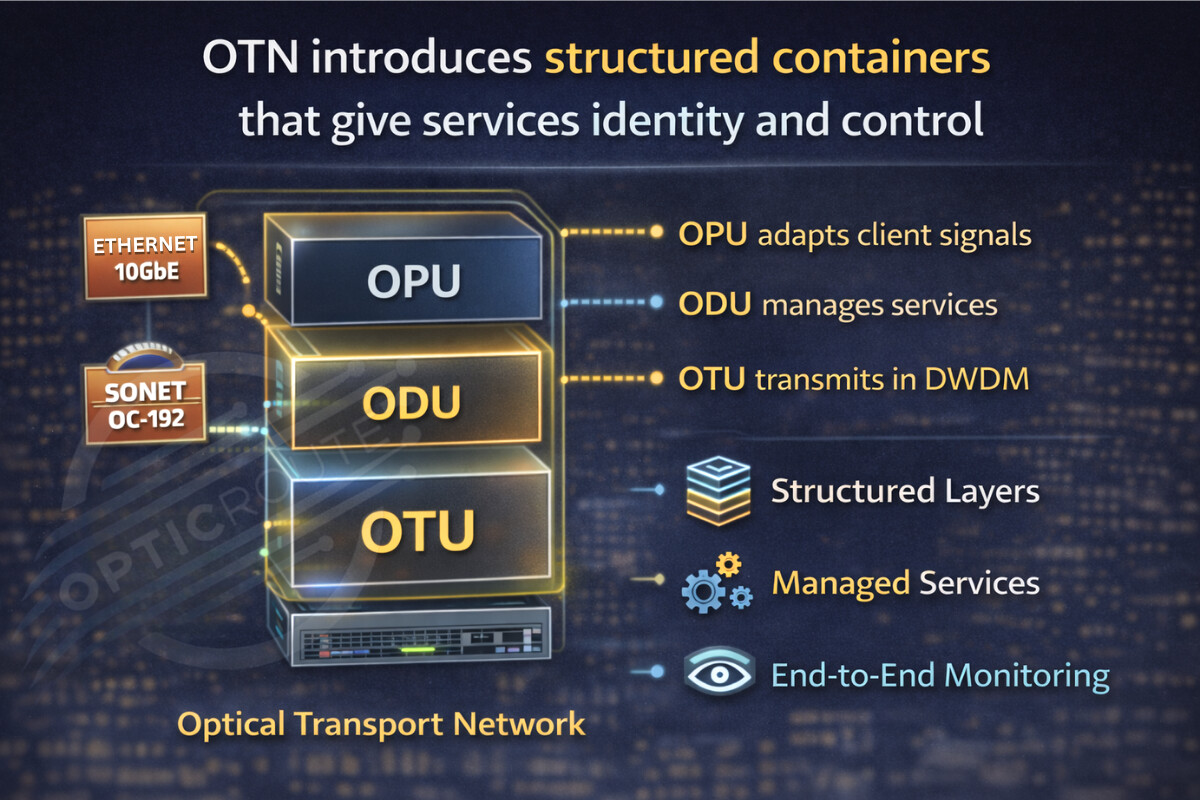
Figure 2.2
Figure 2.2: OTN introduces structured containers that give services identity and control.
The Three Roles Inside OTN
OTN works because each internal layer has a clear responsibility.
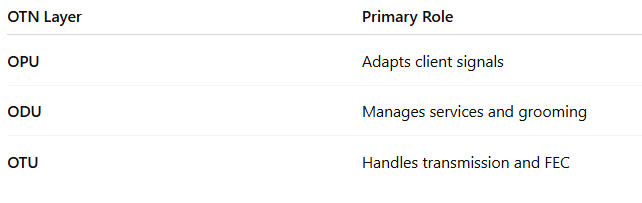
This separation is intentional.
SERVICE ENGINEERING HAPPENS AT THE ODU LEVEL. PHYSICAL TRANSMISSION HAPPENS AT THE OTU LEVEL.
This is why OTN scales cleanly in the core.
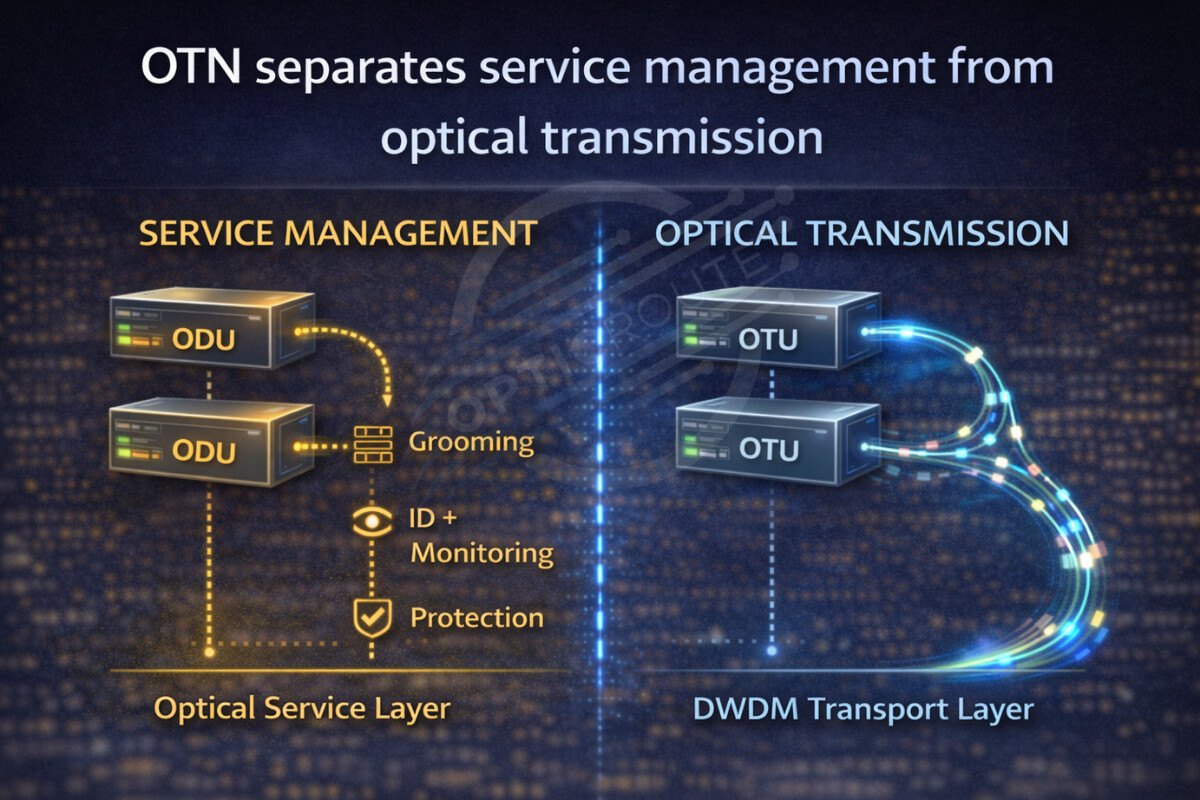
Figure 2.3
Figure 2.3: OTN separates service management from optical transmission.
OTN Turns Traffic Into Services
Before OTN:
- Traffic was aggregated
- Failures were wide
- Recovery was indirect
With OTN:
- Services are explicit
- Failures are contained
- Recovery is deterministic
A service in OTN has:
- known bandwidth
- known monitoring points
- known protection behavior
This is the reason carriers trust OTN in the core.
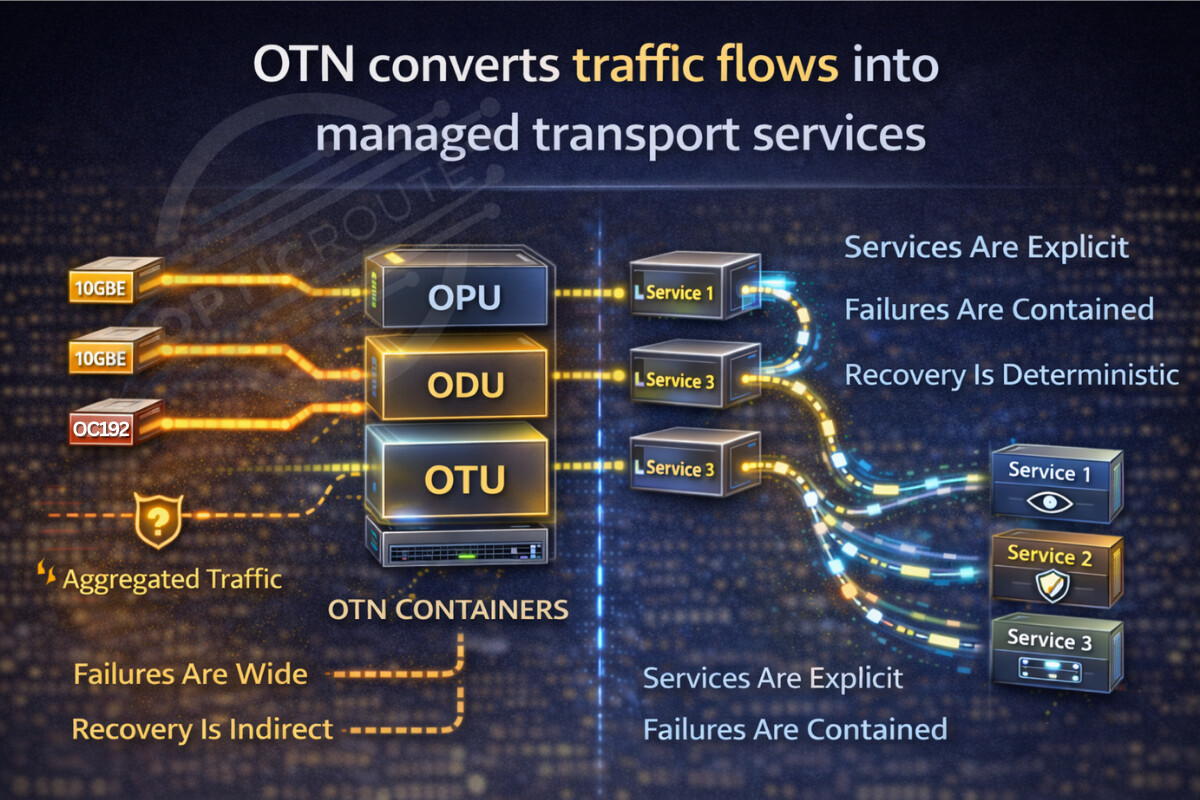
Figure 2.4
Figure 2.4: OTN converts traffic flows into managed transport services.
What OTN Is Not
Clarity comes from contrast.
OTN IS NOT:
- an Ethernet replacement
- a routing protocol
- a congestion-based system
- a vendor feature
OTN IS:
- a transport-layer system
- a service container architecture
- a deterministic control plane for the optical core
Once you see this distinction, the rest of OTN starts to make sense.
What Comes Next
Now that we know what OTN really is, the next question is practical.
How does OTN actually structure traffic?
What are OPU, ODU, and OTU doing in real systems?
In Part 3, we break down the OTN layers one by one and explain who does what and why it matters.
Next part: OPU, ODU, and OTU Explained Simply