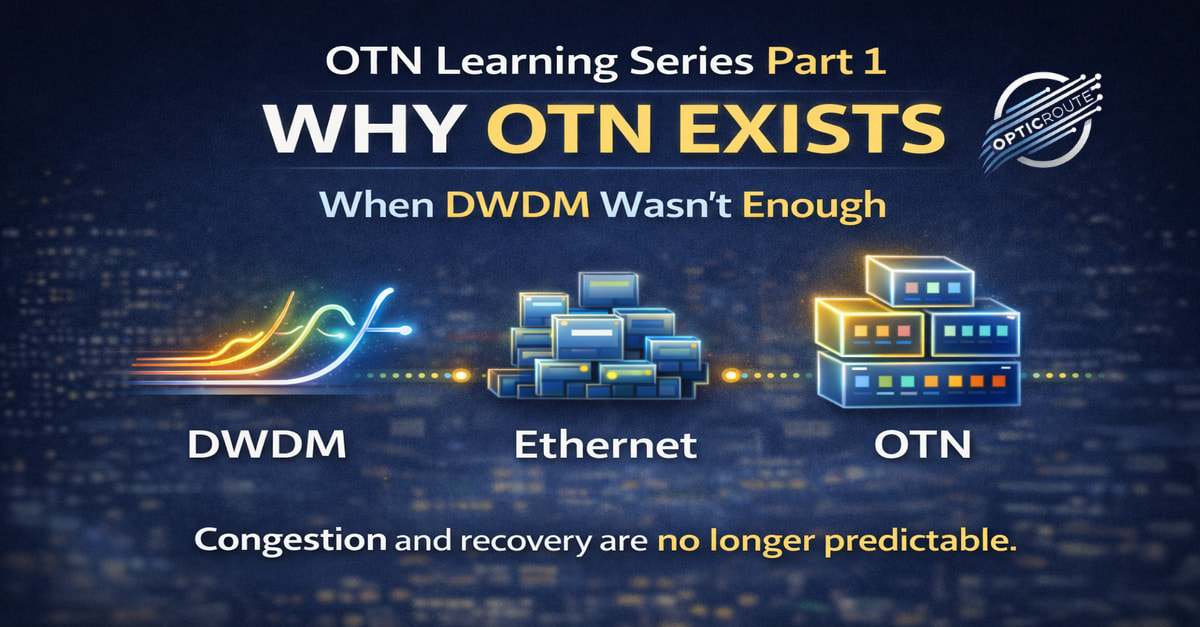
When DWDM Wasn’t Enough
For a long time, optical networks did exactly what they were designed to do.
They MOVED LIGHT. Fast. Far. Efficiently.
Dense Wavelength Division Multiplexing (DWDM) gave operators the ability to push enormous capacity across continents and oceans. Add wavelengths, amplify, repeat. From a physics perspective, it was elegant.
But as traffic evolved, something subtle started to break.
Not in the fiber. Not in the optics. In the ASSUMPTIONS.
DWDM Is Excellent at Moving Light
But It Understands Nothing About Traffic
At its core, DWDM IS BLIND TO SERVICES.
A wavelength could be:
- A 10G enterprise service
- A mobile backhaul link
- A financial trading circuit
- Or multiple unrelated services multiplexed upstream
To DWDM, they all look identical. Just OPTICAL POWER AT A FREQUENCY.
That was acceptable when networks were small and static. It became risky when networks scaled.
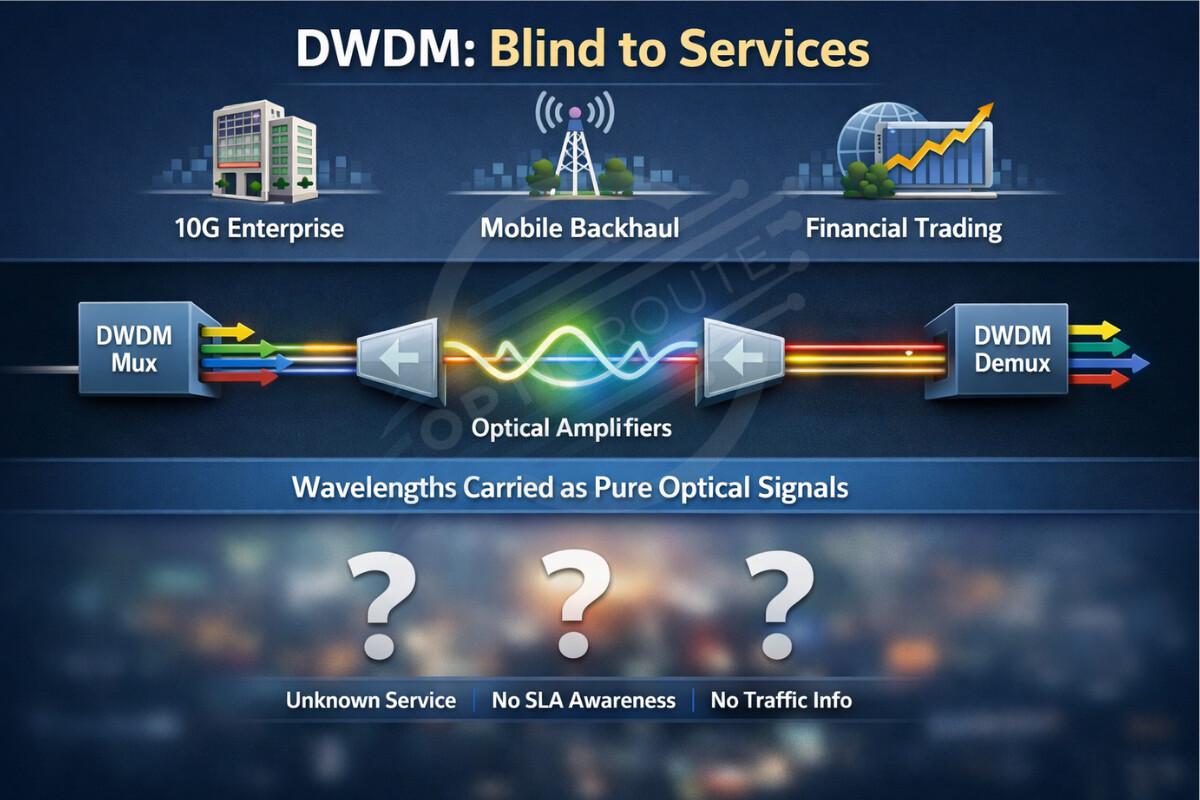
Figure 1.1
Figure 1.1: DWDM transports wavelengths as optical signals without awareness of the services inside.
DWDM can answer:
- Is the POWER LEVEL correct
- Is OSNR within limits
- Is BER acceptable
DWDM cannot answer:
- WHAT SERVICE IS THIS
- WHAT SLA DOES IT HAVE
- WHAT HAPPENS IF THIS FAILS
Those questions were pushed upward.
Ethernet and IP Solved a Different Problem
And They Solved It Probabilistically
Ethernet and IP were built for STATISTICAL MULTIPLEXING.
They assume:
- Traffic is BURSTY
- Congestion is TEMPORARY
- Retransmission is ACCEPTABLE
This works extremely well at the EDGE.
It works poorly in the CORE.
When Ethernet traffic scales without structure:
- LATENCY BECOMES UNPREDICTABLE
- JITTER PROPAGATES
- FAILURE IMPACT EXPANDS
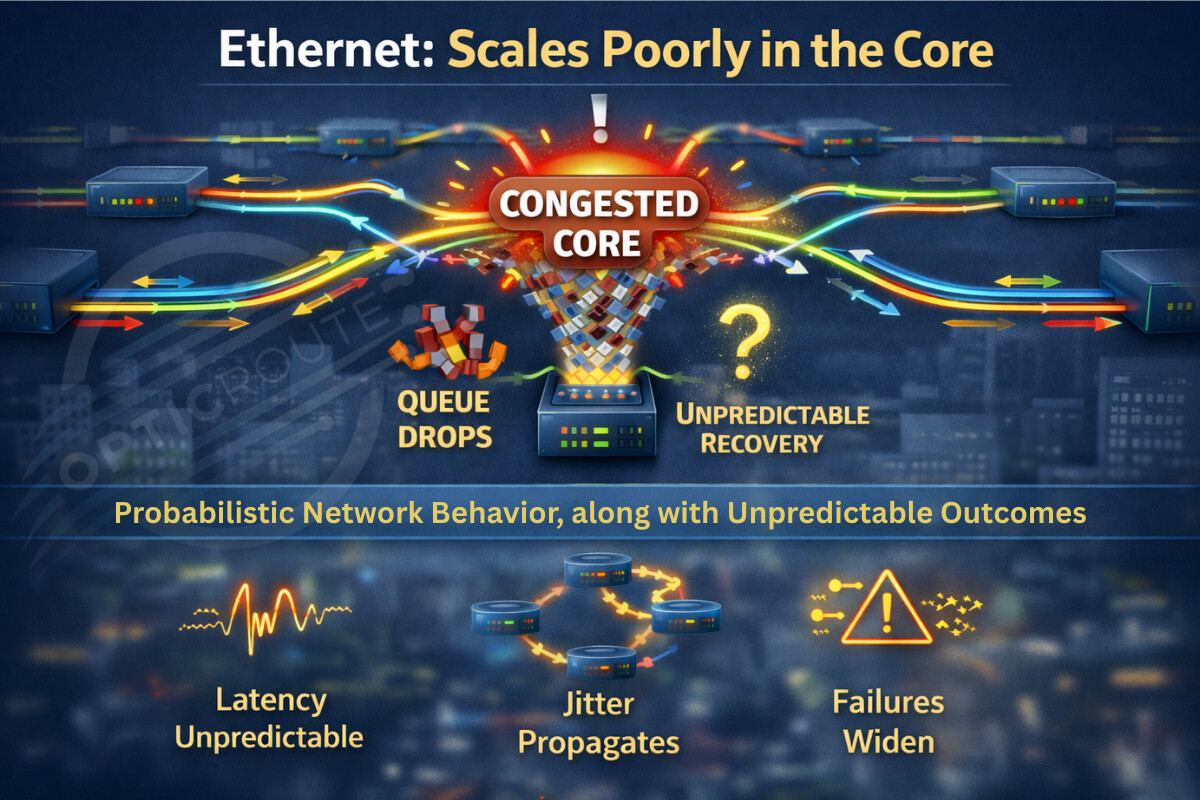
Figure 1.2
Figure 1.2: Ethernet relies on probabilistic behavior. At scale, congestion and recovery are no longer predictable.
In a carrier core network, EVENTUALLY DELIVERED IS NOT GOOD ENOUGH.
Operators needed:
- GUARANTEED BANDWIDTH
- PREDICTABLE LATENCY
- DETERMINISTIC PROTECTION
Neither pure DWDM nor pure Ethernet could provide this alone.
The Real Problem Was the Missing Middle Layer
By the mid-2000s, transport networks had a structural gap.

There was NO LAYER RESPONSIBLE FOR SERVICES.
No clear place to:
- GROOM TRAFFIC DETERMINISTICALLY
- APPLY PROTECTION BELOW IP
- ISOLATE FAILURES
- ENFORCE BANDWIDTH CONTRACTS
That gap is exactly where OTN was born.
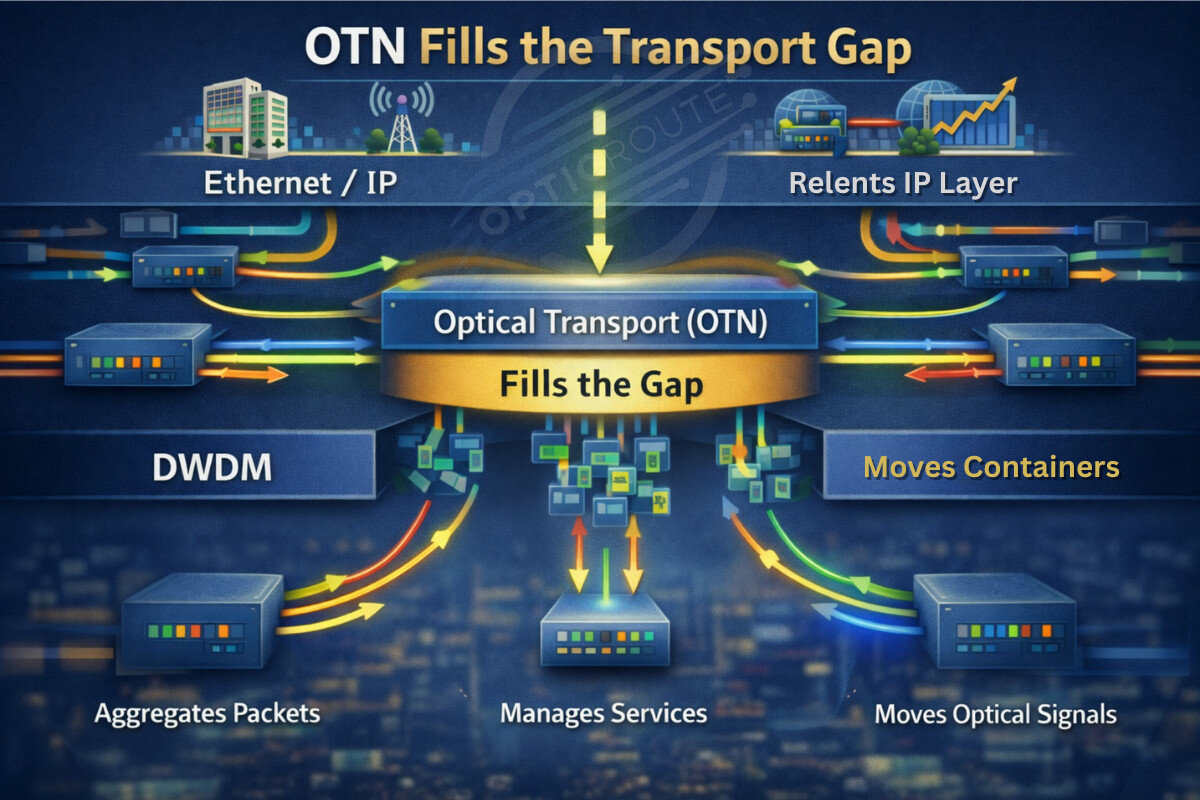
Figure 1.3
Figure 1.3: OTN fills the transport gap between optical physics and packet networks.
Why OTN Exists
OTN EXISTS TO MAKE OPTICAL NETWORKS SERVICE-AWARE, DETERMINISTIC, AND SURVIVABLE AT SCALE.
It does NOT replace DWDM. It does NOT replace Ethernet.
It ORGANIZES THEM.
OTN introduced:
- STRUCTURED CONTAINERS
- EXPLICIT SERVICE HIERARCHY
- BUILT-IN MONITORING
- FAST, DETERMINISTIC PROTECTION
Most importantly, it gave operators CONTROL over how services behave inside the optical core.
What Comes Next
Now that we understand WHY OTN EXISTS, the next question is unavoidable.
WHAT IS OTN, REALLY?
Is it:
- A protocol
- A framing format
- A switching technology
In Part 2, we strip the buzzwords away and explain WHAT OTN ACTUALLY IS and WHAT IT IS NOT.
Next part: What OTN Really Is