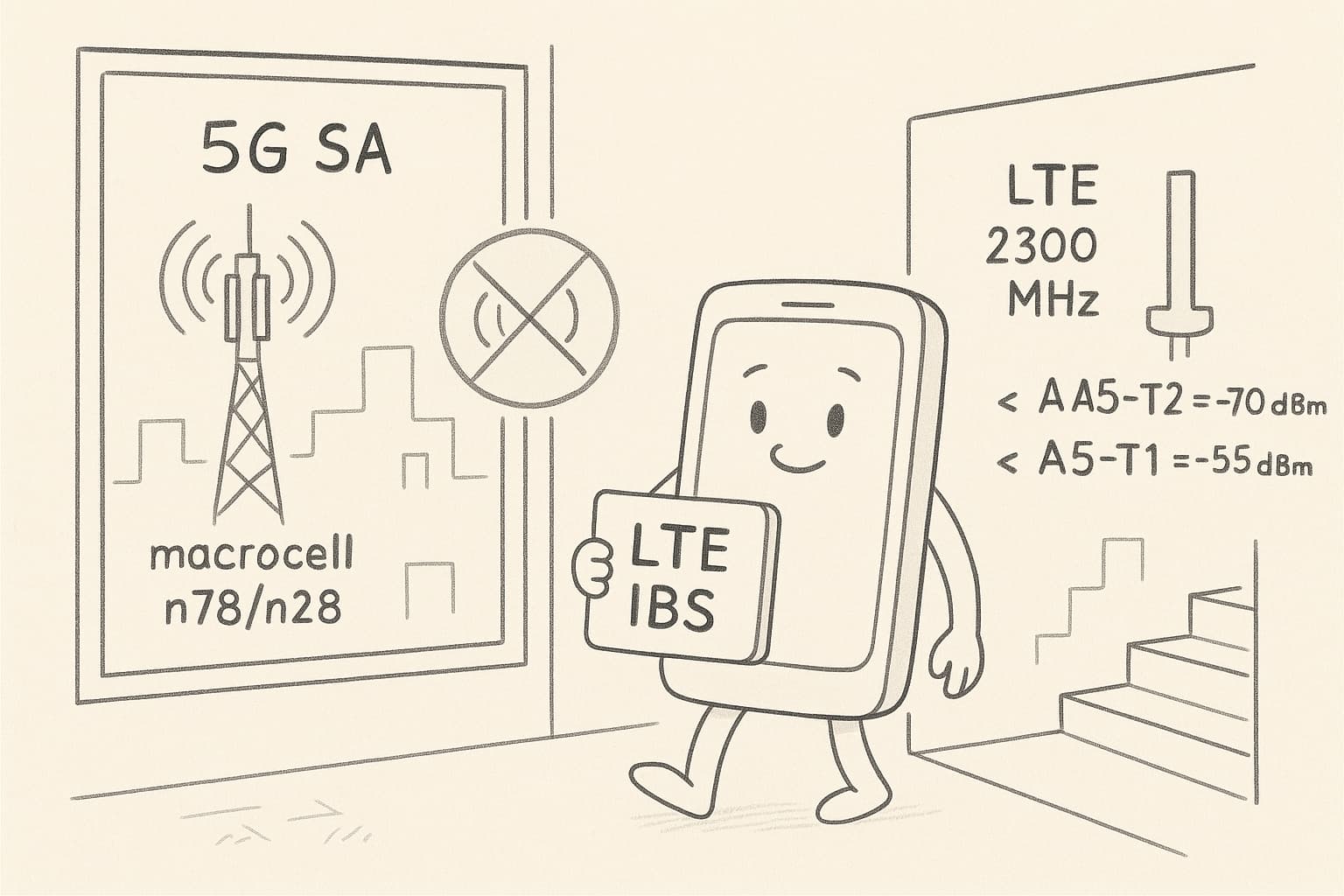
Our operator network includes both 5G SA and LTE layers. The 5G network uses bands n78 and n28, which currently have higher priority than LTE.
We have an in-building LTE solution (IBS) deployed and integrated within a building. The issue arises when users move indoors — their devices tend to stay connected to the outdoor 5G cells because of the higher 5G priority, instead of switching to the indoor LTE IBS cells.
Could you please suggest suitable parameters or configurations to help restrict indoor users to the LTE IBS cells, preventing them from latching onto the outdoor 5G sites?
If the UE is indoors, check whether it’s camped on n78 or n28.
If the UE is on n78:
It’s better to keep it there until the cell edge and trigger an A5-based handover toward LTE. Configure A5-T2 to a relatively low threshold, such as –70 dBm, so the handover occurs only when the signal drops significantly.
If the UE is on n28:
Move it to LTE as soon as possible using A5-T1 = –55 dBm and A5-T2 = –70 dBm.
Alternatively, if your network uses A4-based mobility, you can apply an A4 LTE threshold of around –70 dBm.
(The RSRP values are just examples and should be fine-tuned during optimization.)
For idle mode, adjust threshServingLow for both n78 and n28 to align with the A2 thresholds, and set ThreshXLow so that the UE can easily reselect to LTE 2300 when the 5G signal weakens indoors.
The IBS is integrated only with the 2300 MHz TDD band, and both n78 and n28 are causing issues.
Thanks for the update. However, making changes on the 5G macro layer would also affect outdoor users, which we want to avoid. Our main objective is to keep indoor IBS users on 4G.
I’ve already disabled the 4G IBS-to-5G mobility within the IBS setup.
Additionally, I’ve disabled 5G idle mode and connected mode measurements on the 4G side.
With these changes, once a user camps on the indoor 4G IBS cell, the UE will no longer measure 5G frequencies, ensuring that users remain connected to the 4G IBS while indoors.
If you set A5-T2 to a relatively high value, around –65 dBm, the outdoor users won’t be impacted - since such strong 2300 MHz RSRP levels are typically found only within the IBS coverage area.