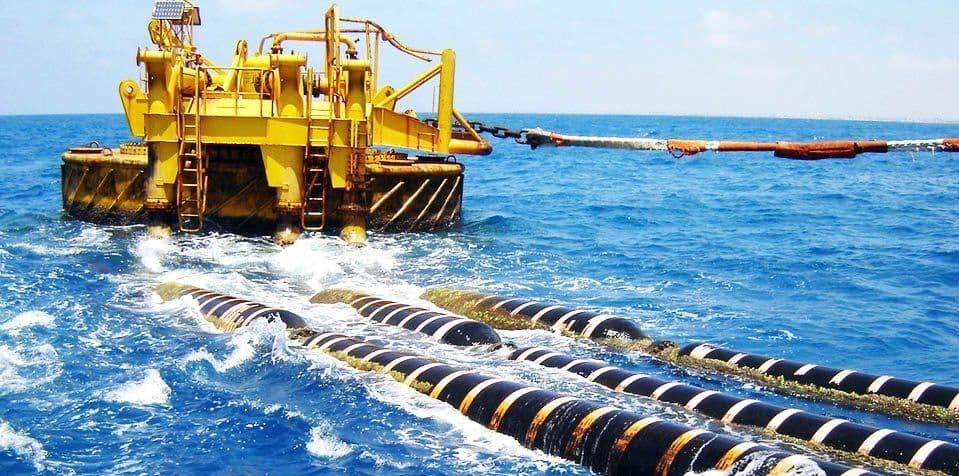
The submarine cable – or subsea system – is a fiber cable system responsible for carrying international internet traffic.
This fiber cable is placed underwater and transports all kinds of international traffic.
We have 2 main scenarios for subsea cables:
- Repeated system – uses undersea amplifiers (repeaters) and is designed for long distances, typically more than 300 km.
- Unrepeated system – relies only on the gain provided by the land station amplifiers, with no underwater amplification needed.
 Note: The fiber cable also carries the power feeding for the repeaters, through an integrated copper wire.
A subsea system consists of several parts:
- Cable – multiple optical fibers.
- Landing Station – the facility where the cable reaches land.
- SLTE – Submarine Line Terminal Equipment, which connects to the cable.
- Power Feeding System – supplies energy to the repeaters.
- Repeaters & Equalizers – amplify and compensate the signal to cover thousands of kilometers.
- BU (Branching Unit) – a key component that delivers traffic to multiple sites/locations while minimizing cables and costs (similar to an OADM – Optical Add-Drop Multiplexer).
- BMH (Beach Manhole) – the termination point at the shore, where the ocean ground plate is connected.
LinkedIn: 