If you can’t see it, you can’t fix it. 
In 5G networks, observability isn’t a nice-to-have. It’s how you meet your SLAs.
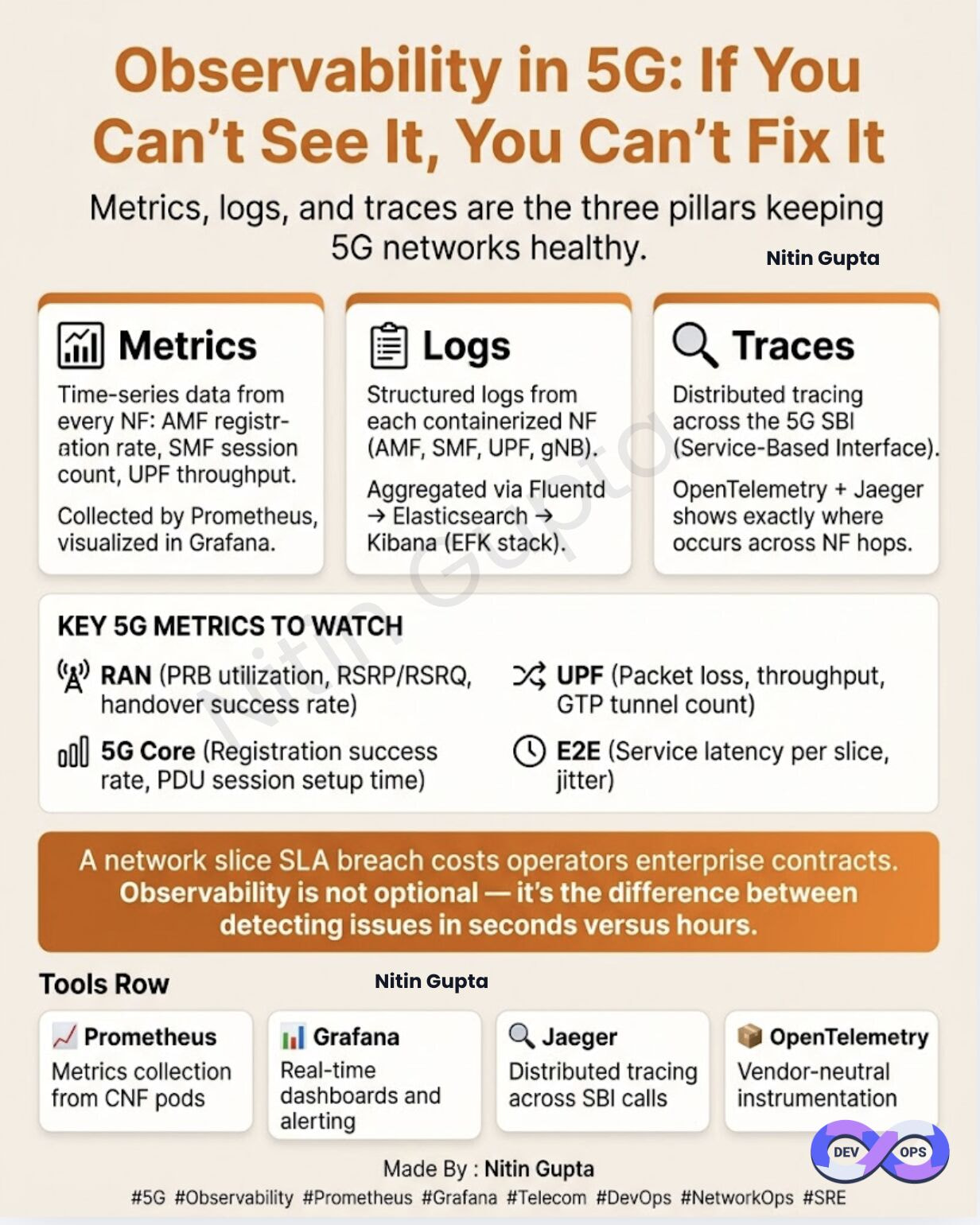
Observability rests on three pillars:
Metrics — Time-series data from every NF.
AMF registration rate. SMF session count. UPF throughput. PRB utilization.
Collected by Prometheus. Visualized in Grafana.
 Logs — Structured event logs from each containerized network function.
AMF, SMF, UPF, and gNB all writing to a central log pipeline.
Aggregated via Fluentd → Elasticsearch → Kibana (the EFK stack).
 Traces — Distributed tracing across the 5G SBI.
When an AMF call takes 200ms too long, Jaeger + OpenTelemetry tells you exactly which NF hop caused the delay.
Key 5G metrics every operator should be watching:
 RAN: PRB utilization, RSRP/RSRQ, handover success rate
 5G Core: Registration success rate, PDU session setup time
 UPF: Packet loss, throughput, active GTP tunnel count
 E2E: Service latency per slice, jitter per QoS class
A network slice SLA breach can cost an operator an enterprise contract.
Detecting it in seconds instead of hours is the difference between a minor incident and a major escalation.
Observability is your early warning system. Build it like one.
LinkedIn: 