 Multiplexing is basically a sharing trick in communication systems.
It means sending multiple signals or data streams over a single channel at the same time, without them stepping on each other—then separating them again at the other end.
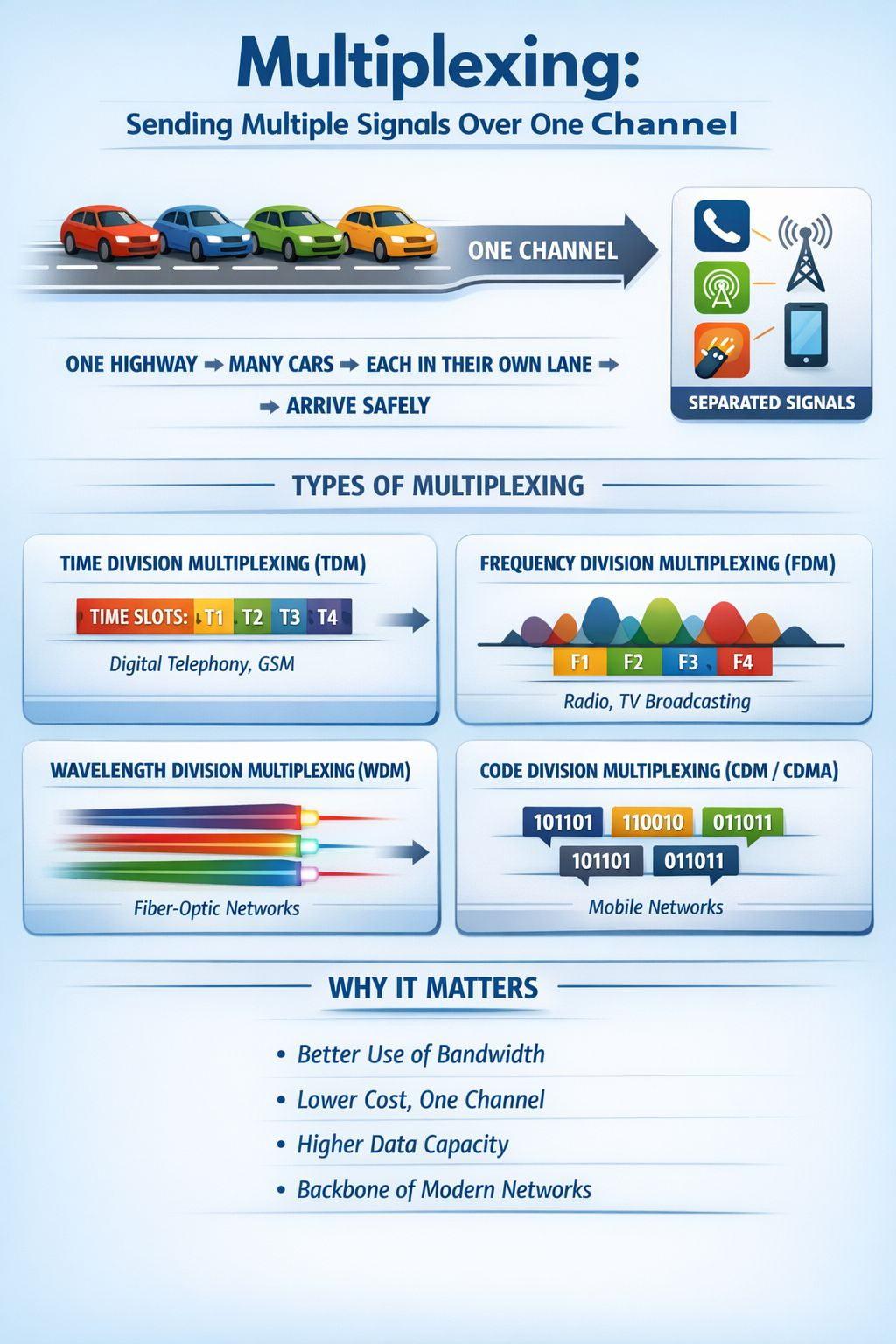
 Think of it like this
One highway ➝ many cars ➝ each car stays in its own lane ➝ everyone arrives safely.
 Common types of multiplexing
 Time Division Multiplexing (TDM)
 Each signal gets a time slot.
Used in: digital telephony, GSM
Frequency Division Multiplexing (FDM)
Each signal uses a different frequency band.
Used in: radio, TV broadcasting
Wavelength Division Multiplexing (WDM)
Like FDM but with light wavelengths.
Used in: fiber-optic networks
Code Division Multiplexing (CDM / CDMA)
All signals share time and frequency but use unique codes.
Used in: some mobile networks
Why it matters 
Better use of bandwidth
Lower cost (one channel instead of many)
Higher data capacity
Backbone of modern networks (internet, mobile, fiber)
LinkedIn: 