-
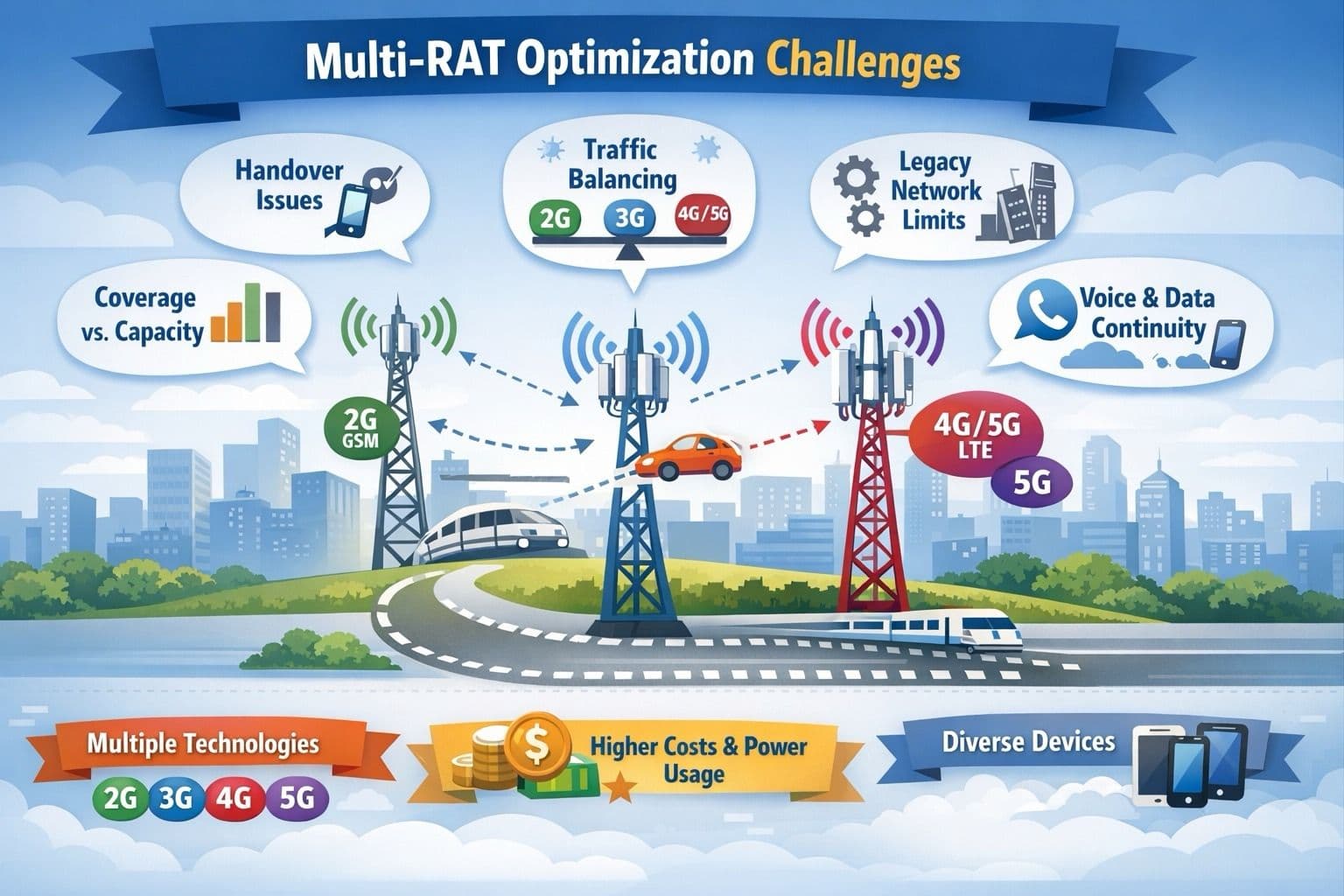
Inter-RAT Handover Complexity
- Ensuring seamless handover between GSM, UMTS, LTE, and NR without call drops or data interruption is challenging due to different radio characteristics and signaling procedures.
-
Load Balancing Across RATs
- Distributing traffic efficiently between 2G, 3G, 4G, and 5G to avoid congestion on one RAT while others are underutilized.
-
Coverage and Capacity Trade-off
- Low-frequency bands provide wide coverage, while high-frequency bands offer higher capacity. Optimizing both simultaneously across multiple RATs is complex.
-
Legacy Network Constraints
- Older technologies (GSM/UMTS) have hardware and software limitations that restrict optimization flexibility compared to LTE/NR.
-
Parameter Alignment and Tuning
- Different RATs use different KPIs, thresholds, and algorithms, making consistent parameter tuning difficult (e.g., reselection, handover margins).
-
Interference Management
- Co-located multi-RAT cells can generate inter-system interference, especially in dense urban deployments.
-
Mobility Management Issues
- High-speed users (e.g., highways, railways) experience frequent RAT changes, increasing signaling load and risk of mobility failures.
-
Voice Service Continuity
- Managing voice services across CS (2G/3G) and PS (VoLTE) domains while maintaining quality is a major challenge.
-
Energy Consumption and Cost
- Operating and optimizing multiple RATs increases power consumption and operational expenditure (OPEX).
-
Device Capability Diversity
- User devices support different combinations of RATs and frequency bands, complicating optimization strategies.
2 Likes