One of the smartest features that makes 5G both fast and reliable is the Modulation and Coding Scheme (MCS). Let’s break it down 
 Step 1 — Modulation Recap
In 5G, data is carried by symbols using different modulation schemes:
QPSK → 2 bits/symbol
16-QAM → 4 bits/symbol
256-QAM → 8 bits/symbol
 Higher modulation = more bits per symbol = faster data rates.
But… higher modulation also requires a cleaner signal.
Step 2 — Channel Quality Indicator (CQI)
So how does the network decide which modulation to use?
The UE (your device) measures signal quality.
It reports a CQI value (0–15) back to the base station.
High CQI → 256-QAM possible.
Low CQI → fallback to 16-QAM or even QPSK.
 CQI = the “health check” that guides modulation choice.
Step 3 — Coding for Reliability
Modulation alone isn’t enough — we also need error protection.
That’s where coding comes in: adding redundancy so errors can be detected & corrected.
Code Rate = Useful bits ÷ Total bits
Low code rate → more redundancy → safer but slower
High code rate → less redundancy → faster but riskier
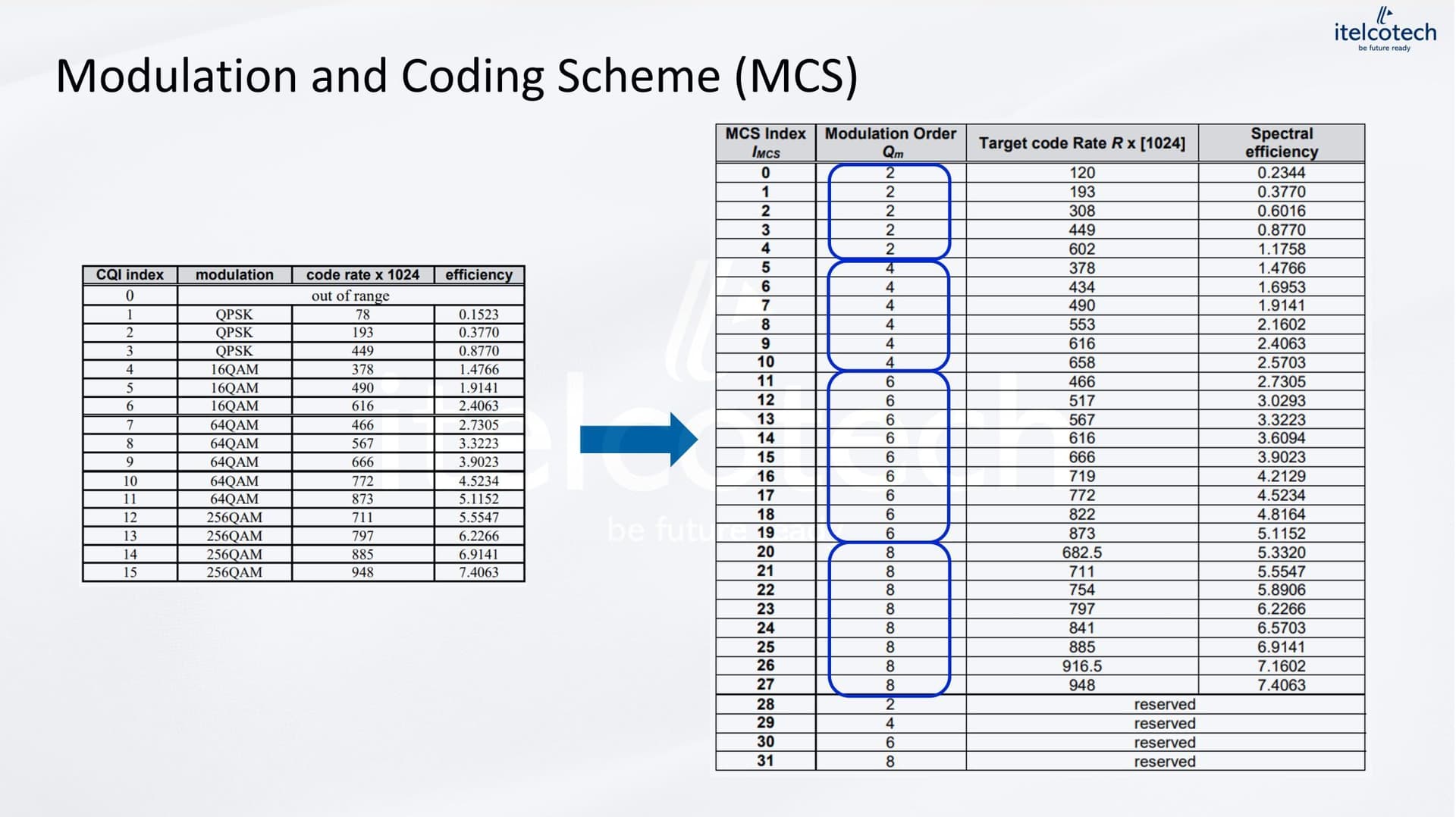
Step 4 — MCS = Modulation + Coding
Together, modulation and coding form the MCS, which dynamically adapts to conditions:
 Good channel (high CQI):
256-QAM + high code rate → blazing speeds
 Poor channel (low CQI):
QPSK + low code rate → more protection, lower throughput
 Why Does MCS Matter?
Imagine downloading a movie:
Near the tower (high CQI) → MCS is high → super-fast download
At the cell edge (low CQI) → MCS drops → slower, but still reliable
For operators, tracking MCS & CQI trends helps answer:
Why is throughput low in certain zones?
Are users struggling at the cell edge?
Is interference limiting performance?
Conclusion
Modulation = how many bits per symbol
Coding = how robust the transmission is
MCS = the adaptive balance of both
Watch videos to learn more how 5G intelligently delivers high speed when possible, and resilience when necessary at:
LinkedIn: