MCP Servers in Telecom: The Missing Link Between AI and Network Intelligence
While exploring how ChatGPT and GitHub Copilot use tools so naturally, I found myself wondering:
What if telecom troubleshooting worked the same way?
As someone who has spent years validating telecom systems, I found AI evaluation raises a different set of challenges.
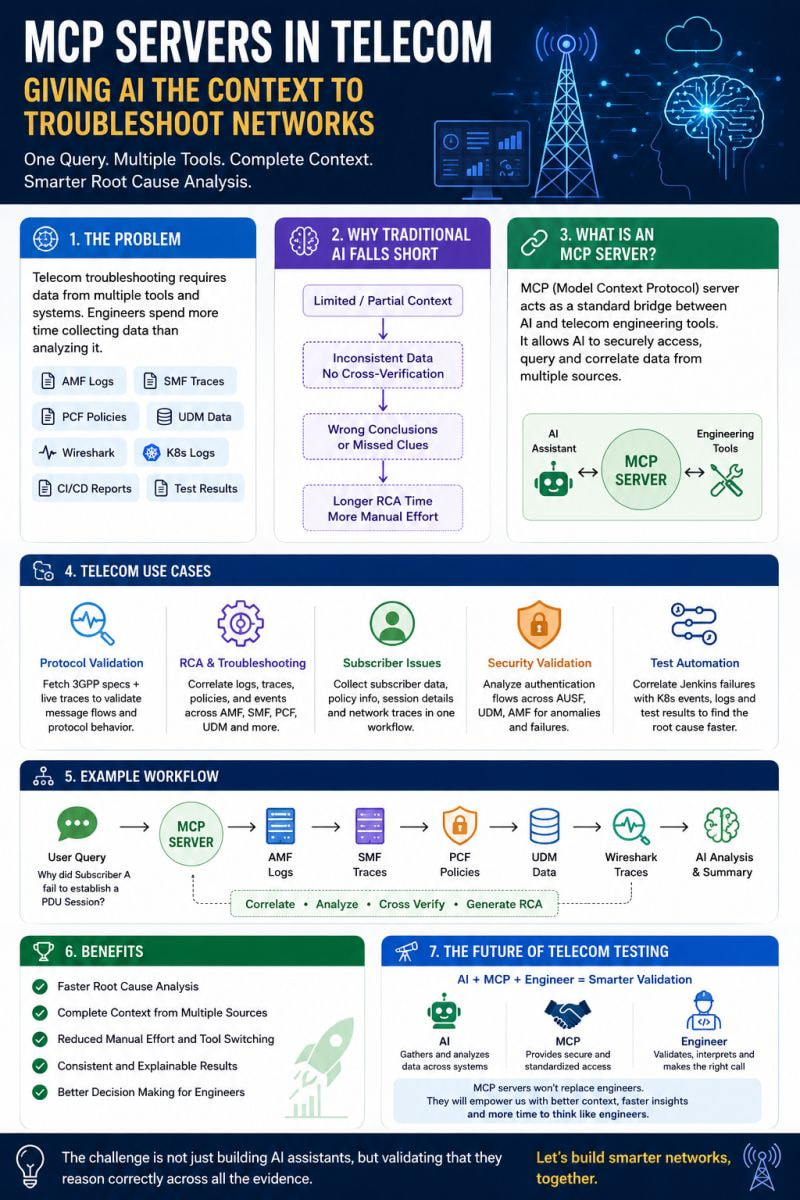
A failed PDU Session or registration issue rarely points to a single log. We jump between AMF, SMF, PCF, UDM, Wireshark traces, Kubernetes events, and test reports before we can confidently identify the root cause.
The challenge isn’t collecting data—it’s connecting it.
That’s where I think Model Context Protocol (MCP) servers could make a real difference.
Instead of building custom integrations for every tool, an MCP server gives AI a standardized way to access engineering systems. Imagine asking, “Why did this subscriber fail to establish a PDU Session?” and having the AI correlate logs, traces, subscriber data, and policy information before presenting a reasoned explanation with supporting evidence.
What excites me isn’t replacing engineers. It’s reducing the time spent switching between tools so we can spend more time analyzing, validating, and solving problems.
As AI becomes part of telecom testing, I believe we’ll also need to validate how AI reasons, not just what answer it gives.
That feels like the next evolution of telecom validation.
How do you see MCP servers being used in telecom testing or network operations?
LinkedIn: 