This video is the third session in LTE KPI Optimization series and explains the LTE ERAB Drop Rate KPI. The session covers the signaling flow for LTE retainability (ERAB Abnormal Release Cases) in detail along with messages where the KPIs are pegged. The causes of LTE drops are also covered in detail along with actions that can resolve those issues.
Youtube: LTE KPI Optimization (Session 3): LTE ERAB Drop Rate - YouTube
LTE E-RAB Drop Rate Optimization
The E-RAB Drop Rate is one of the most critical KPIs in LTE, and improving it is essential for a seamless user experience. Understanding whether a drop is Initiated or MME-initiated is the first step toward effective optimization.
 Key Categories of Drops
eNodeB Initiated
-
RLC Retransmission Max-out: Occurs when the eNodeB fails to get a successful delivery in the downlink after reaching the maximum RLC retransmission threshold.
-
Handover Failures: Triggered when a UE fails to reach the target cell during the execution phase, causing the source eNodeB’s X2 relocation timer to expire.
-
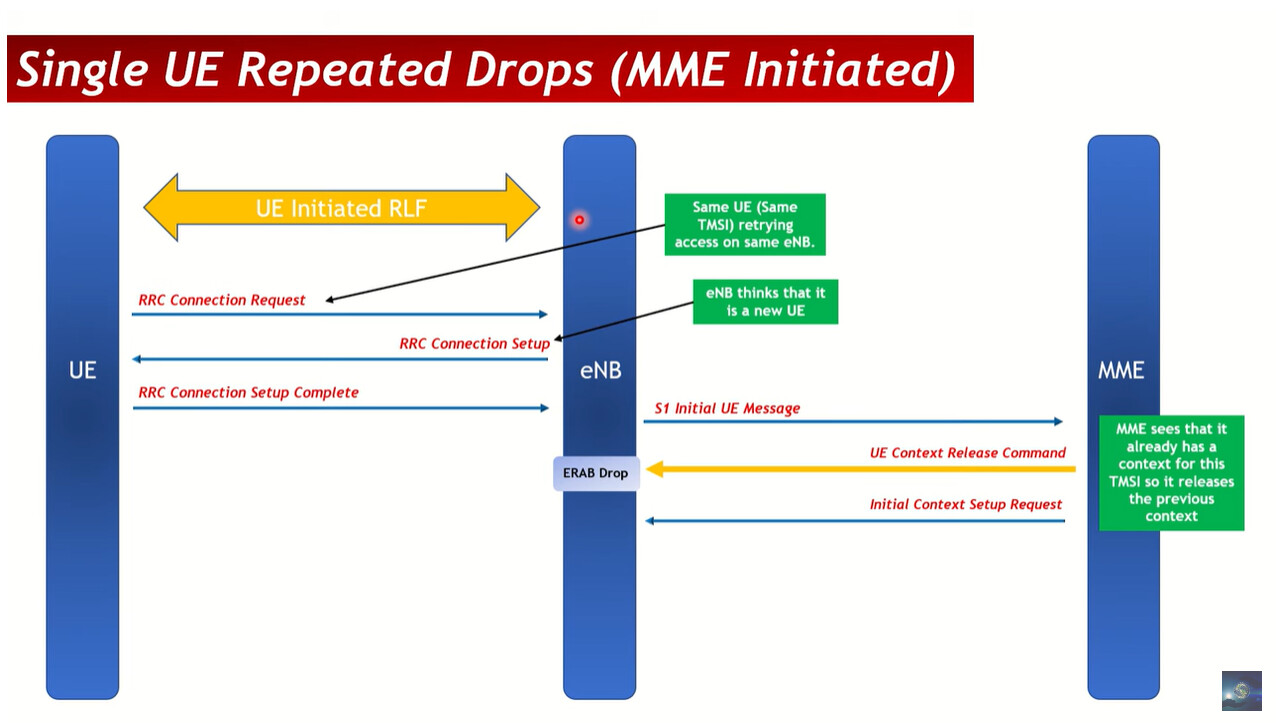
MME Initiated (The “Hidden” Radio Drops): Most MME drops are actually caused by radio issues, such as uplink failures or poor signal quality (N310/T310 failures). If a UE experiences a Radio Link Failure (RLF) and establishes a new connection on a different cell, the MME releases the old context, which the original cell pegs as an “MME-initiated” drop.
 Optimization Actions
-
Adjust RLC Parameters: Increasing the RLC retransmission count (e.g., from 8 to 16) gives the UE more chances to decode data, though it may increase overhead.
-
Timer Tuning: Extending T310 and N310 durations allows UEs to stay in “in-sync” mode longer during temporary signal fluctuations.
-
Neighbor & Physical Optimization: Improve SINR through physical tilts, PCI planning, or blacklisting problematic neighbor relations.
-
Enable Context Fetching: Activating RRC re-establishment context fetching over the X2 interface can prevent drops when a UE moves to a new cell after a failure.
-
Address “Bad” UEs: Use Layer 3 (L3) traces to identify single UEs with compatibility issues that cause repeated drops.
LinkedIn: 
The E-RAB Drop Rate is a key LTE retainability KPI and usually indicates issues in the radio or mobility layer. The first step is to identify whether the drop is eNodeB-initiated or MME-initiated, because the root cause can be different.
In many cases, drops are caused by:
-
Radio Link Failure (RLF) due to poor SINR or coverage
-
RLC retransmission max-out in the downlink
-
Handover failures during mobility
-
Uplink radio issues which later appear as MME-initiated drops
For optimization, engineers typically check:
-
RLC retransmission counters
-
RRC re-establishment attempts/success
-
Handover success rate and neighbor relations
-
RF conditions like coverage, interference, and antenna configuration.
Improving radio conditions, optimizing handover parameters, and tuning timers (like T310/N310) can significantly reduce the E-RAB drop rate.